How We Rate AI Risk
Hi, I'm Daniel Wang, founder of brigenai. I wrote this page because you deserve to know exactly where your AI Risk Score comes from, including the parts we're still working on.
Here's the honest version. Today, your score is an AI-generated estimate. It's a useful place to start thinking about your career. It is not a verdict, and it is not a prediction about you. It will get better, and further down I'll show you exactly how.
How the score works today
Right now, the AI Risk Score is produced by Claude, a large language model made by Anthropic. When you enter a job, Claude looks at what that job typically involves day to day. It then estimates how much of that work today's AI could take over or change.
That is genuinely useful. Language models are good at breaking a job into its tasks and judging which ones are routine and screen-based, and which ones depend on hands-on skill, judgment or human trust.
But I won't pretend it's more than it is. The score is not yet built on live labour market data. It isn't yet checked against how AI is actually being used in workplaces. It reflects an AI's informed judgment, not hard measurement.
Here's a simple example. A bookkeeper spends much of the day entering, checking and reconciling numbers on a computer. AI can already help with a lot of that, so the score comes out higher.
An electrician has to show up on site, work with their hands and take responsibility for safety. AI can't do most of that, so the score comes out lower. Neither score tells you whether you'd enjoy the work, or whether it suits you.
How to read your score
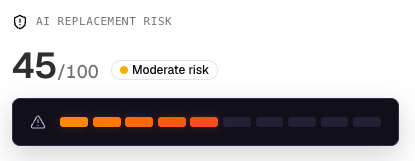
Your score runs from 0 to 100. The higher the number, the more of a job's everyday tasks today's AI could take over or change. To make it easier to read, every score also comes with a level: Low, Medium or High.
- Low. Most of the work relies on hands-on skill, judgment or human contact. AI may help around the edges, but the core of the job is hard to automate.
- Medium. AI can take on a real share of the work. The job will likely change, but people are still needed for much of it.
- High. Much of the day-to-day work is the kind AI already handles well. The job is likely to change significantly, so it's worth planning ahead.
A higher score is a signal to look more closely, not a sign that the job will disappear.
What the score can and can't tell you
The score can give you a rough sense of how exposed the tasks in a job are to current AI. It can also point to which parts of the work are more routine, and which parts lean on things AI still struggles with.
The score can't tell you:
- Whether you, personally, will lose your job.
- How your employer, industry or country will actually adopt AI.
- How fast any of this will change.
- Anything about your skills, your experience or the value you bring.
One more thing worth saying plainly: AI makes mistakes, including the AI behind this score. If a result feels wrong for the work you actually do, trust what you know about your own job, and tell us. Treat the score as one input, never the final answer.
What we're working on
Today's score isn't perfect, and we know it. But this is our first version, not our last. We want the score to stand on real, current, global data, not on one AI's judgment alone. Here's what we're building toward:
- Real-world AI usage data. Which tasks people are actually using AI for at work, not just which ones it could do in theory.
- International occupational research. So the score reflects how jobs look in different countries, not just the United States.
- Local job demand and pay. So you can see whether a career is actually hiring where you live, and what it pays.
- Task-by-task detail. Which specific parts of your job are most exposed, and which skills help you stay ahead.
- Trends over time. Whether AI's reach into a job is speeding up, slowing down or holding steady, so you can plan years ahead, not just for today.
Put together, these will turn a single score into something far more useful: an honest view of where a career is heading, and practical help planning your next step or a full career change. That's what brigenai is here for.
I won't give you a launch date I can't keep. As each improvement goes live, we'll update this page and tell you exactly what changed.
Why a score alone isn't enough
This is the part I care about most. Knowing your AI risk doesn't tell you what to do next.
A low-risk career can still be the wrong career for you. Maybe the training takes two years you can't afford. Maybe the work would drain you. Maybe it pays well in one city and poorly in yours. A good career decision needs the full picture:
- Your finances. How long you can go without income, what retraining costs, and what you need to earn.
- Your interests. Work you can see yourself doing for years, not just getting through.
- Your personality. How you like to work: with people or with your hands, with structure or with variety.
- Your situation. Family, location, visa, time and energy.
No AI can weigh all of that for you. Not ours, not anyone's. AI can help you think more clearly. The decision is still yours, and you should make it with your eyes open.
See the full picture
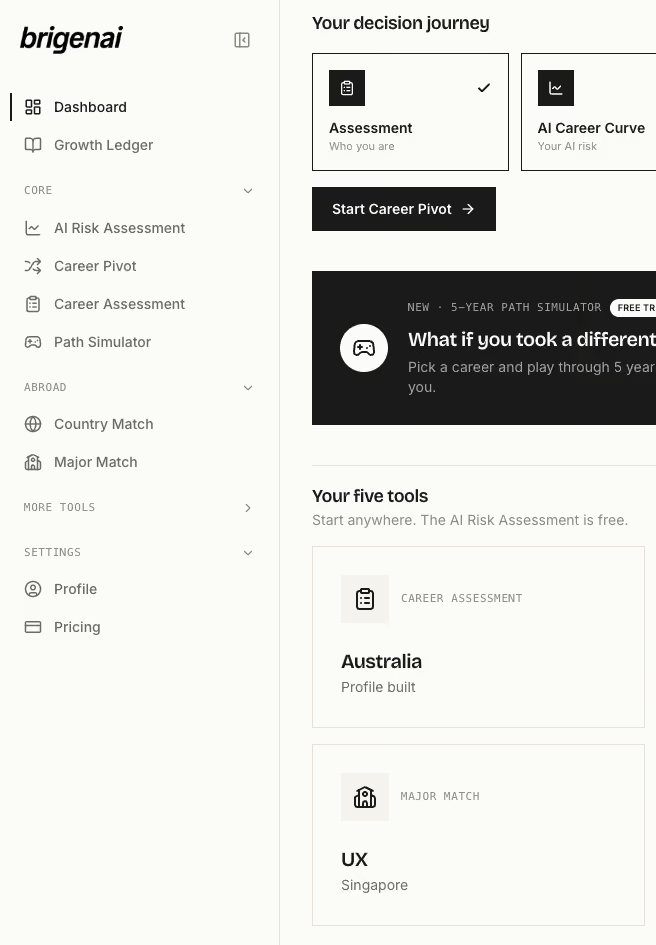
That's why brigenai is more than a risk score. The AI Risk Assessment sits alongside tools that look at you, not just the job:
- Career Assessment. Helps you find careers that fit your interests, strengths and personality.
- Career Pivot. Helps you plan a realistic move from the job you have to the one you want.
- Path Simulator. Lets you play through five years in a career, month by month, making a key decision every six months.
Start with the full set of tools, then use your AI Risk Score as one part of a bigger picture.
Thanks for reading, and for taking your future seriously.
Daniel Wang Founder, brigenai · 10 years in product design
Questions people ask
Is the AI Risk Score accurate? It's a reasoned estimate, not a measurement. It's most useful for comparing careers side by side and spotting which tasks deserve a closer look.
Why use AI to rate AI risk? Breaking a job into tasks and judging each one is something language models do well. Researchers do this too: the GPTs are GPTs study published in Science and the International Labour Organization's 2025 global index both used language models alongside human input to rate job tasks. Still, one source isn't enough, which is why we're adding real-world data.
Will my score change? Probably, yes. AI keeps improving, and so will our data. When our method changes, we'll update this page.
Does a high score mean I should quit my job? No. A high score means parts of the work are exposed to AI, and many jobs change shape rather than disappear. It's a reason to plan, not to panic.
I think my score is wrong. What should I do? Tell us at hello@brigenai.com. You know your work better than any model does, and your feedback helps us improve the score for everyone.