
Nursing is one of the few careers where there is a constant shortage of workers almost everywhere, but international nursing graduates still find it hard to land their first job. (Nurses, n.d.) The problem usually isn't clinical skills. It's the paperwork, learning new healthcare systems, and figuring out which advice actually matters.
According to a recent qualitative study, many first year graduate entry nursing students in Australia and New Zealand find that their initial motivations for pursuing nursing are affirmed in practice, offering insights beyond simply focusing on study and registration. Here are her 10 tips, focused on helping international students and entry-level nurses find and keep their first job abroad.
1. Start your registration pathway before you graduate, not after
Getting registered as a nurse in countries like Australia (AHPRA) and New Zealand (Nursing Council) can take several months, and the process changes depending on where you earned your degree. (Internationally Qualified Nurses, n.d.) If you wait until after your final exam to look at the registration requirements, you could lose months unnecessarily. Check the visa and registration requirements for your target country in your second-to-last semester, and start collecting transcripts, references, and English test results while you can still easily access your university's admin office.
2. Know the difference between "registered" and "employable"
Passing your registration exam does not mean you will automatically get a job. Many international graduates are surprised to find that hospitals have separate, competitive graduate programs with their own application timelines, often six to nine months before the job starts. (Graduate Nurse Program, 2026) Treat registration and job-hunting as two separate tasks. According to The Women's, you should apply to graduate nurse programs as soon as applications open, even if your registration is still being finalized.
3. Build a portfolio of clinical placements, not just a resume line
A resume that only says "Completed clinical placement, Ward 4B" does not tell a hiring manager much. Be prepared to talk about a specific patient case, a complication you helped manage, or a time you raised a concern in the right way. Nursing interviewers almost always ask scenario-based questions. (Nursing Interview Questions & Tips: How to Ace Your Job Interview in Australia, 2025) Having two or three real stories from your placements, with details about what you did and why, will help you stand out among many similar resumes. Nursing interviewers almost always ask scenario-based questions. Having two or three real stories from your placements, with details about what you did and why, will help you stand out among many similar resumes browsing through healthcare job listings.
4. Get fluent in the local healthcare system's structure, not just clinical terms
International graduates often know the medical knowledge but not the local system, such as how triage categories work in a country's emergency departments, how medication charts are set up, or what a "handover" looks like in a particular hospital. These differences may seem small until your first shift. (Pung & Goh, 2017, pp. 146-165) Ask your placement supervisor directly about how the system differs from what you learned, and write down the answers. This habit helps new grads adjust in weeks instead of struggling for months.
5. Treat your first preceptor relationship as the most important relationship of your career
Most nursing graduate programs assign a senior nurse to mentor you during your first weeks or months. (Graduate registered nurses (RNs) and enrolled nurses (ENs), 2023) International graduates sometimes hesitate to ask questions because they worry it looks like a weakness, but it is actually the opposite. Preceptors remember and support grads who ask good questions and come prepared, and this support often decides if you stay on after your graduate year. In your first month, ask as many questions as you need.
6. Understand your visa's link to your registration and your employer
In many APAC nursing markets, your visa pathway is directly linked to your registration status and sometimes to a specific employer who sponsors you. Changing your employer, ward, or even switching between part-time and full-time hours can affect your visa status. (Health and Care Worker visa: Update your visa if you change job or employer, 2023) Before making any changes to your work arrangement, check with both HR and a registered migration adviser, not just a forum post, to see exactly how it will affect your visa. This one step can prevent the most common and costly mistake international nurses make. talk it through with an AI advisor who knows your destination country's visa rules — not just a forum post, to see exactly how it will affect your visa. This one step can prevent the most common and costly mistake international nurses make.
7. Document your hours and competencies as you go, not at appraisal time
Nursing registration renewals, specialty certifications, and permanent residency applications all require detailed proof of your hours worked and skills demonstrated. (Continuing competence, 2024) According to Immigration New Zealand, international nurses who keep regular records of their work experience, including dates, wards, hours, and key skills, will find the process of meeting visa and registration requirements much smoother. Taking a few minutes each week to update this log can help avoid unnecessary stress when applying for visa renewals.
8. Learn the unwritten communication norms of your new healthcare system
Direct or hierarchical communication styles that are common in some countries' nursing education can seem too blunt or too passive in another hospital system. (Xu & Davidhizar, 2005, pp. 209-215) Pay attention to how senior nurses in your hospital raise concerns with doctors, including their tone, timing, and structure, and try to adapt to that style. This is not about losing your voice, but about making sure you are heard in the way the system expects.
9. Don't isolate yourself with only other international graduates
It's natural to spend time with colleagues from your own background in your first months, but this can slow down your adjustment to local clinical and social norms. Make an effort to build relationships with colleagues who trained locally as well. They are often your quickest source of informal knowledge about how things really work on your ward, beyond what is written in the policy manual. and read real workplace culture experiences from other international nurses to get a head start before your first shift. They are often your quickest source of informal knowledge about how things really work on your ward, beyond what is written in the policy manual.
10. Plan your specialty path early, even in your graduate year
Nursing offers much more long-term mobility than most international students realize. Critical care, mental health, perioperative, and community health all have different demand levels, training paths, and visa-relevant skill shortages in different countries. (Health Workforce Plan 2024: Nursing Analysis, n.d.) Use your graduate rotations to try out specialties you are interested in, not just the ones that seem easiest. Clinical competence plays a crucial role in helping nursing students successfully complete their education, according to research by Lejonqvist and colleagues. What really determines if your first two years abroad go smoothly is everything outside of clinical work, like registration timing, visa details, understanding the system, and building relationships. International nursing graduates who treat these as skills to learn, just like studying for an exam, usually have a much easier transition than those who rely only on their clinical skills.
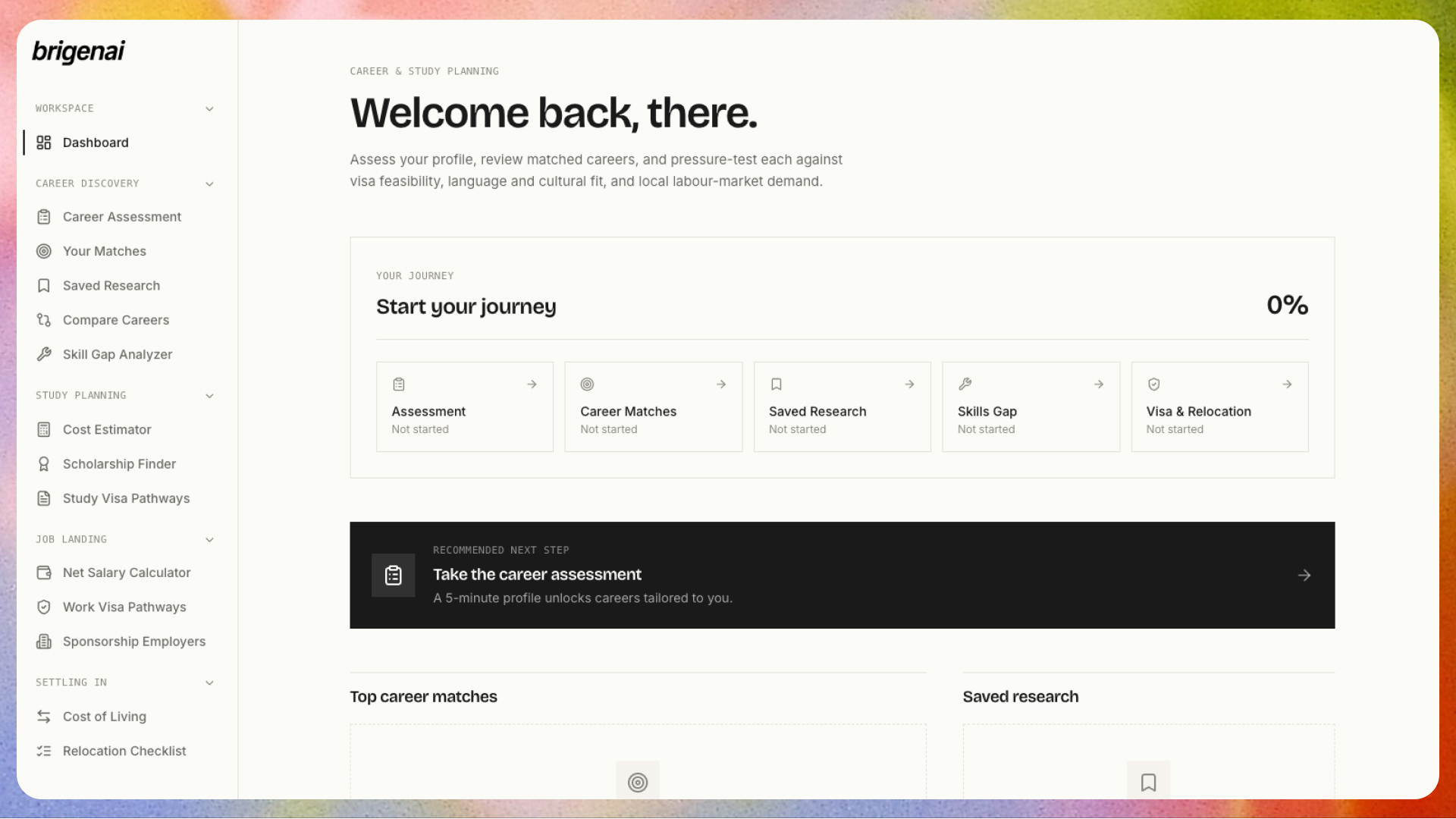
If you are comparing nursing registration pathways, visa requirements, and graduate program timelines in Australia, New Zealand, Singapore, and Taiwan, using a platform designed for this purpose can save you months of scattered research on government websites and forums. BrigenAI brings together real experiences from international nurses and healthcare professionals working in these countries, along with AI-powered guidance on registration and relocation, so you do not have to piece everything together from random online threads.
Are you looking for entry-level, visa-friendly nursing and healthcare jobs across APAC? Check out the current listings on BrigenAI's jobs board, which are filtered specifically for international students and recent graduates.