
Auditors check whether financial records are accurate, complete and follow the rules. AI won't replace auditors, but it is changing the work fast. AI can now test every transaction instead of a sample and flag unusual entries automatically, so routine testing will shrink. Auditors who apply professional judgment, understand risk and sign off on the results will remain in demand. The role is rated Moderate AI impact.
What Does an Auditor Do?
Auditors give organisations, investors and regulators confidence in financial information:
- Planning: understanding a business and its risks.
- Testing: checking transactions, controls and records.
- Investigating: following up on errors, unusual items and potential fraud.
- Reporting: giving an opinion on whether the accounts are true and fair.
Auditors work in accounting firms, internal audit teams, government and regulators.
Will AI Replace Auditors?
Not fully, but AI is taking over much of the testing.
What AI can do: analyse entire data sets, spot anomalies, match documents and automate routine sampling.
What AI cannot do:
- Apply professional judgment. Deciding whether something is material or suspicious needs experience.
- Understand the business. Auditors talk to management and assess risks AI can't see in the data.
- Challenge people. Professional scepticism means asking difficult questions.
- Sign off. Across Asia-Pacific and North America, audit opinions must be signed by qualified, accountable professionals.
Compare other ratings in our full list of careers AI can't replace.
How This Career Is Changing
- Full-data testing. AI checks everything instead of samples.
- Fewer junior testing roles. Entry-level ticking and matching is shrinking.
- More focus on risk and judgment. Auditors spend more time on complex areas.
- New areas. IT audit, cybersecurity and sustainability reporting are growing.
How to Stay Ahead
If you're already an auditor:
- Learn data analytics and AI audit tools.
- Specialise in IT audit, cybersecurity or sustainability assurance.
- Build communication skills to work with management and boards.
- Consider related roles such as Accountant or Cybersecurity Analyst.
If you're thinking of switching into auditing: you'll usually need an accounting degree or conversion programme plus a professional qualification. A free career assessment can help you see if it suits you.
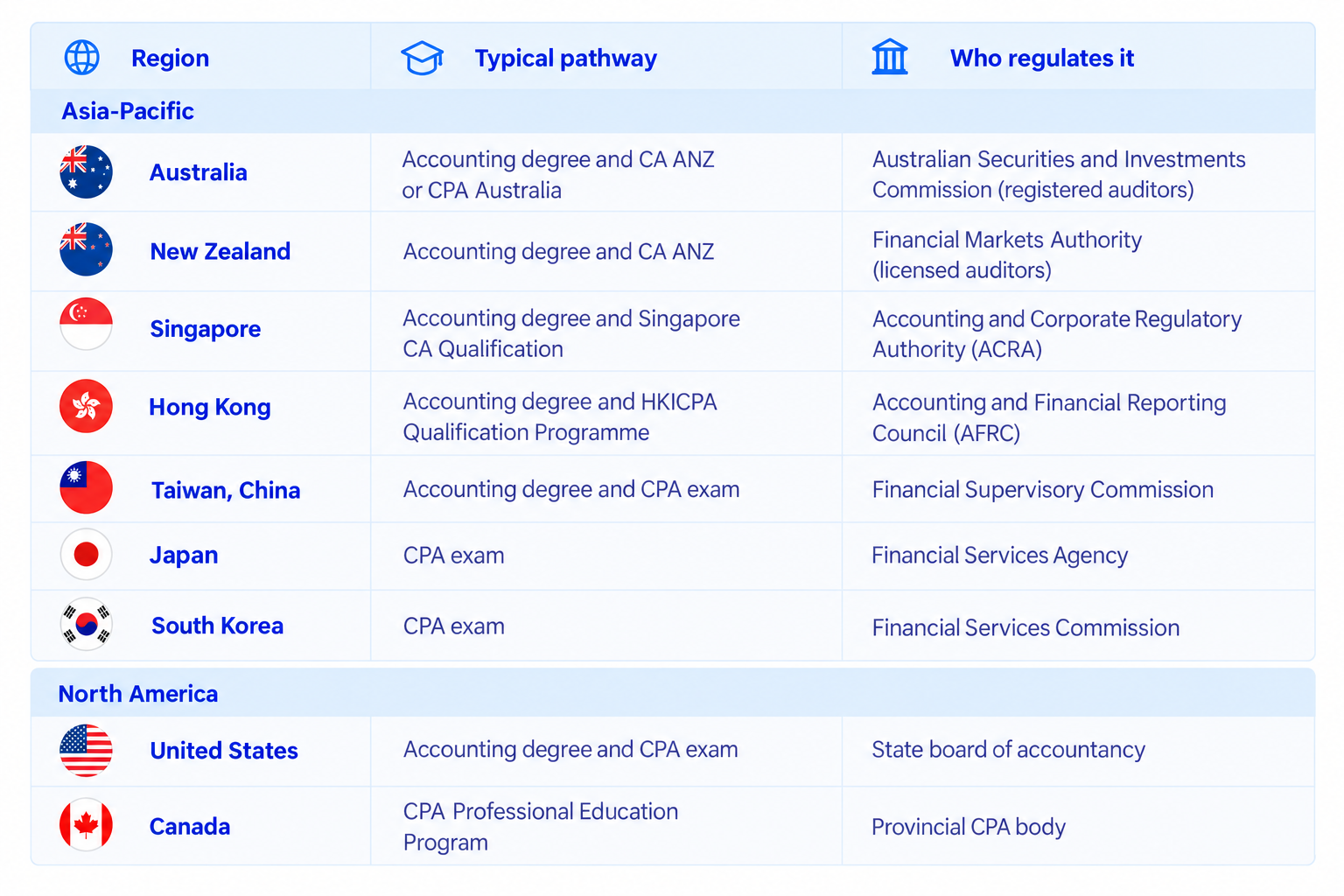
Qualifications by region
Asia-Pacific
- Australia: Accounting degree and CA ANZ or CPA Australia. Registered auditors are regulated by the Australian Securities and Investments Commission (ASIC).
- New Zealand: Accounting degree and CA ANZ. Licensed auditors are regulated by the Financial Markets Authority.
- Singapore: Accounting degree and Singapore CA Qualification. Regulated by the Accounting and Corporate Regulatory Authority (ACRA).
- Hong Kong: Accounting degree and HKICPA Qualification Programme. Regulated by the Accounting and Financial Reporting Council (AFRC).
- Taiwan, China: Accounting degree and CPA exam. Regulated by the Financial Supervisory Commission.
- Japan: CPA exam. Regulated by the Financial Services Agency.
- South Korea: CPA exam. Regulated by the Financial Services Commission.
North America
- United States: Accounting degree and CPA exam. Licensed by the state board of accountancy.
- Canada: CPA Professional Education Program. Regulated by the provincial CPA body.
Requirements change, so always check with the professional body in your region.
Is It Worth It?
Pros:
- Respected, well-paid profession
- Strong career progression
- Skills valued across all industries
Cons:
- Long hours during busy season
- Junior roles are shrinking
- Requires ongoing professional study
It suits detail-oriented, sceptical thinkers who enjoy solving puzzles.
FAQs
Will AI replace auditors?
No, but it will automate much routine testing. Auditors who apply judgment and understand risk will remain in demand.
How long does it take to become an auditor?
Usually three to five years, including a degree and professional qualification.
What skills will auditors need in the future?
Data analytics, IT and cybersecurity knowledge, and strong communication.
Not sure if your current job is at risk? Check your AI risk score for free and see which careers match your skills. brigenai helps you find a career that lasts, with AI tools and real people to guide your switch.






