
Business & Finance

Will AI Replace Bookkeepers? AI Risk, Salary & Outlook

What does a bookkeeper do, and is it a good career? See salary, key skills, how to become one, and whether AI will replace them.
AI Resilience
High
30/100
How this career is affected by AI.
Low
Moderate
High
Run a full AI risk assessment in 5 minutes

Getting In

Training Time
6–12 months (certificate)
Education Required
Diploma
Entry Difficulty
Easy

Pay & Outlook

Salary Range
$38,000–$60,000/year
Job Growth
-5.6% by 2035 (US)
Career Progression
Bookkeeper → Accounts Supervisor → Finance Manager
Simulate 5 years in this career

Job Fit & Work Style & Requirements

Physical Demand
Low
Human Interaction
Low
Remote Work
Yes
Best Countries
Australia, Canada, United Kingdom
Visa Opportunity
Low
Key Skills
Bookkeeping, accounting software (Xero, QuickBooks), reconciliation, accounts payable and receivable, accuracy

Bookkeepers record a business's financial transactions, reconcile accounts and keep the books up to date. Cloud accounting software and AI now automate much of this work, and traditional bookkeeping roles are likely to shrink significantly within five years. The good news: your knowledge of numbers, accounts and business operations transfers well to more secure finance careers. This page explains what's changing and where you can go next.

What Does a Bookkeeper Do?

Bookkeepers keep financial records accurate and organised:

  • Recording transactions: entering sales, purchases, receipts and payments.
  • Reconciliation: matching bank statements to the accounts.
  • Accounts payable and receivable: tracking what's owed and paying bills.
  • Payroll and tax support: preparing payroll and records for accountants.

Bookkeepers work for small businesses, accounting firms or as freelancers.

Will AI Replace Bookkeepers?

In large part, yes. Bookkeeping is one of the roles most affected by automation.

What AI can already do:

  • Import bank transactions automatically.
  • Categorise expenses and match receipts.
  • Reconcile accounts with little human input.
  • Generate invoices and financial reports.

Software like Xero and QuickBooks already handles much of this, which means businesses need far fewer bookkeeping hours.

What still needs a person:

  • Fixing errors and unusual transactions.
  • Advising business owners on their finances.
  • Handling complex payroll and compliance issues.

That's why bookkeeper is rated High AI impact. Compare more secure options in our full list of careers AI can't replace.

Where Can You Go From Here?

Your financial skills are valuable. These careers build on them and are more resistant to AI:
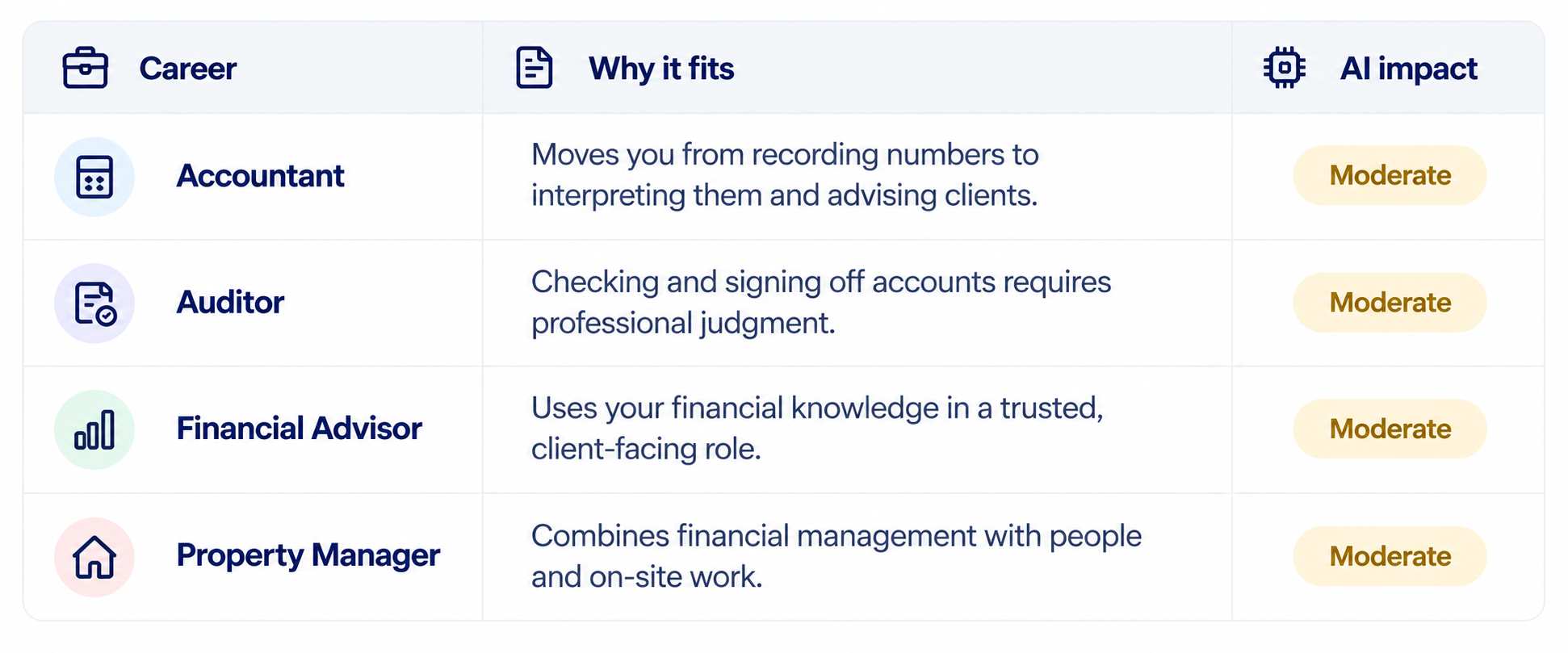
Not sure which direction suits you? A free career assessment matches your skills to careers that last.

How to Start Over

  1. List your transferable skills. Accuracy, financial knowledge, software skills and understanding small businesses are all valuable.
  2. Choose a direction. Go deeper into finance (accounting, auditing, advice) or move into property or operations.
  3. Get a qualification. Accounting and financial advice require recognised qualifications and, often, professional membership.
  4. Shift to advisory work. If you stay in bookkeeping, offer cash-flow advice, budgeting and business support.
  5. Master the software. Being an expert in accounting tools makes you more valuable to clients.

Is It Worth Staying a Bookkeeper?

Reasons to stay (for now):

  • Small businesses still need help setting up and checking software.
  • Advisory bookkeeping can still be valuable.

Reasons to plan your move:

  • Routine data entry is disappearing.
  • Fees and pay are under pressure.
  • Accounting software keeps getting smarter.

The best time to plan your switch is before your role changes, not after.

FAQs

Will AI replace bookkeepers?

‍AI and accounting software are replacing most routine bookkeeping. Bookkeepers who offer advice and handle complex work will last longer.

What can a bookkeeper become?

‍Common next steps include accountant, auditor, financial advisor or property manager.

Is bookkeeping still a good career?

‍Only as a stepping stone. Consider moving into accounting or advisory roles.

Not sure if your current job is at risk? Check your AI risk score for free and see which careers match your skills. brigenai helps you find a career that lasts, with AI tools and real people to guide your switch.


Business & Finance
Share on
Training Providers

1. University of Melbourne (Australia)
2. University of Auckland (New Zealand)
3. National University of Singapore (Singapore)
4. University of Hong Kong (Hong Kong)
5. National Taiwan University (Taiwan)

Top Companies

1. Deloitte Australia (Australia)
2. PwC New Zealand (New Zealand)
3. KPMG Singapore (Singapore)
4. EY Hong Kong (Hong Kong)
5. PwC Taiwan (Taiwan)

Is this career right for you?

See how your skills match, how exposed your current job is to AI, and what it takes to make the switch.

AI resilience score
Free AI risk check
Personalized career matches
Step-by-step switch plan
Check your AI risk

Explore related careers

Technology
Moderate

Data Analyst

Salary
US: $65,000–$95,000/year (median ~$75,000); varies by country
AI Resilience Score
55/100
Job Growth
No official projection
Training Time
3–4 years (degree or bootcamp)
View details
Technology
Low

AI Engineer

Salary
$100,000-$220,000+ USD
AI Resilience Score
80/100
Job Growth
+21.8% by 2035 (US)
Training Time
3–6 years (degree in CS or related)
View details
Technology
Moderate

Software Engineer

Salary
$95,000-$165,000 USD
AI Resilience Score
60/100
Job Growth
+10.2% by 2035 (US)
Training Time
3–4 years (degree or bootcamp)
View details
Technology
Moderate

Data Scientist

Salary
$95,000-$165,000 USD
AI Resilience Score
65/100
Job Growth
+34.6% by 2035 (US)
Training Time
4–6 years (degree or master's)
View details
Technology
High

Junior Software Developer

Salary
$60,000–$95,000/year
AI Resilience Score
42/100
Job Growth
+10.2% by 2035 (US)
Training Time
3–4 years (degree or bootcamp)
View details
Technology
Moderate

Cybersecurity Analyst

Salary
US median $124,910/year (BLS, May 2024); entry-level roles typically start around $70,000-$85,000
AI Resilience Score
72/100
Job Growth
+21% by 2035 (US)
Training Time
2–4 years (degree or certifications)
View details
Free to start

Ready to build a career that lasts?

Check your AI risk, find careers that fit your skills, and get a clear plan to switch, with real people to help along the way.

Free AI risk check
170+ careers rated for AI impact
Expert guidance when you need it
AI Risk Check
Career Assessment
Career Pivot
Path Simulator
Skill Gap Analyzer

Ready to build a career that lasts?

Check your AI risk, explore career matches, and plan your switch for free. Upgrade only when you want deeper guidance.

Instant AI Guidance
AI Risk Check / Career Assessment / Country Match / AI Guide
Career Change Toolbox
brigenai QR code
Your next big decision, in your pocket.
Scan to continue on your phone, no download, no setup. Pick up your AI risk check and career plan wherever you are.
Ready to build a career that lasts?


