
Customer service representatives answer customer questions, solve problems and handle complaints by phone, chat and email. AI chatbots and voice assistants are already handling a large share of this work, and routine customer service jobs are likely to shrink significantly within five years. The good news: your communication and problem-solving skills are valuable in several more secure careers. This page explains what's changing and where you can go next.
What Does a Customer Service Representative Do?
Customer service representatives help customers get what they need. Their work includes:
- Answering questions: about products, bills, orders and accounts.
- Solving problems: fixing issues, processing refunds and updating records.
- Handling complaints: calming frustrated customers and finding solutions.
- Recording interactions: logging calls and updating customer systems.
They work in call centres, banks, telecoms, retailers, airlines and government agencies.
Will AI Replace Customer Service Representatives?
For routine work, largely yes. This is one of the roles most affected by AI.
What AI can already do:
- Answer common questions instantly, 24 hours a day, in many languages.
- Handle simple tasks like tracking orders, resetting passwords and updating details.
- Summarise calls and suggest responses to human agents.
Many companies now use AI to handle most first-contact enquiries, which means fewer people are needed for the same volume of work.
What still needs a person:
- Complex or emotional complaints.
- Situations that need judgment or exceptions to policy.
- Vulnerable customers who need extra care.
Some roles will remain, but they will focus on difficult cases. That's why customer service representative is rated High AI impact. Compare more secure options in our full list of careers AI can't replace.
Where Can You Go From Here?
Your people skills, patience and problem-solving transfer well. These careers build on them and are harder for AI to replace:
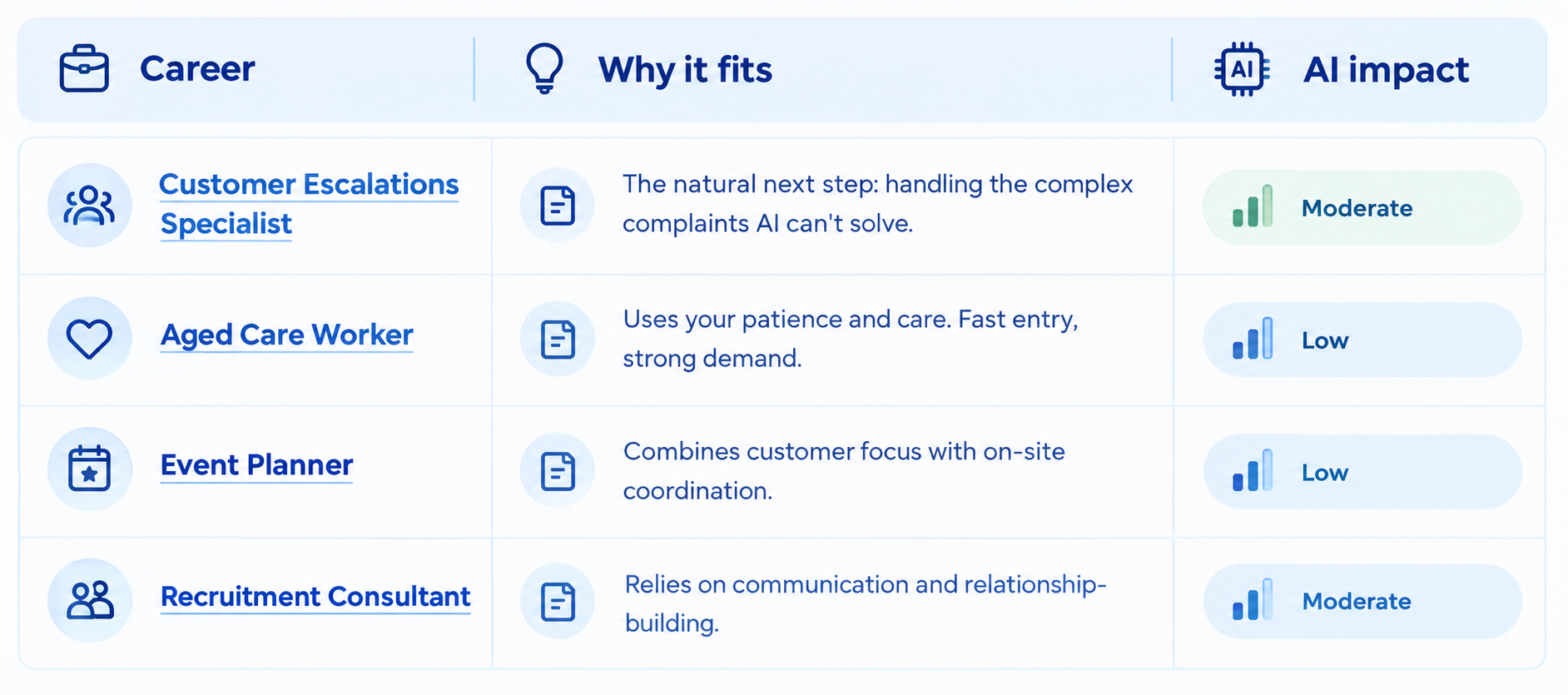
Not sure which direction suits you? A free career assessment matches your skills to careers that last.
How to Start Over
- List your transferable skills. Communication, de-escalation, problem-solving and working under pressure are valuable everywhere.
- Choose a direction. Decide whether you want to stay close to customer work, such as escalations or recruitment, or move into hands-on work like aged care.
- Get a short qualification. Many options, such as aged care or event coordination, need only a short course.
- Use your current job. Ask to handle escalations, train new staff or work with AI tools. This builds experience for your next role.
- Move before you have to. It's easier to switch while you're still employed.
Is It Worth Staying in Customer Service?
Reasons to stay (for now):
- Complex and escalation roles are still needed.
- Experience with AI tools makes you more valuable.
Reasons to plan your move:
- Entry-level roles are shrinking fast.
- Pay growth is limited as AI takes over routine work.
- Your people skills are most valuable when used in a more secure role.
The best time to plan your switch is before your role changes, not after.
FAQs
Will AI replace customer service jobs?
AI will replace most routine enquiries. Roles handling complex, emotional or high-value cases will last longer.
What can customer service workers do instead?
Common next steps include escalations specialist, aged care, event planning and recruitment.
Is customer service still a good job to start in?
Only as a short-term stepping stone. Consider moving into a more AI-resistant role early.
Do customer service skills transfer to other careers?
Yes. Communication, patience and problem-solving are valued in healthcare, hospitality, recruitment and many other fields.
Not sure if your current job is at risk? Check your AI risk score for free and see which careers match your skills. brigenai helps you find a career that lasts, with AI tools and real people to guide your switch.






