
Personal trainers design exercise programmes and coach clients to reach their fitness goals. AI fitness apps are everywhere, but they're unlikely to replace personal trainers for at least 20 years. What clients pay for is motivation, accountability and correct technique, which a human coach does best. For career changers, it's one of the fastest ways into an AI-resistant career: you can qualify in a few months.
What Does a Personal Trainer Do?
Personal trainers help people get fitter, stronger and healthier:
- Assessment: checking fitness, goals and any injuries.
- Programming: designing workouts tailored to each client.
- Coaching: teaching correct technique and adjusting exercises.
- Motivation: keeping clients consistent and accountable.
They work in gyms, studios, outdoors, online and as self-employed business owners.
Will AI Replace Personal Trainers?
No. AI apps will compete with basic training, but not with real coaching.
What AI can do: generate workout plans, track progress, count reps and give basic form feedback through phone cameras.
What AI cannot do:
- Motivate in person. Accountability to a real person is one of the strongest reasons clients succeed.
- Correct technique safely. Spotting, adjusting and preventing injury needs a trained eye and hands.
- Adapt to the person. Pain, mood, stress and life changes all affect training.
Growing interest in health and ageing well keeps demand strong for good trainers. That's why personal trainer is rated Low AI impact. See how it compares in our full list of careers AI can't replace.
Can You Switch to This Career?
Yes, and it's one of the easiest switches. People often come from:
- Sport and coaching: you already know training.
- Hospitality and sales: people and sales skills help build a client base.
- Healthcare: useful for working with older or injured clients.
- Any job: a passion for fitness is the main requirement.
Not sure which of your skills transfer? A free career assessment can show how well you match.
Is it too late at 40 or 50? No. Older trainers often attract clients their own age who prefer someone who understands their needs.
How to Start Over as a Personal Trainer
- Get certified. Complete a recognised fitness qualification, usually in a few months.
- Get first aid and CPR certification. Required by most gyms.
- Gain experience. Start at a gym, then build your own client base.
- Specialise. Older adults, injury rehab, strength or pre/post-natal training can set you apart.
Qualifications by region
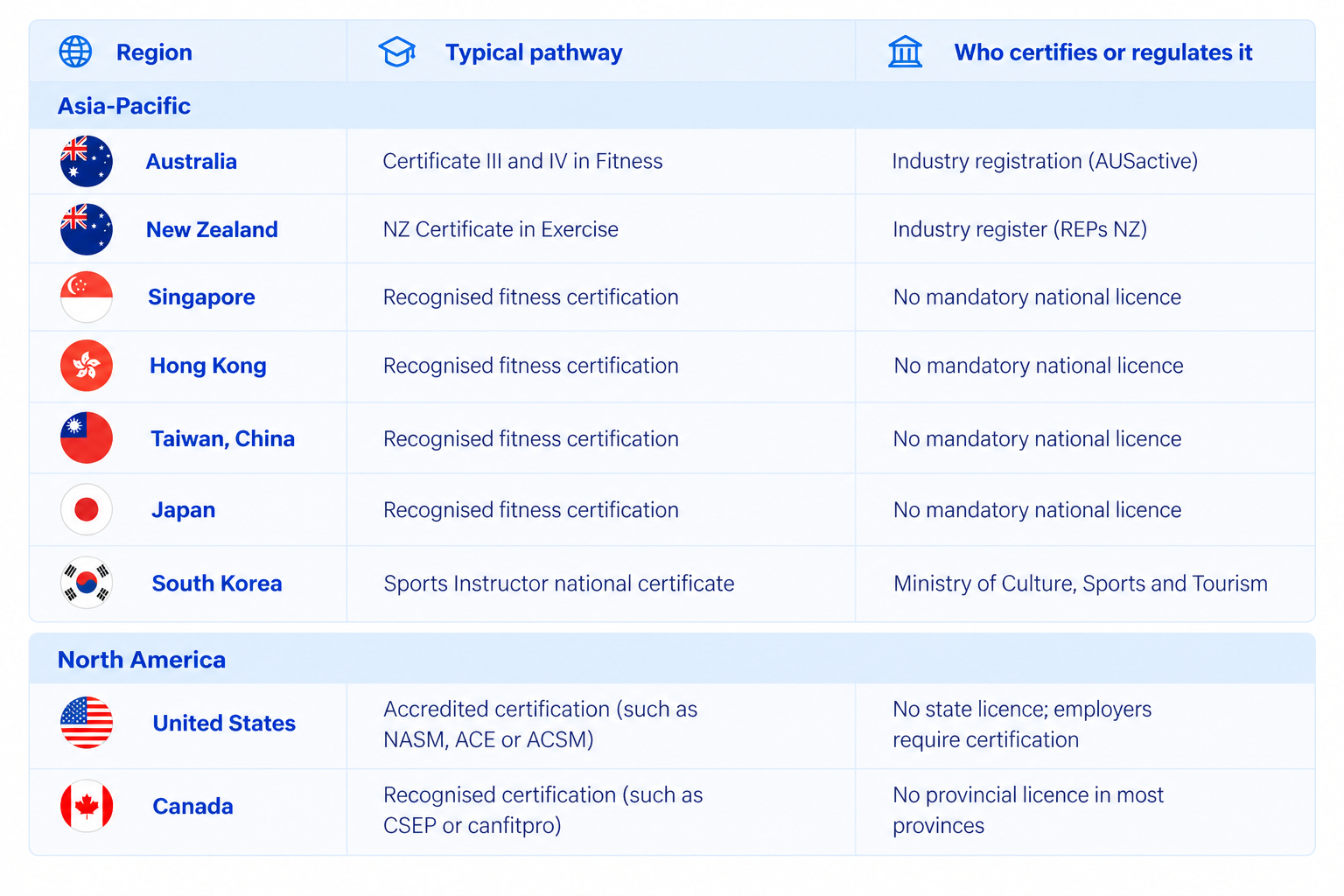
Asia-Pacific
- Australia: Certificate III and IV in Fitness. Industry registration through AUSactive.
- New Zealand: NZ Certificate in Exercise. Industry register through REPs NZ.
- Singapore: Recognised fitness certification. No mandatory national licence.
- Hong Kong: Recognised fitness certification. No mandatory national licence.
- Taiwan, China: Recognised fitness certification. No mandatory national licence.
- Japan: Recognised fitness certification. No mandatory national licence.
- South Korea: Sports Instructor national certificate, issued by the Ministry of Culture, Sports and Tourism.
North America
- United States: Accredited certification (such as NASM, ACE or ACSM). No state licence; employers require certification.
- Canada: Recognised certification (such as CSEP or canfitpro). No provincial licence in most provinces.
Requirements change, so always check what employers in your region expect.
Is It Worth It?
Pros:
- Fast and affordable to qualify
- Flexible hours and self-employment options
- Rewarding work helping people improve their health
Cons:
- Income depends on building a client base
- Early mornings and evenings are common
- Competition from cheap apps and online programmes
It suits energetic, motivating people who love fitness and enjoy working with others.
FAQs
How long does it take to become a personal trainer?
Usually a few weeks to six months, depending on the course.
Will AI fitness apps replace personal trainers?
No. Apps handle basic plans, but clients pay trainers for motivation, technique and accountability.
Can I become a personal trainer at 50?
Yes. Many clients prefer trainers who understand their stage of life.
Not sure if your current job is at risk? Check your AI risk score for free and see which careers match your skills. brigenai helps you find a career that lasts, with AI tools and real people to guide your switch.






