
Police officers keep communities safe by responding to emergencies, preventing crime and enforcing the law. AI will change policing, but it's unlikely to replace frontline officers for at least 30 years. The job depends on judgment, de-escalation and legal authority, which society expects humans to hold. For career changers, policing is an AI-resistant career with paid training and clear career progression.
What Does a Police Officer Do?
Frontline police officers handle a wide range of situations:
- Emergency response: attending crimes, accidents and disturbances.
- Patrol: keeping a visible presence in communities.
- Investigation: gathering evidence and interviewing witnesses.
- Community support: helping vulnerable people and resolving conflicts.
- Paperwork and court: writing reports and giving evidence.
Officers can later specialise in areas such as detective work, traffic, cybercrime or community policing.
Will AI Replace Police Officers?
No. AI will help with analysis and paperwork, but policing stays human.
What AI can do: analyse crime data, review CCTV footage, transcribe interviews and help write reports.
What AI cannot do:
- De-escalate situations. Calming tense or violent situations requires empathy and communication.
- Use judgment. Officers make decisions about safety, rights and the law in real time.
- Hold legal authority. Arrests, searches and use of force must be decided by accountable people.
- Build community trust. Good policing depends on relationships.
That's why police officer is rated Low AI impact. See how it compares in our full list of careers AI can't replace.
Can You Switch to This Career?
Yes. Police services actively recruit career changers. People often join from:
- Military and security: discipline and situational awareness transfer well.
- Healthcare, social work and education: experience with vulnerable people is valuable.
- Customer service and hospitality: communication and de-escalation skills help.
- IT and finance: in demand for cybercrime and fraud units.
Not sure which of your skills transfer? A free career assessment can show how well you match.
Is it too late at 30 or 40? Usually not. Many services welcome mature recruits for their life experience, though age limits vary by region.
How to Start Over as a Police Officer
- Check eligibility. Requirements include citizenship or residency, background checks, health and fitness.
- Prepare for selection. Expect aptitude tests, fitness tests, interviews and psychological assessments.
- Complete academy training. Usually several months of paid training.
- Serve a probation period. New officers work under supervision before becoming fully confirmed.
How to get in by region
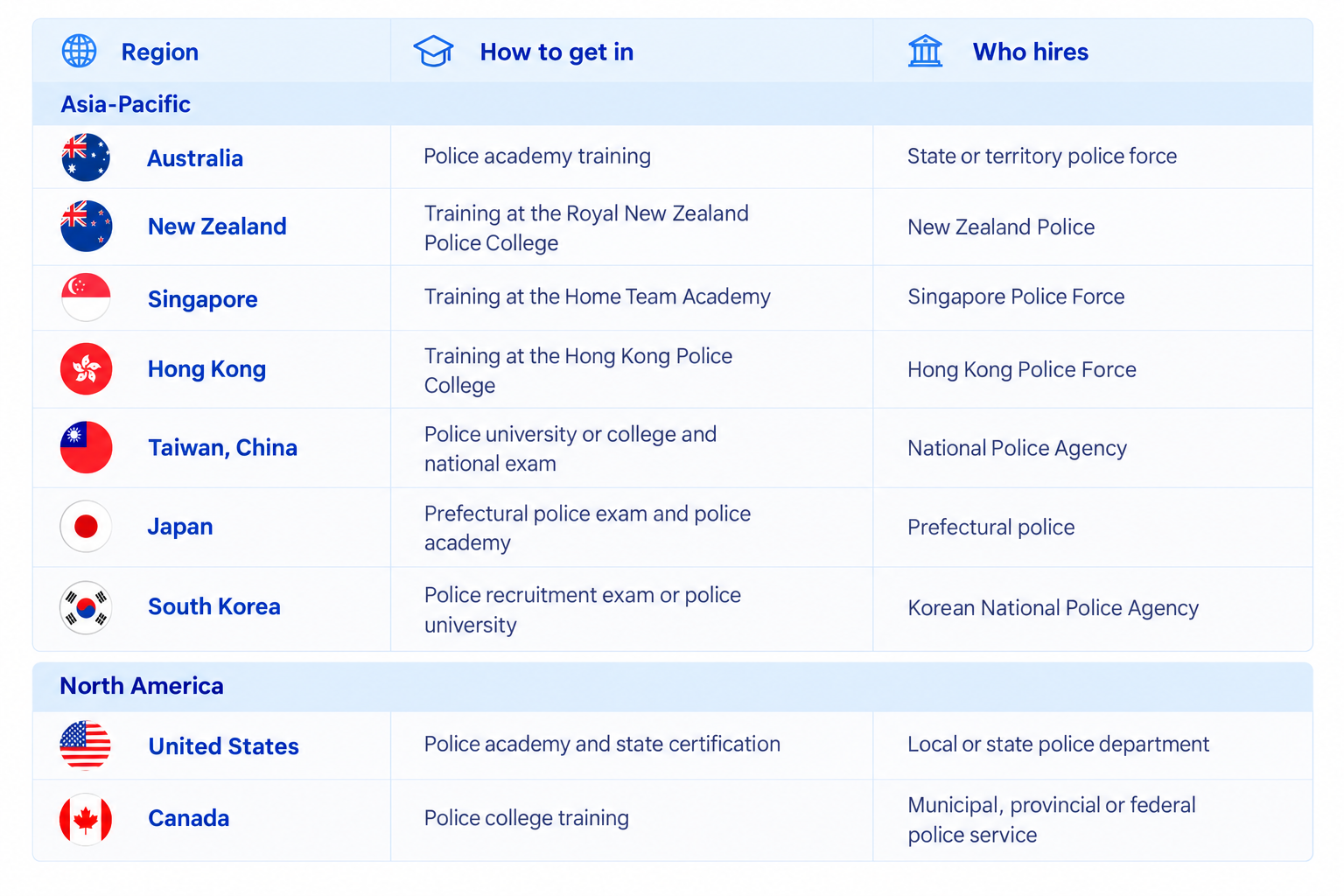
Asia-Pacific
- Australia: Police academy training. Hired by the state or territory police force.
- New Zealand: Training at the Royal New Zealand Police College. Hired by New Zealand Police.
- Singapore: Training at the Home Team Academy. Hired by the Singapore Police Force.
- Hong Kong: Training at the Hong Kong Police College. Hired by the Hong Kong Police Force.
- Taiwan, China: Police university or college and national exam. Hired by the National Police Agency.
- Japan: Prefectural police exam and police academy. Hired by prefectural police.
- South Korea: Police recruitment exam or police university. Hired by the Korean National Police Agency.
North America
- United States: Police academy and state certification. Hired by local or state police departments.
- Canada: Police college training. Hired by municipal, provincial or federal police services.
Requirements change, so always check with the police service in your region.
Is It Worth It?
Pros:
- Meaningful work protecting the community
- Paid training and stable employment
- Many specialist career paths
Cons:
- Shift work and high stress
- Exposure to danger and trauma
- Public scrutiny and heavy paperwork
It suits calm, fair-minded people with strong communication skills.
FAQs
How long does it take to become a police officer?
Usually several months to a year, including selection and academy training.
Can I become a police officer at 40?
Often yes. Many services value mature recruits, but check the age rules in your region.
Will AI replace police officers?
No. AI will help with data and paperwork, but frontline policing requires human judgment and authority.
Not sure if your current job is at risk? Check your AI risk score for free and see which careers match your skills. brigenai helps you find a career that lasts, with AI tools and real people to guide your switch.






