
The question "will AI replace my job?" accelerated from abstract worry to urgent career planning concern around 2024, as AI adoption across industries reached a visible tipping point. Workers across sectors are running searches, asking friends, and losing sleep over a question that actually has an answer, or at least a directional one. Several free tools now let you run a real AI job risk assessment in under ten minutes, tools like JobRoute (roughly one to three minutes) and AI Career Index (about ten minutes), and the results are more useful than the anxiety spiral that usually takes their place.
This article covers the best online resources to evaluate if AI will replace my current job role, comparing each tool by what it actually measures, how to use it practically, and what its results do and don't mean. Then you'll get a three-option action plan based on your specific score, not generic career advice.
The roundup includes the government-backed O*NET database, the private-sector Anthropic Economic Index (Anthropic's dataset mapping observed Claude usage to occupational tasks), interactive job automation tools like AI Career Index and JobRoute, and brigenai's AI Risk Check, which pairs your risk rating with career match suggestions, a role-switching plan, and guidance drawn from people who've actually made the move.
The free AI job risk tools worth actually running
Research-backed data sources: O*NET and the Anthropic Economic Index
O*NET is the U.S. Department of Labor's occupation database, and it's the raw material that every serious automation study is built on. It covers detailed task statements, skills, abilities, work activities, and task importance and frequency ratings for hundreds of occupations. It doesn't hand you a single risk score, but that's actually a feature: you use it to map which specific tasks in your role are most exposed before any calculator touches them.
To use it practically, search for your occupation on the O*NET site, pull up the task list, and identify which tasks are repetitive and digital versus which require physical presence, judgment, or ongoing human relationships. That task inventory becomes your actual risk map. The Anthropic Economic Index complements this by measuring observed AI use rather than theoretical capability, specifically how Claude is used on real occupational tasks drawn from the O*NET database. The index is a private-sector dataset published by Anthropic, not a government source. Together, these two sources give you a grounded picture of what AI is already doing in roles like yours. Break that second point up: the index captures current behavior. It doesn't predict what future AI capability will unlock.
Best online resources to evaluate job automation risk: AI Career Index, Rolespan, and JobRoute
AI Career Index is the most detailed of the interactive options. It runs 35 questions and produces a 0, 1,000 score with a five-dimension breakdown, a 24-month directional projection, and your first recommended action, all free with no credit card. The full report sits behind a one-time $49 upgrade. Plan for about ten minutes.
JobRoute AI Ready Score is the fastest and most generous free option. It covers 1,000-plus occupations using O*NET, Anthropic Economic Index data, and BLS projections. You get a 0, 100 exposure score, a breakdown of which skills AI strengthens versus which it may replace, and adjacent role recommendations, all in roughly one to three minutes with no signup required. You can retake it as many times as you want.
The main limitation shared across all of these tools is the same: they estimate technical exposure or likely task transformation, not whether your employer will actually cut your role tomorrow. Adoption speed depends on wages, regulation, organizational redesign, and worker acceptance, none of which show up in a calculator. Run at least two tools for the same occupation and compare the task-level output rather than fixating on the headline percentage.
Where brigenai's AI Risk Check fits differently
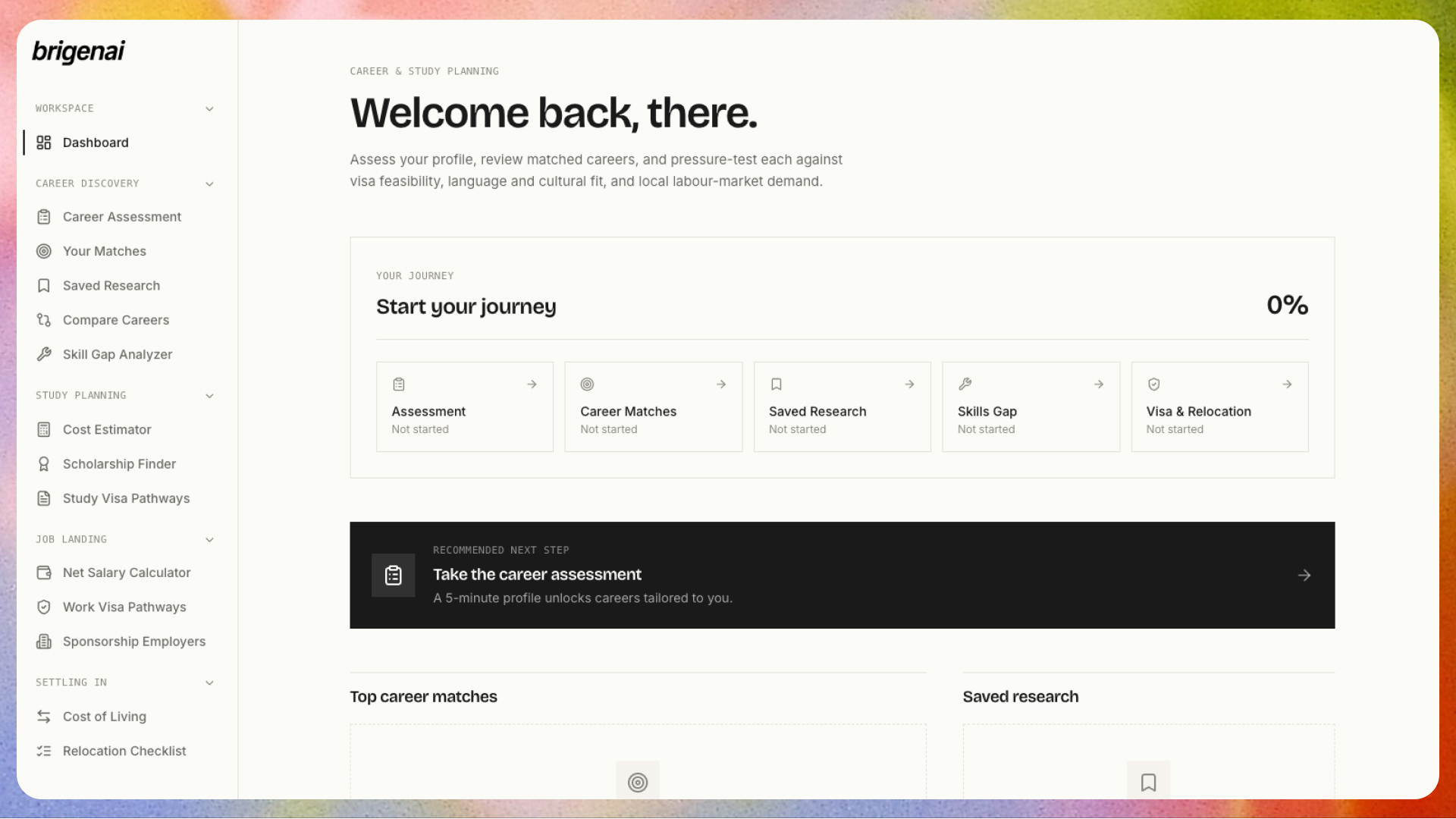
brigenai's AI Risk Check produces an automation risk checker score for your role, and it goes further than a raw exposure number. It pairs that rating with career match suggestions, a step-by-step role-switching plan, and access to guidance drawn from people who've navigated career changes and international moves. Other calculators leave you with a number. This one gives you a starting point for an actual transition plan.
It's most useful if you're already thinking about a career change or international relocation alongside your risk assessment, not just satisfying a passing curiosity. That context is what makes it genuinely different: less of a calculator, more of a transition tool built for people who are ready to act on what they find. Think of it as a next-step coach rather than a single data point.
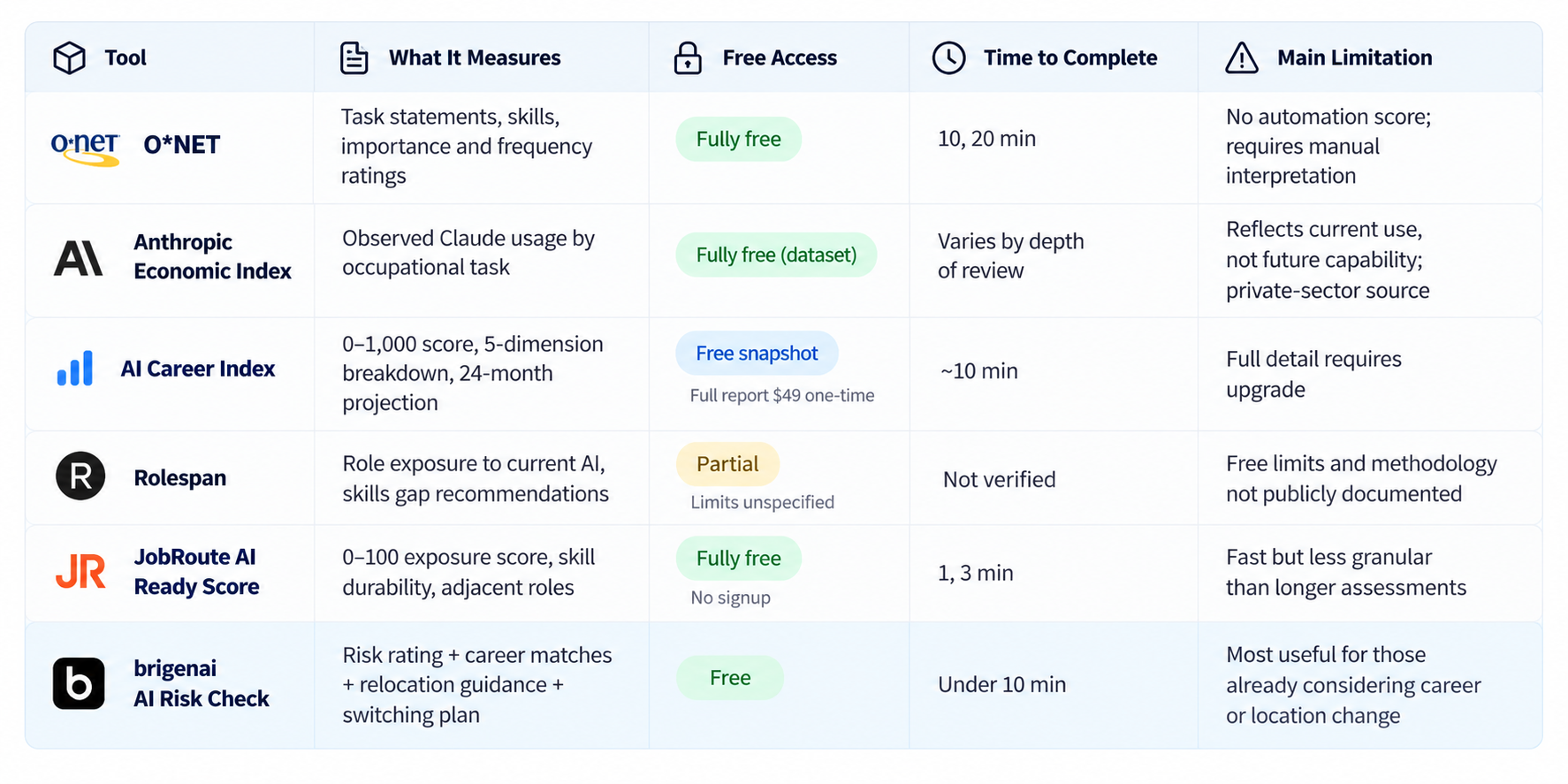
Side-by-side: what each tool actually measures
Comparison table
What all these tools get wrong (and why that matters)
Every tool in this list measures technical automatability or occupation automation probability, not actual employment outcomes. A task can be technically automatable and still not get automated, because the cost of switching isn't worth it, regulation creates friction, or employers find it easier to redesign roles than replace workers outright. That gap between what AI can do and what organizations actually do with it is where most fear-based takes fall apart.
There's also an occupation-level aggregation problem. Two people with the same job title, say, "Marketing Manager", can do radically different work depending on their company, industry, and team structure. A single risk score for that title may not reflect your actual daily task mix at all. Treat any score as a directional signal, not a verdict on your specific job.
How to read your risk score without spiraling
What a high, medium, or low score actually means
A high score means a large portion of your role's tasks are technically feasible for AI to perform or assist with today. It does not mean your job disappears next year. It means your task mix has significant exposure and deserves attention now rather than later.
A medium score usually signals that some tasks are exposed while others, involving judgment, relationships, or physical presence, are not. A low score means your role contains a high proportion of tasks that are currently hard to automate, but it doesn't make you immune to indirect disruption if the industry around you shifts fast enough.
Task-level susceptibility to AI: the part worth focusing on
The headline percentage is the least useful output any of these tools produces. The task breakdown is where the real signal lives. Which specific tasks does the tool flag as automatable now versus soon versus unlikely? That's the question worth sitting with.
Separate your own task list into three buckets: repetitive and digital work (higher exposure), physical and non-routine work (lower exposure), and judgment or relationship-heavy work (most resilient). The ratio of those buckets tells you more about your actual risk than any single score ever will.
The signals worth trusting vs. ignoring
Trust task-level classifications, especially when two or more tools flag the same tasks independently. Distrust precise timelines like "your job will be automated by 2027" and single-score verdicts that arrive without any task-level context. The research behind every major automation study is careful to avoid those claims; the calculators that make them are extrapolating well past what the data supports.
The skills that hold their value as AI scales
Human-first skills AI consistently struggles to replace
Social and emotional intelligence sits at the top of every credible low-exposure skills list: empathy, negotiation, active listening, coaching, conflict resolution, and the ability to build trust over time. These aren't just soft buzzwords. They show up consistently in Anthropic's research, OECD datasets, and O*NET-linked studies as the lowest-exposure task categories across occupations.
Judgment and accountability follow closely. AI can generate recommendations, but organizations still require humans to own consequential decisions, weigh competing values, and take responsibility for outcomes. Complex problem-solving in novel situations, creativity in contexts where human interpretation matters, and hands-on capability in variable physical environments round out the most resilient skill profile. The most durable combination, supported by O*NET task classifications and BLS occupational data, is deep domain expertise paired with AI fluency and human accountability. Neither skill alone is enough.
Task types with the strongest occupational resilience
Ambiguous diagnosis and problem framing outperform data entry and categorization. Negotiation, caregiving, and conflict resolution outperform repetitive writing and content generation. Decisions involving ethics and trust outperform standardized financial processing. Cross-functional leadership and stakeholder management outperform routine forecasting and templated analysis.
The key qualification: low AI impact on occupations doesn't mean safe from all disruption. Some lower-skilled physical roles carry less generative AI risk but remain vulnerable to robotics and mechanization. The goal isn't to find a zero-risk role; it's to build a profile where your most valuable tasks are the hardest ones for AI to absorb.
Your three-option action plan based on the results
Option 1: Upskill inside your current role
If your score is low to medium and you like your field, the move is to increase the proportion of high-resilience tasks in your daily work while building AI fluency alongside your existing domain expertise. Identify the one or two tasks in your current role most exposed to automation and actively shift time toward the judgment-heavy or relationship-heavy work that surrounds them.
Short-term programs worth looking at: Google Career Certificates, Microsoft Learn, IBM SkillsBuild, and responsible AI specializations for compliance, management, and operations roles. The strongest short-list for most professionals starts with a Google Data Analytics or IT Support certificate, followed by a role-specific cloud or security credential and a small portfolio of job-relevant projects.
Option 2: Pivot to a more AI-resistant career path
If your score is high and the task breakdown confirms that most of what you do daily is already exposed, a deliberate career change beats waiting for a restructuring announcement. The strongest transition targets for 2026 are cybersecurity, cloud infrastructure, data engineering, UX, AI governance, and healthcare technology. These fields consistently show both high demand and low automation probability for the roles themselves.
brigenai's AI Risk Check is particularly useful here because it doesn't just confirm your risk level and leave you alone with it. It pairs your rating with career match recommendations and a step-by-step switching plan that accounts for where you're starting from, not just where you want to go.
Option 3: Relocate to a market with stronger demand
For international students, expats, or anyone open to relocation: some job markets show significantly higher demand for AI-resilient roles than others. The U.S. offers the largest absolute market for cybersecurity and data engineering. The UK and France are especially strong for governance and compliance technology. Germany leads in industrial and OT security. Singapore, Canada, and the Nordic countries are among the fastest-growing markets for applied AI and data infrastructure roles.
This is where brigenai's platform adds something the other tools in this comparison don't offer: it overlaps AI job risk data with visa guidance, career paths abroad, and lived experience from expats already working in target markets. Run your score, review the career matches, then explore whether demand for your target role is stronger in another market before committing to a retraining path.
The best online resources to evaluate if AI will replace your job, and what to do next
You now have a clear map of which future-proof career resources actually measure your exposure, how to read what the results mean, and three concrete paths forward. A high risk score is not a verdict. It's a signal that your task mix needs adjusting, your skills need updating, or your market needs expanding.
Run two tools today and focus on the task-level output rather than the headline number. JobRoute takes three minutes with no signup. AI Career Index takes ten and gives you more dimension. Compare what they flag at the task level and use that to classify your own work.
Then decide which of the three paths fits your situation. If you're weighing a career change or an international move alongside your will AI replace my job assessment, brigenai's AI Risk Check connects all three steps in one place: your risk rating, your next career direction, and the practical guidance to get there.