
What are the best free career assessment tools online? You take a 30-question career quiz, hit submit, and get a list: "graphic designer, therapist, park ranger." Cool. Now what? The problem isn't the tests themselves. It's that nobody tells you how to pick the right one, read the results, or take a single step forward. This article fixes that.
Below is a direct comparison of the most useful free career assessment tools available right now. Each one is broken down by what it actually measures, how long it takes, whether it gives real career recommendations, and where it falls short. One of the tools covered also rates how exposed your shortlisted careers are to AI displacement and builds you a step-by-step switching plan. Whether you're changing careers, worried AI is coming for your job, or picking a college major, this gives you a clear path from quiz to action.
Why most free career tests leave you more confused than when you started
Three very different people take career tests. Students need broad exploration: they're not sure what direction to head yet, and they need options. Career changers with real work experience need skills-based matching: they already know what they can do, and they need to find where those skills transfer. Professionals worried about AI displacement need something else entirely: they need to know which careers are actually safe to move into, not just which ones sound interesting. One test doesn't serve all three equally well. Knowing which group you're in narrows the field before you open a single browser tab.
The word "free" also deserves a closer look. Some tools are genuinely free, full results included, no credit card required. Others give you a teaser and charge $19.99 for anything useful. Nothing is worse than spending 45 minutes on a test only to hit a paywall at the results screen. Every tool in this comparison either delivers complete, actionable output at no cost or clearly flags its paywall upfront, so you know exactly what you're walking into. For each tool below, the review notes which outputs are free and where the pricing line falls.
The 7 best free career assessment tools, compared at a glance
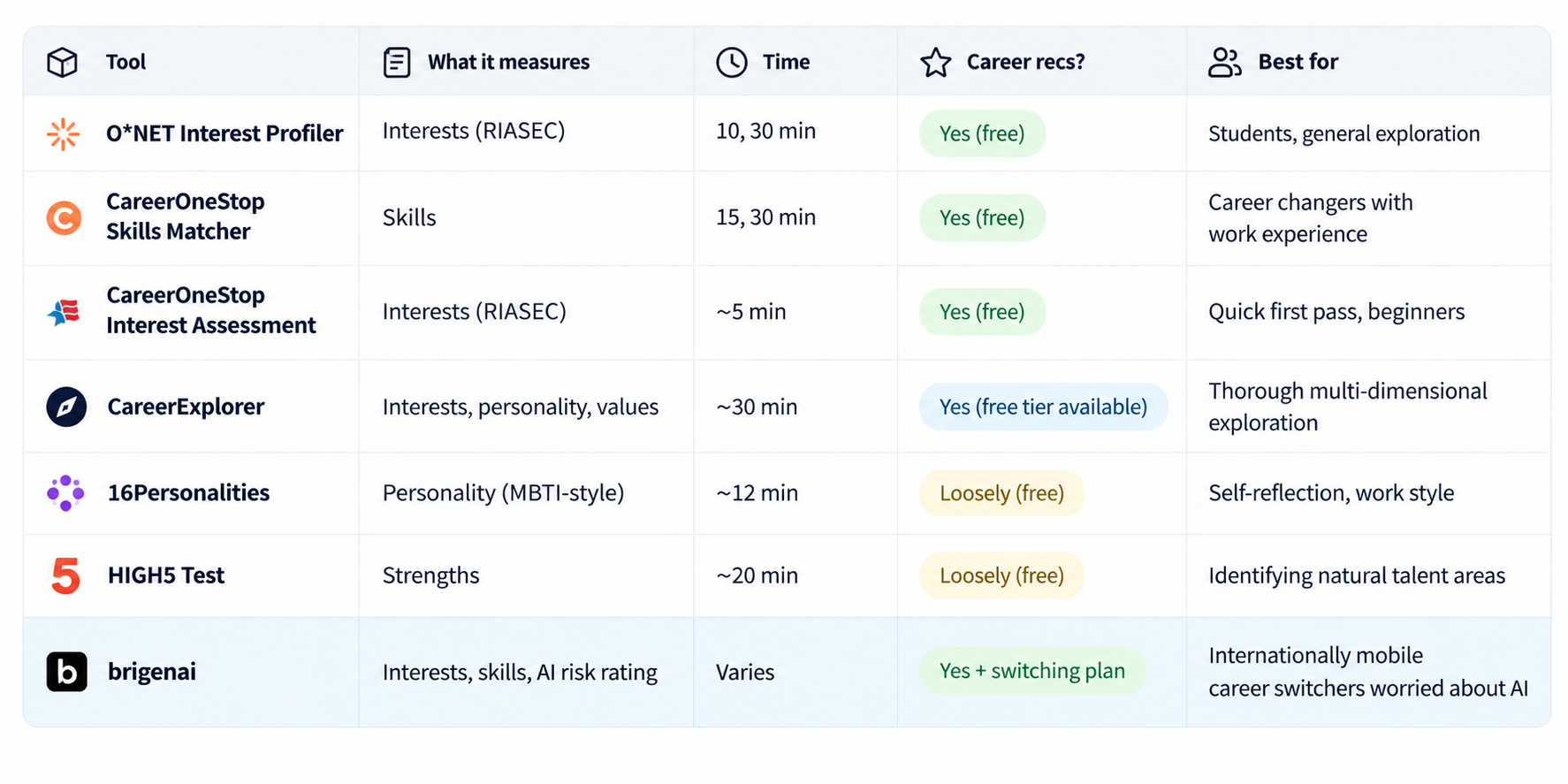
O*NET Interest Profiler is the most research-backed option on this list. Sponsored by the U.S. Department of Labor and tied directly to the O*NET-SOC occupation database, it uses the RIASEC model with published reliability evidence. The 60-question version takes 10 to 30 minutes and surfaces real occupation titles filtered by how much training you're willing to take on. It's not flashy, but it's grounded in actual labor market data in a way most quiz-style tools aren't, and the full results are free with no account required.
CareerOneStop is the strongest combo suite here. The Skills Matcher, Interest Assessment, and Work Values Matcher are three separate free tools that work together inside a single platform. You rate 40 workplace skills, check your interests, then clarify your values. Together they match skills to what you're drawn to and filter by the job conditions you actually need, a shortlist built on more than just curiosity.
CareerExplorer goes broader across interests, personality, and work preferences and typically takes around 30 minutes. Its internal reliability holds up under testing, and it produces ranked career matches with fit scores on the free tier. The caveat: its validation research mainly shows that users endorse its top suggestions, not that those suggestions predict long-term career satisfaction. Treat the results as hypotheses, not verdicts.
16Personalities is personality-first, not career-first. It's useful for understanding how you prefer to work, what environments drain you, and how you tend to communicate. It's not a career-matching instrument in the same way O*NET is, and its four-letter typing approach has well-documented instability on retest. Use it for self-reflection. Don't use it alone to choose a career.
HIGH5 Test surfaces your five strongest natural talent areas. The free results are accessible, and the language it uses to describe your strengths is useful for job applications and self-advocacy. Like 16Personalities, it doesn't produce an occupational shortlist the way a RIASEC-based tool does, so it works best as a complement rather than a starting point.
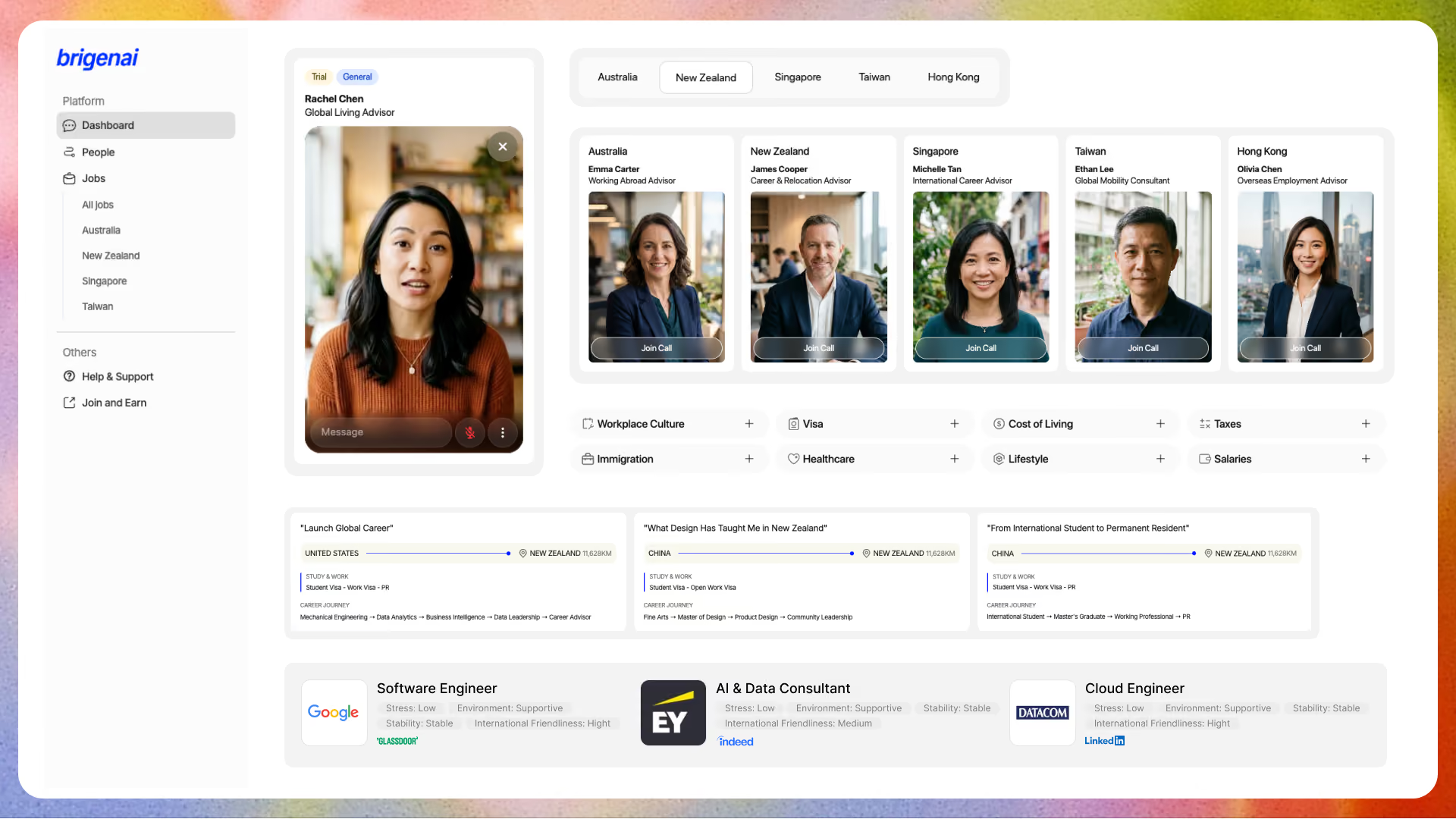
brigenai is built differently from the rest. According to the platform, it combines career matching with an AI risk rating for each shortlisted occupation and generates a step-by-step switching plan tailored to your situation. You also get access to real stories from international students and expats who've navigated similar transitions, real-world context that no quiz algorithm can replicate. Its main limit: it's built primarily for people exploring study or work across borders, so it performs best for internationally mobile career switchers. If that describes your situation, it's worth putting at the top of your list.
What each test type actually measures (and why it matters which one you start with)
Interest inventories like the O*NET Interest Profiler and CareerOneStop Interest Assessment use the Holland RIASEC model, Realistic, Investigative, Artistic, Social, Enterprising, and Conventional. Your results produce a three-letter code based on your highest-scoring interest areas. An "ISA" result means you're drawn to investigative, social, and artistic work environments. Think UX researcher, science communicator, or health information analyst. That code then maps to hundreds of real occupations in the O*NET database. Interest inventories answer one core question: what kinds of work feel engaging?
Personality assessments like 16Personalities and HIGH5 answer a different question: how do you prefer to work? They describe your thinking style, interaction preferences, and natural strengths. That's genuinely useful, but it doesn't tell you which occupations you're suited for in the same direct way a RIASEC-based tool does. The smartest move is to use both: let interests generate your career shortlist, then use personality data to evaluate whether the day-to-day work environment of each option actually fits how you operate.
Skills assessment tests: the most underrated category for career changers
The CareerOneStop Skills Matcher asks you to rate 40 workplace skills, then compares your profile against the skill requirements for over 900 occupations. A mid-career project manager who rates highly in coordination, budgeting, problem-solving, and communication might see project management specialists, management analysts, and operations managers rise to the top. The results reflect what you can already do, not just what sounds interesting. Pair the skills matcher with the Work Values Matcher, which clarifies whether you need autonomy, income, social impact, or stability from a job, and you get a shortlist grounded in both capability and preference.
How to read your results without getting paralyzed
A Holland code is a starting filter, not a final answer. If your result is "ISA", investigative, social, and artistic, open the O*NET occupation database, enter your code, select the Job Zone that matches your current or desired education level, and you'll get a concrete list of 5 to 10 occupations worth researching. From there, read the actual job duties, not just the title. That's where most people stop, and that's exactly where the useful work starts.
Sometimes the results feel completely off. The test says "accountant" and you've never touched a spreadsheet voluntarily. That's a calibration problem, not a test failure. It usually happens because interest tests capture what you say you prefer, not what you've actually experienced. If a result surprises you, take a second test from a different category: if your interest result feels wrong, try the skills assessment test instead. Treat any single result as a hypothesis. The goal is convergence, when two or three different tools point toward the same occupational cluster, that cluster is worth taking seriously.
Turning results into action: AI risk, career shortlisting, and your switching plan
Most career test comparisons end at the results page. Here's what actually matters next. Once you have a shortlist of target careers, the step most people skip is checking how AI-exposed those careers are. Administrative roles, junior software developers, customer service representatives, data-entry workers, and some writing and research positions currently face significant automation exposure, according to recent labor market research from sources including the Bureau of Labor Statistics and McKinsey Global Institute. If your shortlist includes occupations in those categories, that's worth knowing before you invest time and money in a transition.
brigenai, according to the platform, includes an AI risk rating for each career it surfaces, so you're not running between multiple tools trying to cross-reference that data yourself. If a career on your shortlist scores high for AI displacement risk, you can look at adjacent options before committing to a plan. That single feature changes which careers make the final cut for a lot of people taking these tests specifically because they're worried about their current role becoming automated.
Knowing what career you want and knowing how to get there are two different problems. After assessment, the practical next steps are: identify your transferable skills, spot the gaps, then find the training that closes them. Most career quiz tools give you the first output and leave you to figure out the rest. brigenai's switching plan, as described by the vendor, generates that sequence for you. Combined with access to real people who've navigated similar international career transitions, it positions itself as a tool that takes you from interest matching through to a concrete roadmap, a gap none of the other free tools in this comparison attempt to close.
Which free career assessment should you start with?
Here's the direct answer by situation:
- Students choosing a major:Start with the O*NET Interest Profiler. After you have your Holland code, use CareerExplorer for broader exploration across personality and preferences. Together they give you a wide lens backed by solid research.
- Career changers with work experience:Start with the CareerOneStop Skills Matcher, then run the Work Values Matcher. Skills-based matching reflects what you already bring; values data filters the results to what you'd actually want to do.
- Professionals worried about AI replacing their job:Start with brigenai. The platform combines career matching with AI risk scoring and a switching plan in one place, and it connects you to real experiences from people who've navigated major career transitions across borders.
No single test gives you a career. The test narrows the field. The real work is what you do after: an informational interview, a short course, a trial project, a conversation with someone already doing that work. A test result is only as good as the action you pair with it. The best free career assessment tool online is the one you actually follow through on.
FAQ: What are the best free career assessment tools online?
What are the best free career assessment tools online?
The best free career aptitude tests online in 2026 depend on your situation. For broad exploration, the O*NET Interest Profiler and CareerExplorer are strong starting points. For career changers, the CareerOneStop Skills Matcher is the most practical option. For professionals weighing AI risk alongside career matching, brigenai offers a combined approach that the other tools don't. Using two or three tools together, an interest inventory, a skills assessment test, and a personality tool, gives you more reliable results than relying on any single quiz.
Are free career assessments accurate?
The federally backed tools (O*NET, CareerOneStop) have published reliability data and are tied to real labor market information. Others like CareerExplorer show strong internal consistency. No career quiz predicts long-term satisfaction with certainty, treat results as a starting shortlist, not a verdict, and cross-reference across multiple tools.
How long do free career tests take?
Most take between 5 and 30 minutes. The CareerOneStop Interest Assessment runs about 5 minutes; the O*NET Interest Profiler takes 10 to 30 minutes depending on which version you choose; CareerExplorer typically runs around 30 minutes. Completion times for 16Personalities and HIGH5 vary by respondent but generally fall in the 12 to 20 minute range, confirm current estimates on each tool's site.
If you want career matching, AI risk data, and a real switching plan in one place, explore what brigenai offers and see whether it fits your next move.