

Global employment contracts are legally binding agreements that define the terms, rights, and obligations of employment when a professional works across national borders. The standard industry term for these arrangements is “international employment agreement,” though both terms are used interchangeably in practice. More than 60% of international employment disputes stem from initial contract ambiguity, according to a 2025 analysis by the Global Workforce Institute. That single statistic tells you everything about why getting the contract right before you board the plane matters more than any other step in your international career move.
What are the essential components of a global employment contract?
International employment contracts must comply with the labour laws of the country where the employee physically works, not where the employer is headquartered. This is the foundational rule that most professionals overlook when they receive a contract drafted by a foreign employer’s home-country legal team. Deel’s 2026 compliance update confirms this principle applies regardless of which governing law clause the employer inserts.
A well-structured cross-border employment contract covers six core areas:
Bilingual contracts in English and the local language improve legal enforceability and employee clarity, according to Law & More’s 2026 guidance for international workers. This matters most in countries like France, the Netherlands, and Taiwan, where courts may default to the local-language version in a dispute.
Pro Tip: Request a bilingual contract as a standard condition of acceptance, not an afterthought. If your employer resists, ask for a certified translation at their cost. The few hundred dollars this costs is trivial compared to the risk of signing a document you cannot fully read.

How do local labour laws shape your international employment agreement?
Local labour laws govern employee protections regardless of where the employer is based or what the contract says. Global templates are often insufficient; local addenda or standalone contracts are required for enforceability in countries like Germany and the Philippines. This is not a technicality. It is the difference between a contract that holds up in court and one that does not.
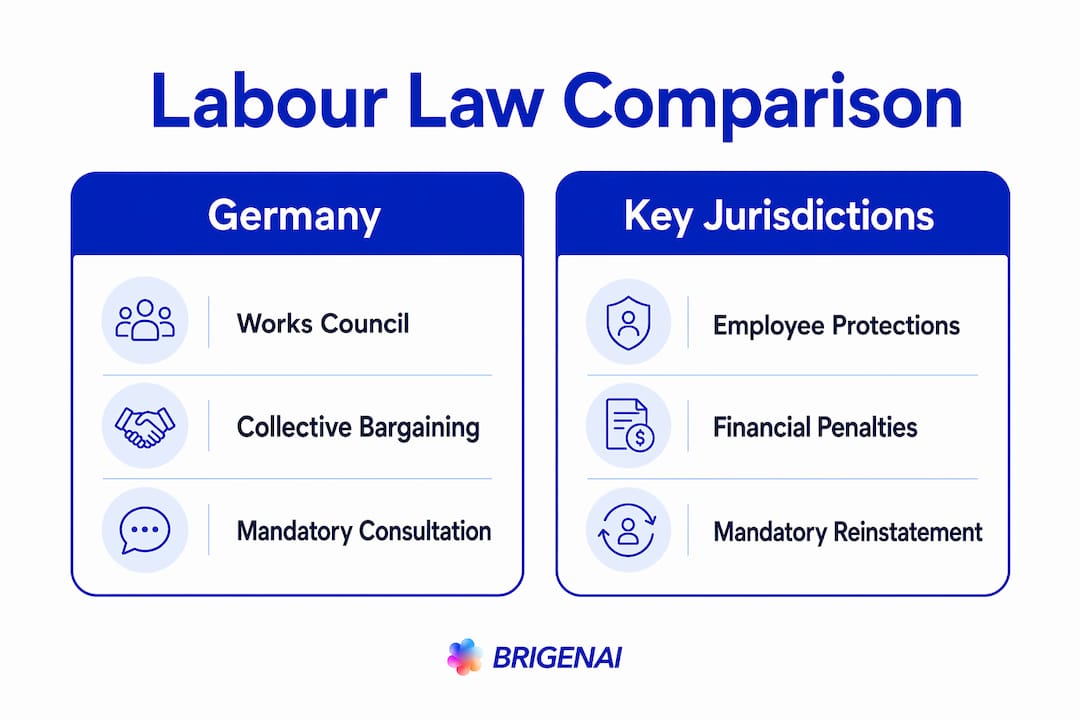
The table below illustrates how mandatory requirements differ across four key jurisdictions that attract significant numbers of international professionals.
CountryKey mandatory clauseNotable requirementGermanyWorks council consultationEmployer must consult works council before hiring or terminatingFranceCollective bargaining agreementSector-level agreements override individual contract termsNetherlands30% ruling disclosureTax ruling eligibility must be addressed in the contractPhilippines13th-month payMandatory annual bonus equivalent to one month’s salary
Local labour law nuances such as works council involvement and collective bargaining strongly shape contract terms, according to Teamed’s global employment contract checklist. The practical implication is that a contract your employer uses for staff in Singapore will not be legally sufficient for a hire in Germany, even if both roles are identical.
The risks of non-compliance are concrete. Employers face financial penalties, mandatory reinstatement orders, and reputational damage. Employees face the loss of statutory protections they did not realise they were entitled to. Treating an employment contract as a strategic asset rather than a template reduces compliance failures and talent loss, as NeZda Global’s analysis consistently demonstrates.
Pro Tip: Before signing any cross-border employment contract, check whether your destination country requires a locally registered employer. In many jurisdictions, a foreign company cannot legally employ you directly without establishing a local entity or using an Employer of Record service.
What relocation and repatriation clauses should you negotiate?
Relocation and repatriation terms are the most financially consequential clauses in any expatriate work agreement, and they are the ones professionals most often fail to negotiate before signing. Negotiating relocation and repatriation clauses reduces personal financial risks linked to premature contract termination, according to Law & More’s expert guidance. The cost of an unplanned repatriation, including flights, shipping, and temporary housing, can easily exceed $30,000 for a family.
The following clauses deserve explicit attention in any international relocation:
Avoiding common relocation mistakes before you sign is far easier than correcting them after you have already moved. The financial and logistical complexity of international relocation requires structured HR processes well beyond standard travel arrangements.
How does contract type affect your rights as an international professional?
Types of employment contracts and local labour rules vary widely, affecting probation limits, notice periods, and fixed-term restrictions, according to WorkMotion’s 2026 employment contract guide. The contract type you accept shapes your tax obligations, social security entitlements, and access to statutory benefits in your destination country.
Contract typeKey characteristicPrimary compliance riskPermanent employmentOngoing, no end dateTermination procedures and severance vary by countryFixed-termDefined end dateAutomatic renewal rules and conversion to permanent statusPart-timeReduced hoursPro-rata entitlements and minimum hours legislationIndependent contractorNo employment relationshipMisclassification risk and loss of employee protections
Contractor agreements carry the highest compliance risk in global hiring practices. Many countries, including Australia, the United Kingdom, and Germany, apply strict tests to determine whether a contractor is actually an employee in disguise. If a court or tax authority reclassifies you as an employee, the employer faces back-payment of social security contributions, leave entitlements, and penalties. You may also face unexpected tax liabilities.
Fixed-term contracts deserve particular scrutiny. In France and Germany, fixed-term contracts convert automatically to permanent employment after a defined period or number of renewals. Employers who do not understand this rule often find themselves with permanent obligations they did not intend to create. Understanding the international career transition workflow before you accept a fixed-term offer abroad helps you anticipate these conversion rights and negotiate accordingly.
How to review and negotiate your global employment contract
Reviewing an international employment agreement requires a different checklist than reviewing a domestic contract. Employers and employees commonly err by using standardised templates that ignore hyper-local nuances, according to legal experts at NeZda Global and Teamed. The following process protects your interests before you sign.
Pro Tip: Ask your employer which entity will legally employ you. If it is not a locally registered company in your destination country, ask how they intend to comply with local employment law. The answer reveals whether they have done this properly before.
Plan your international move with Brigenai
Understanding your contract is one piece of a much larger puzzle when you are preparing to work abroad.

Brigenai is built specifically for professionals making exactly this kind of move. The platform combines AI-powered tools with real-world community insights to help you find roles that match your skills, understand visa occupation requirements through the Australia and New Zealand skills lists, and prepare for relocation with a structured international relocation checklist. Whether you are comparing destinations, assessing salary benchmarks, or working through the compliance requirements of a new contract, Brigenai gives you the intelligence to move with confidence rather than guesswork.
FAQ
What is a global employment contract?
A global employment contract is a legally binding agreement that governs the terms of employment when a professional works in a country different from their employer’s home jurisdiction. It must comply with the labour laws of the country where the employee physically works.
Why do standard contract templates fail for international hires?
Standard templates ignore hyper-local requirements such as mandatory benefits, termination procedures, and works council obligations that vary by country. Local addenda or standalone contracts are required for enforceability in many jurisdictions, including Germany and the Philippines.
What happens if my employer misclassifies me as a contractor?
Misclassification exposes both parties to significant risk. The employer may owe back-payment of social security contributions, leave entitlements, and penalties, while you may face unexpected tax liabilities and lose access to statutory employee protections.
Do governing law clauses in my contract actually protect me?
Governing law clauses have limited power in employment disputes. Local courts generally claim mandatory jurisdiction over employment matters regardless of which country’s law the contract nominates, meaning local employee protections apply whether or not the contract acknowledges them.
What relocation costs should my employer cover in an international contract?
At minimum, negotiate explicit coverage of removalist fees, temporary accommodation, return flights, and visa or work permit costs. Repatriation funding if the employer terminates early is equally critical and should be stated as a specific financial obligation, not a general commitment.