
Employee relocation is the structured process of moving a worker from one location to another, typically across national borders, to fill a critical role or support organisational growth. Done well, knowing how to relocate employees transforms talent mobility from a compliance burden into a genuine competitive advantage. The challenge is that international moves involve at least five interdependent workstreams: immigration, payroll registration, tax compliance, legal contracting, and family logistics. Each one has its own timeline, its own specialists, and its own failure modes. Miss the sequencing, and you create delays that cost money and erode employee trust before the assignment even begins.
How to relocate employees: stakeholders and prerequisites
Successful employee relocation starts long before a visa application is submitted. The first task is assembling the right team, because no single person or department can manage all the moving parts alone.
The core stakeholders in any international move include:
Each stakeholder needs a defined scope and a clear handoff protocol. Without this, tasks fall into gaps between teams, and the employee ends up chasing answers from multiple directions.
Before initiating any move, align on the relocation type. A permanent transfer carries different compliance obligations than a short-term assignment or a commuter arrangement. The business objective drives this choice, and it shapes every downstream decision from contract structure to benefit entitlements.

Pro Tip: Integrate your relocation intake form with the offer acceptance workflow so that employee data, passport details, family information, and destination preferences are captured upfront and routed to all vendors simultaneously. This parallel distribution cuts weeks off the pre-move phase.
Documentation is the other prerequisite that organisations consistently underestimate. Passports, birth certificates, marriage certificates, academic qualifications, and prior tax records all need to be gathered, sometimes apostilled, and sometimes translated. Build a document checklist into your intake process from day one.
How do you plan and sequence the relocation workflow?
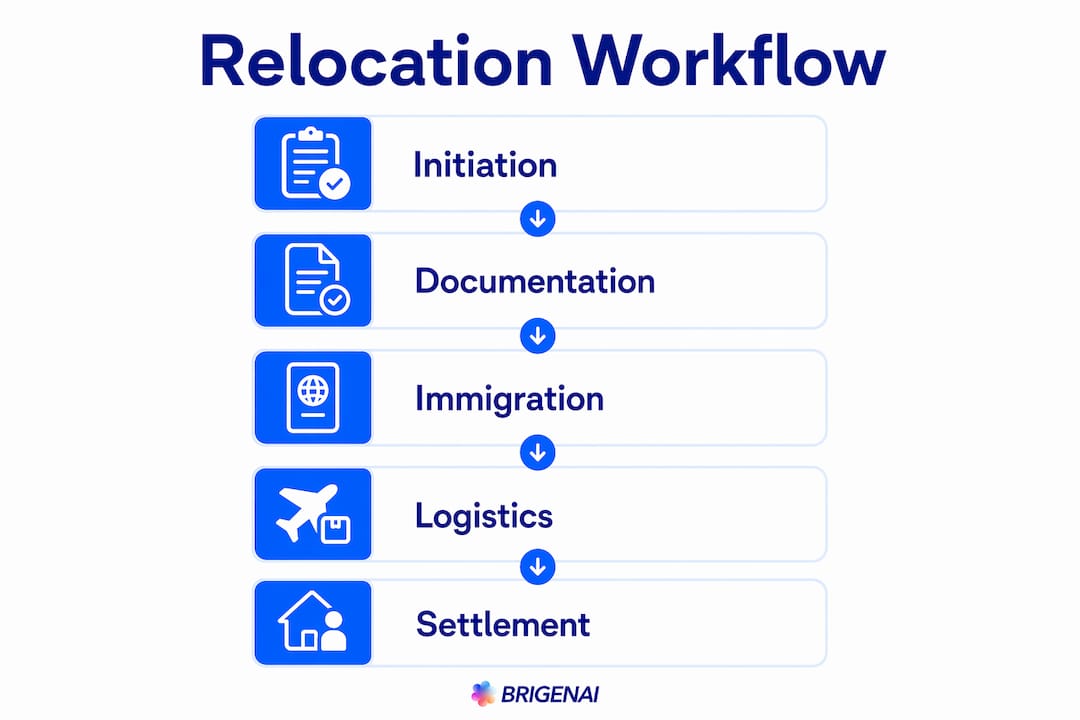
The most common mistake in international employee relocation is treating the process as a linear checklist rather than a network of interdependent workflows. The immigration-to-payroll-to-tax dependency is the most consequential chain in the entire process, and immigration is almost always the slowest link, taking six to twelve weeks in most jurisdictions. That means payroll registration and tax setup cannot begin until the work permit is approved, which means the employee cannot be paid compliantly until weeks after arrival if you have not planned ahead.
The practical solution is to build interim workflows that run in parallel with immigration processing. While the visa application is in progress, your payroll team can prepare the host-country payroll structure, your tax adviser can model the equalisation position, and your destination service provider can begin the housing search.
Best practices for pre-move planning recommend the following sequence:
The table below shows typical timeframes for each major relocation component.
ComponentTypical lead timeKey dependencyVisa and work permit6 to 12 weeksPassport, employer sponsorship documentsPayroll registration2 to 4 weeks after visaApproved work permit, local addressTax registration2 to 4 weeks after payrollTax file number or equivalentHousing search8 to 12 weeksDestination confirmed, budget approvedHousehold goods shipment4 to 8 weeks (sea freight)Move date confirmed
Pro Tip: Plan your entire relocation timeline around the slowest process, which is almost always immigration. Build every other workstream to be ready and waiting when the visa clears, not starting after it clears.
What does an effective relocation package include?
A well-designed relocation package is the difference between an employee who arrives motivated and one who arrives resentful. Relocation policies typically contain eligibility criteria, tiered benefit structures, defined cost coverage, and clawback provisions that recover costs if the employee leaves within a set period, usually six to twenty-four months.
The standard inclusions in a corporate relocation package are:
Tiering matters. A junior analyst moving domestically does not need the same package as a regional director relocating from Sydney to Singapore. Build at least three tiers into your policy: entry-level, mid-level, and senior or executive. Define eligibility thresholds clearly, including minimum move distance and minimum tenure, to avoid disputes.
Clawback clauses protect the organisation’s investment. A common structure requires full repayment if the employee leaves within twelve months, fifty percent repayment between twelve and twenty-four months, and no repayment after twenty-four months. Document these terms in a signed relocation assistance agreement before any costs are incurred.
How do you manage execution and post-arrival support?
Execution is where well-designed plans either hold together or fall apart. The first week in the destination country is the highest-risk period for the employee and the organisation alike. Visa approval triggers a cascade of tasks: local contract signing, tax file registration, bank account opening, health insurance activation, and school enrolment if applicable.
Digital tracking tools increase relocation accuracy by up to forty percent by reducing errors and missed compliance deadlines. Assign each task in your tracking system to a named owner with a due date. When no one owns a task, it does not get done.
Communication is equally critical. Transparent, structured updates from a dedicated point of contact reduce employee anxiety and prevent the kind of misunderstandings that turn into formal complaints or early departures. Set a communication cadence before the employee boards the plane.
A structured check-in schedule post-arrival should include:
Regular structured feedback at these milestone intervals allows HR to address emerging needs before they become assignment-ending problems. The ninety-day mark is particularly important because it is when initial excitement fades and practical frustrations surface.
It is also worth noting that nearly sixty-two percent of employees are more likely to accept a relocation when they see it as a career advancement opportunity. Frame the move in those terms from the first conversation, and reinforce that framing throughout the settling-in period. Employees who understand the career logic of their move are more engaged and less likely to disengage when the inevitable friction of relocation hits.
For HR teams managing multiple concurrent moves, consider exploring global tax comparison tools to model tax obligations across destinations before finalising package structures.
Key takeaways
Effective international employee relocation requires sequencing immigration, payroll, tax, and family logistics as parallel workstreams, not a linear checklist, with immigration as the critical path driver.
PointDetailsImmigration sets the paceBuild all other workstreams to be ready when the visa clears, not starting after it clears.Stakeholder alignment is non-negotiableAssign named owners to HR, legal, payroll, and vendor roles before any application is submitted.Package tiers protect fairnessUse at least three benefit tiers and document clawback terms in a signed agreement upfront.Post-arrival support determines successStructured check-ins at 30, 60, and 90 days catch problems before they become assignment failures.Digital tracking reduces errorsAssignment tracking tools cut compliance errors and missed deadlines by up to forty percent.
Why most relocation programmes fail at the handoff
I have reviewed a lot of corporate relocation programmes, and the failure point is almost never the policy document. The policy is usually fine. The failure is the handoff between teams, specifically the moment when HR passes the baton to immigration counsel, or when immigration counsel passes to payroll, and nobody has confirmed the other side is ready to receive it.
The organisations that do this well treat relocation as a portfolio of concurrent workstreams, each with a named owner, rather than a sequential process where one team finishes before the next begins. That mental model shift alone changes outcomes. It forces parallel preparation, which compresses timelines and surfaces conflicts early when they are still cheap to fix.
The other thing I consistently see undervalued is the employee experience during the waiting period, specifically the six to twelve weeks between visa application submission and approval. That is a period of genuine uncertainty for the employee and their family. The organisations that fill that gap with structured communication, clear milestones, and a single point of contact retain far more goodwill than those that go quiet and resurface when the visa arrives.
Transparency is not a soft skill in global mobility. It is an operational requirement. An employee who understands why moving abroad accelerates their career is a fundamentally different participant in the relocation process than one who feels processed. That distinction shows up in engagement scores, assignment completion rates, and whether the employee recommends the programme to colleagues.
Plan your next employee move with Brigenai
Managing an international employee relocation involves dozens of interdependent decisions across immigration, payroll, tax, and family logistics. Brigenai brings structured intelligence to every stage of that process.
The Brigenai international relocation checklist gives HR teams a practical, milestone-driven framework covering pre-move preparation through post-arrival compliance. The platform’s global salary benchmarking database helps you design competitive, market-aligned packages for destinations including Australia, New Zealand, Singapore, and Taiwan. For organisations that need hands-on support, Brigenai’s relocation services connect HR teams with destination-specific expertise to reduce errors and accelerate timelines.
FAQ
What is the typical timeline for relocating an employee internationally?
Most international employee relocations take three to six months from initiation to the employee starting work in the destination country. The immigration process is the longest single step, typically requiring six to twelve weeks for visa and work permit approval.
What should an employee relocation package include?
A standard relocation package covers moving costs, temporary housing for thirty to ninety days, a house-hunting trip, tax gross-up payments, and a miscellaneous expense allowance for costs like utility deposits and contract termination fees. Senior roles typically receive extended temporary housing of up to one hundred and eighty days.
How do clawback clauses work in relocation agreements?
Clawback provisions require the employee to repay some or all relocation costs if they leave the organisation within a defined period, usually six to twenty-four months. A common structure is full repayment within twelve months, fifty percent between twelve and twenty-four months, and no repayment after that.
How can HR reduce errors during international relocation execution?
Digital assignment tracking tools reduce compliance errors and missed deadlines by up to forty percent. Assigning named owners to every task and running structured check-ins at thirty, sixty, and ninety days post-arrival are the most effective operational controls.
Why do employees decline international relocation offers?
The most common reasons are family concerns, uncertainty about career outcomes, and lack of clarity on financial support. Framing the move as a career advancement opportunity significantly improves acceptance rates, with research showing that nearly sixty-two percent of employees are more likely to accept when they see a clear career benefit.