
Many graphic designers reach a point in their careers where they want to move beyond creating visual assets and start influencing how products work. Product Design has become one of the most attractive career paths for designers because it combines creativity, problem-solving, user experience, and business thinking.
The good news is that graphic designers already possess many of the foundations needed to become successful product designers. The challenge is learning how to design experiences, not just visuals.
In this guide, you'll learn exactly how to transition from Graphic Designer to Product Designer, how long it takes, what skills you need, how much it costs, and the fastest route to landing your first Product Design role.
Current Situation Assessment: Can a Graphic Designer Become a Product Designer?
Before creating a learning plan, it's important to understand where you already have an advantage.
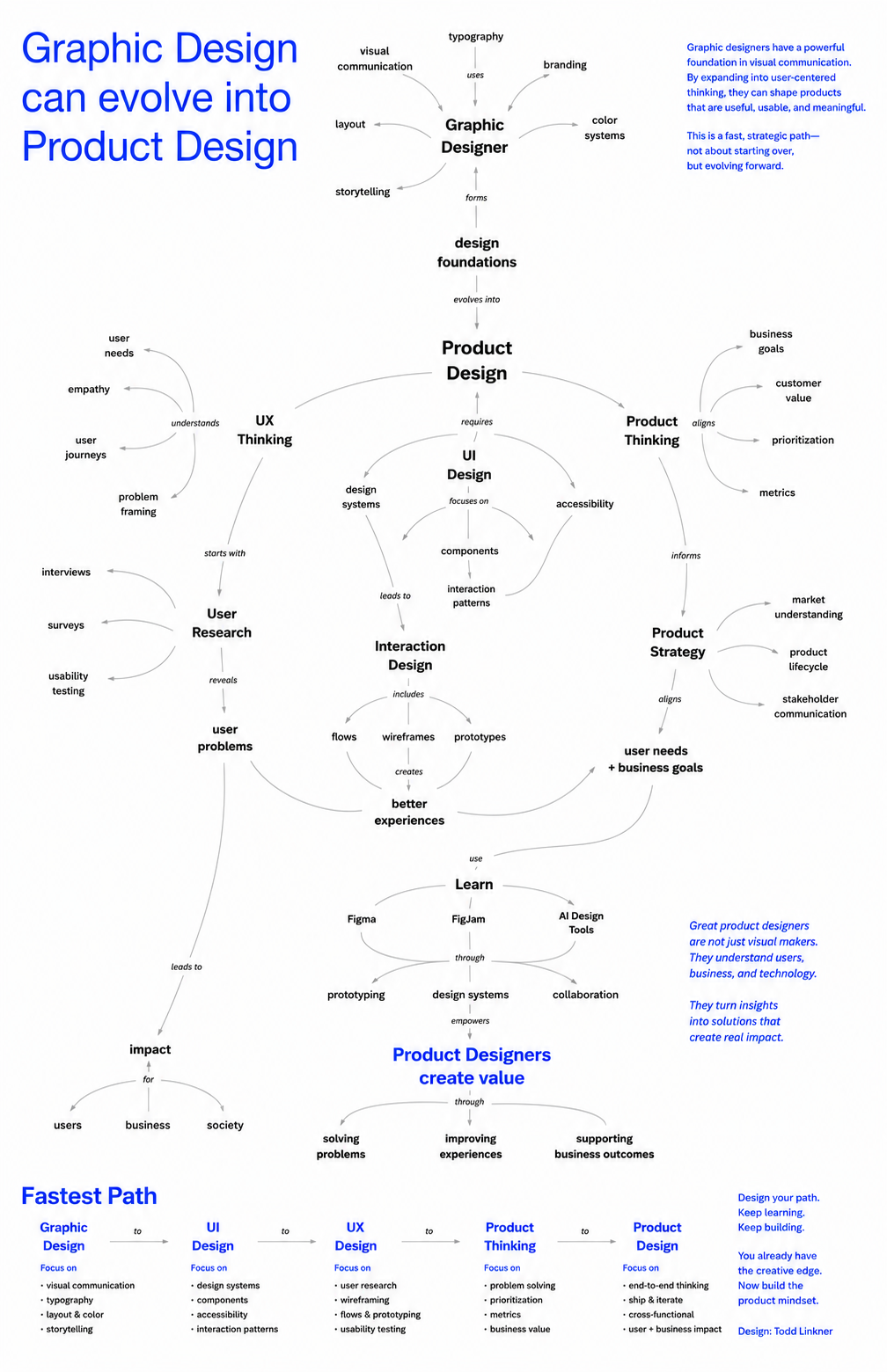
A graphic designer typically brings strong visual communication skills, typography knowledge, layout design experience, branding expertise, and proficiency with tools such as Adobe Creative Suite and Figma. These skills translate directly into UI design and visual design components of product design.
However, many graphic designers have limited exposure to user research, interaction design, usability testing, information architecture, and product strategy. Product designers are expected to solve business and user problems, not simply create visually appealing interfaces.
For most graphic designers, the transition is highly realistic because approximately 60-70% of the visual design skillset is already transferable.
Skills Gap Analysis
The biggest difference between Graphic Design and Product Design is the shift from visual communication to user-centered problem solving.
AI Skills That Create a Competitive Advantage
In 2026, product designers are increasingly expected to understand AI-assisted workflows. Learning tools such as ChatGPT, Claude, Cursor, Lovable, and Figma AI can significantly improve productivity.
Designers who understand AI-powered user experiences, prompt design, and AI prototyping often stand out from traditional applicants.
Preparation Roadmap
The most successful transitions happen when graphic designers stop thinking like visual creators and start thinking like product problem-solvers.
Rather than taking dozens of courses, focus on building a portfolio that demonstrates your ability to identify user problems and create effective solutions.
Start by learning UX fundamentals, including user research, wireframing, user flows, and usability testing. Then move into interaction design and advanced Figma prototyping.
A practical approach is redesigning existing products. For example, choose a food delivery app, banking platform, or travel booking website and document the entire redesign process from problem identification to final solution.
Employers are often more interested in your thinking process than your final visual design.
Portfolio Strategy
Most graphic designers make the mistake of showcasing only polished UI screens.
Product Design hiring managers want to see how you think.
A strong portfolio should include:
- Problem statement
- User research
- User personas
- User journey mapping
- Wireframes
- Design iterations
- Interactive prototype
- Final solution
- Key outcomes and lessons learned
Aim to create three complete case studies before applying for jobs.
One strong case study is worth more than ten beautiful mockups.
Learning Timeline
The timeline depends on your current experience level and available study time.
Example Fast-Track Plan
Month 1 focuses on UX fundamentals and Figma.
Month 2 introduces user research, wireframing, and interaction design.
Month 3 centers on portfolio project creation.
Months 4-6 are dedicated to advanced case studies, networking, and job applications.
Common Challenges and How to Overcome Them
One of the most frustrating moments for graphic designers is realizing that visual skills alone are not enough.
Many candidates struggle because they create beautiful interfaces without demonstrating research or strategic thinking.
Another common challenge is competing against candidates who already hold UX or Product Design titles.
The solution is to position yourself as a designer who combines strong visual execution with user-centered problem-solving.
Employers often value visual excellence because many product teams lack strong UI design skills.
Imposter syndrome is also common during the transition. Remember that most successful product designers came from adjacent fields such as graphic design, web design, marketing, architecture, or front-end development.
Lowest-Cost Transition Pathway
You do not need an expensive bootcamp to become a product designer.
A budget-friendly route could include:
- Figma (Free)
- Google UX Design Certificate
- Coursera UX Courses
- YouTube UX Tutorials
- Nielsen Norman Group Articles
- UX Collective Blog
- Self-Directed Portfolio Projects
A motivated designer can realistically make the transition for under $300 USD.
Budget Breakdown
The professional route typically includes structured courses, mentorship, portfolio reviews, and networking events.
Job Market Outlook
Product Design remains one of the strongest design careers globally.
Demand is particularly strong in SaaS, fintech, healthtech, AI products, and e-commerce companies.
Typical salary ranges:
Over the next five years, AI will automate repetitive design tasks but increase demand for designers who can solve complex user problems and design AI-powered experiences.
Study Abroad Pathway
For designers interested in studying overseas, countries such as Australia, New Zealand, Canada, and the UK offer strong UX and Product Design programs.
Many graduates use these programs as a pathway into local technology industries and eventually secure long-term work visas or residency opportunities.
For international students, Product Design often provides a stronger return on investment than traditional graphic design because of higher salaries and broader career opportunities.
12-Month Action Plan
First 30 Days
Learn UX fundamentals and Figma prototyping.
First 90 Days
Complete your first end-to-end product redesign case study.
First 6 Months
Build three portfolio projects and begin networking with product designers.
First Year
Apply for Product Designer, UX Designer, and UI/UX Designer roles while continuously improving your portfolio.
Key Takeaways
Transitioning from Graphic Designer to Product Designer is one of the most achievable and rewarding career moves in the design industry. Your visual design foundation already gives you a significant advantage. By learning UX principles, product thinking, user research, and AI-powered design workflows, you can realistically move into Product Design within 6–12 months and significantly increase your career opportunities and earning potential.
FAQ
Is Graphic Design a good background for Product Design?
Yes. Graphic designers already possess many transferable visual design skills that product teams value.
Do I need a degree in UX Design?
No. Most employers prioritize portfolio quality and problem-solving ability over formal qualifications.
Can I become a Product Designer in 6 months?
Yes, especially if you already have professional graphic design experience and can dedicate 15–30 hours per week to learning and portfolio building.
What is the fastest way to become a Product Designer?
Build practical portfolio case studies, learn Figma deeply, understand UX fundamentals, and network with professionals already working in product teams.