

TL;DR:
- New Zealand offers a stable, lifestyle-focused work environment with flat hierarchies and a tight-knit professional community.
- Salaries are 20 to 40 percent lower than in Australia, the US, and UK, but cost of living and quality of life compensate.
- Strong immigration pathways and recognition of high-demand skills make career opportunities accessible despite market size limitations.
Despite earning 20 to 40 per cent less than their counterparts in Australia or the United States, thousands of Asia-Pacific professionals continue to choose New Zealand every year. That fact alone should prompt a more careful look. New Zealand’s professional appeal is not simply about salary bands or visa points. It sits in the intersection of policy stability, liveable cities, a different kind of work culture, and a lifestyle that is genuinely hard to replicate elsewhere. This guide cuts through the noise to give you an honest, structured picture of what a career in New Zealand actually looks like from the ground up.
Table of Contents
- What makes New Zealand unique for professional careers
- Comparing career opportunities: New Zealand vs Australia, US and UK
- Policy stability and skill recognition: How immigration rules shape opportunity
- Lifestyle trade-offs: Beyond money and status
- The uncomfortable truth about Kiwi careers: What most guides overlook
- Connect with expert advisors for your New Zealand journey
- Frequently asked questions
Key Takeaways
| Point | Details |
|---|---|
| Salary trade-off | New Zealand offers lower salaries than Australia, US and UK, but may compensate with lifestyle and work-life balance. |
| Skill-based immigration | Skilled migrants have clear pathways, but must research whether their profession is supported. |
| Comparison matters | Career opportunities differ sharply by industry and region, so comparing is essential for informed choices. |
| Lifestyle advantage | New Zealand delivers personal and environmental benefits that appeal to many professionals beyond just pay. |
| Expert guidance | Consulting advisors and migration specialists can streamline your relocation and ensure you maximise opportunities. |
What makes New Zealand unique for professional careers
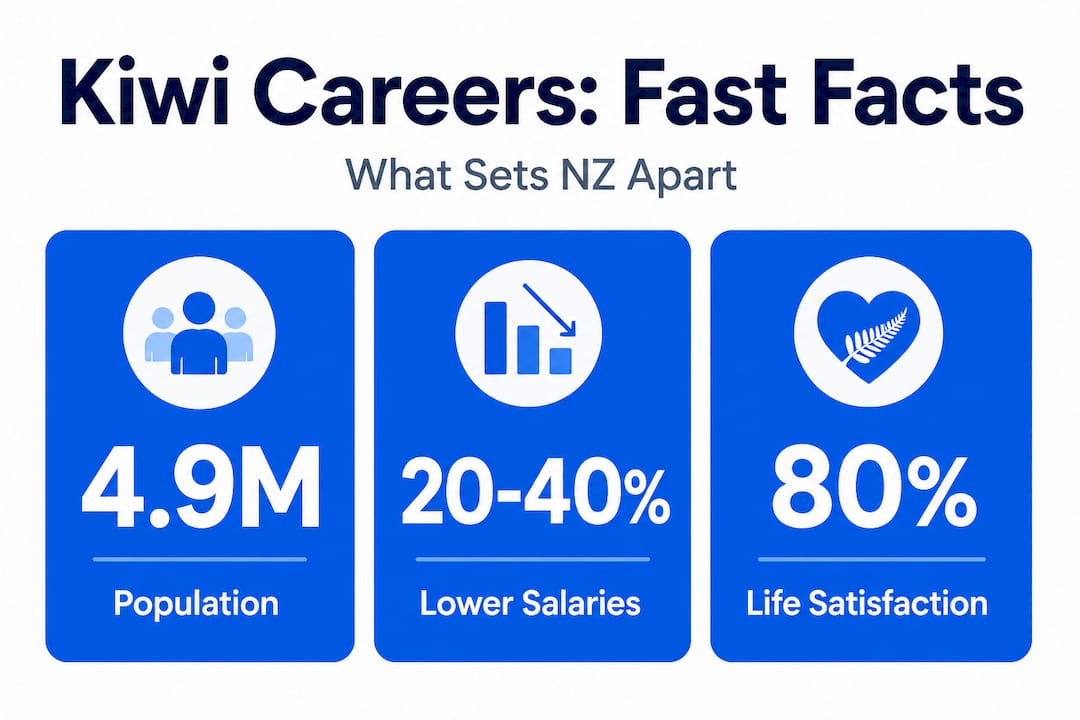
New Zealand is a small country with a population just under five million. That scale shapes everything about how professional life works here. Workplaces tend to be flat in structure, meaning fewer layers of management and more direct access to decision makers. For professionals coming from large corporate environments in Singapore, Taiwan, or Hong Kong, this can feel either refreshingly direct or surprisingly limiting, depending on what you are optimising for.
The New Zealand jobs and living guide at BRIGENAI consistently highlights this duality. Professionals who relocate for career reasons often cite the tight-knit professional community as a genuine advantage. It is easier to build a reputation quickly. Networking happens in person, relationships deepen faster, and your work tends to be visible in ways that can take years in a larger market.
That said, the numbers require honesty. Average salaries in New Zealand across most industries sit well below comparable roles in Australia, the United Kingdom, and the United States. Research shows that salaries run 20 to 40% lower than those destinations, and talent outflow to Australia remains a persistent challenge for local employers. This is not a secret. New Zealand employers are actively rethinking their hiring and retention strategies to stay competitive.
Here is what professionals consistently report as standout features of the Kiwi career landscape:
- Work-life balance that is culturally embedded, not just a marketing line
- Flat workplace hierarchies that reward contribution over seniority
- Strong outdoors and wellness culture that feeds into daily working life
- Genuine multicultural acceptance, particularly in Auckland and Wellington
- Proximity to Australia as a natural career progression route if needed
Pro Tip: Before committing to a move, research your specific industry in detail. Technology, healthcare, engineering, and construction currently show stronger demand than finance or media, and the salary gaps between these sectors are significant.
Comparing career opportunities: New Zealand vs Australia, US and UK
Having considered New Zealand’s unique professional landscape, let’s compare directly against other popular destinations for Asia-Pacific professionals. The salary gap is real, but context matters enormously.
| Industry | New Zealand (NZD) | Australia (AUD) | United Kingdom (GBP) | United States (USD) |
|---|---|---|---|---|
| Software engineer | $85,000 to $130,000 | $110,000 to $170,000 | £55,000 to £90,000 | $120,000 to $200,000 |
| Registered nurse | $65,000 to $90,000 | $75,000 to $105,000 | £32,000 to £50,000 | $70,000 to $110,000 |
| Civil engineer | $75,000 to $115,000 | $100,000 to $145,000 | £45,000 to £75,000 | $85,000 to $140,000 |
| Secondary teacher | $55,000 to $90,000 | $70,000 to $105,000 | £30,000 to £50,000 | $50,000 to $80,000 |
| Accountant | $65,000 to $100,000 | $80,000 to $130,000 | £40,000 to £70,000 | $75,000 to $130,000 |
The raw figures tell one story. But cost of living, tax rates, housing markets, and career trajectory tell another. New Zealand’s income tax system is relatively straightforward, and Auckland’s cost of living, while high, is still below Sydney or London when housing costs are adjusted for typical wages.
What the moving to New Zealand comparison data at BRIGENAI highlights is that the talent churn dynamic matters for your own career planning. When skilled workers leave New Zealand for Australia, it creates gaps that employers struggle to fill. This means that professionals who stay and build local expertise can move quickly into senior roles, sometimes faster than they would in a larger, more competitive market.
“New Zealand’s small job market limits career advancement and salaries are notably lower than Australia, the US, and the UK. Talent outflow to Australia continues to shape the local hiring landscape in meaningful ways.”
The New Zealand salary breakdown by role and region is worth studying closely before you make any firm decisions. Wellington, for instance, tends to offer stronger public sector and technology salaries, while Auckland leads in finance, logistics, and professional services.
Key points to weigh up before making your comparison:
- Cost-adjusted salary is more meaningful than gross figures alone
- Career progression speed can be faster due to smaller talent pools
- Industry demand signals matter more in a small market than credentials alone
- Proximity to Australia means career optionality is genuinely accessible
Policy stability and skill recognition: How immigration rules shape opportunity
Now that we have compared options, we’ll explore how New Zealand’s stable policies and skills pathways shape the career experience for migrants. This is where New Zealand distinguishes itself in ways that go beyond salary comparisons.
New Zealand operates one of the most structured skills-based immigration systems in the Asia-Pacific region. The framework prioritises occupation-specific pathways, with the Green List careers system offering streamlined residence for professionals in high-demand roles. This is not a lottery or a points-only system. It is built around genuine labour market needs, which means that if your skills are in demand, your pathway is clearer.
Here are the key steps to navigate a skill-based migration to New Zealand effectively:
- Confirm your occupation against the current Green List or Skilled Migrant Category requirements
- Assess credential recognition through the relevant New Zealand professional body for your field
- Secure a job offer where possible, as this significantly strengthens your application
- Apply for an Accredited Employer Work Visa (AEWV) as the most common route for skilled professionals
- Build towards residence through the Skilled Migrant Category or Green List Straight to Residence pathway
- Register with professional bodies such as Engineering New Zealand, the Nursing Council, or the New Zealand Law Society
The framework is stable and reasonably predictable, which is genuinely valuable when you are planning a multi-year career move. That said, the New Zealand Treasury has raised important questions about the long-term returns on public investment in skills. The Treasury Working Paper on emigration flags that emigration churn, where trained professionals leave for higher-paying markets, reduces the return on public investment in education and workforce development.
This matters for you as a migrant professional in a specific way. It signals that New Zealand values skilled retention and is investing in policies designed to keep talented people in the country. It also means that employers, particularly in the public sector, are increasingly motivated to offer non-salary incentives like flexible work, professional development funding, and structured mentorship.
| Immigration pathway | Best suited for | Timeline to residence |
|---|---|---|
| Green List Straight to Residence | Tier 1 listed occupations | Direct, no work visa needed |
| Green List Work to Residence | Tier 2 listed occupations | 24 months |
| Skilled Migrant Category | Broad skilled professionals | Varies, typically 12 to 24 months |
| Accredited Employer Work Visa | Most skilled workers with job offer | 3 to 5 years pathway |
Pro Tip: Check your Green List job definitions early in your planning process, well before you apply for any visa. Occupation titles matter and small variations in how your role is described can affect your eligibility significantly.
Lifestyle trade-offs: Beyond money and status
After clarifying policy and career structure, let’s look at daily life, what living and working in New Zealand really feels like for newcomers from the Asia-Pacific region.

The lifestyle case for New Zealand is genuinely strong, and it is not the soft argument that career-focused professionals sometimes dismiss. Research consistently shows that talent outflow accelerates when professionals feel undervalued, but the reverse is also true. Professionals who find a community, a pace of life, and a physical environment that suits them tend to stay longer and build deeper careers.
Lifestyle benefits commonly reported by migrants:
- Stunning natural environment within easy reach of every major city
- Shorter commutes and less congestion compared to Singapore, Hong Kong, or Tokyo
- Strong public education system for families with children
- Excellent cost of living relative to lifestyle quality, especially outside Auckland
- Safety, low crime rates, and political stability
Honest challenges to plan for:
- Geographic isolation from family in Asia can weigh heavily over time
- Status and career prestige carry less weight culturally, which some professionals find jarring
- Community integration takes deliberate effort, especially outside diverse urban centres
- Entertainment, dining, and cultural events are limited compared to major Asian cities
- Housing affordability in Auckland remains a genuine pressure
The New Zealand workplace culture is notably different from most Asian corporate environments. Kiwi colleagues tend to separate professional and personal spheres with more ease, which can feel warm at times and distant at others. The key is recognising that integration requires active participation in social and community life, not just professional networks.
Pro Tip: Before prioritising career advancement, spend real time defining what your personal non-negotiables are. Professionals who move to New Zealand specifically for lifestyle and then find career fulfilment tend to report far higher satisfaction than those who move purely for career reasons and find themselves missing the pace and prestige of larger markets.
The uncomfortable truth about Kiwi careers: What most guides overlook
Most career guides about New Zealand focus on the visa steps or the salary comparisons. Very few address the deeper question: what does career sustainability actually look like in a small, geographically isolated market?
Here is what professionals who have spent five or more years in New Zealand consistently report. The early years are often energising. The flat structures, the manageable pace, and the sense of space, both physical and professional, feel genuinely rewarding. But somewhere around year three or four, a specific challenge emerges. The ceiling becomes visible. In a market of under five million people, the number of senior roles in any given industry is genuinely small. The next step up might require waiting for someone to retire, relocating to Wellington or Christchurch, or crossing the Tasman to Australia.
The New Zealand Treasury’s public investment research makes this tension explicit. The returns to skills in New Zealand are lower than in comparable economies, and emigration churn represents a real fiscal cost. This is not pessimism. It is a systemic reality that shapes the career mathematics for anyone staying long-term.
What this means practically is that career satisfaction in New Zealand is most durable when it is built on more than financial return. The professionals we hear from most consistently are those who have built local reputations, contributed to their communities, and developed industries rather than simply joining them. That takes time and intention.
The underreported reality is that New Zealand rewards professionals who build careers in immigration, healthcare, construction, and infrastructure far more generously than it rewards those chasing prestige titles in finance or media. The market signals clearly which skills it needs. Professionals who align with those signals, rather than fighting them, tend to find both financial and personal satisfaction.
“The returns to skills investment in New Zealand are shaped significantly by emigration patterns. Retention strategies and non-salary incentives are increasingly central to how employers compete.”
The uncomfortable truth is this: New Zealand will not outbid Australia or the US for your talent. It will offer you something else entirely, a place where your work is visible, your impact is tangible, and your life outside work is genuinely worth living. Whether that trade is right for you depends entirely on knowing yourself well enough to answer it honestly.
Connect with expert advisors for your New Zealand journey
Planning a career move to New Zealand involves far more than reading articles. The gap between knowing the facts and making a confident, well-timed decision is where most professionals get stuck.

BRIGENAI’s network of vetted advisors includes career counsellors, migration specialists, and professionals who have personally navigated the New Zealand pathway from Asia-Pacific countries. Whether you need help assessing your visa options, benchmarking your salary expectations, or understanding how your credentials translate to the Kiwi market, the platform connects you with people who have done it. Explore the full range of relocation services to see what fits your stage of planning. Book a session with international career advisors who specialise in the New Zealand market, or get specific support through visa assistance for your pathway. Your next step is a real conversation, not another search.
Frequently asked questions
Are salaries in New Zealand really lower than in Australia or the US?
Yes, research consistently shows that New Zealand salaries run 20 to 40 per cent lower than comparable roles in Australia, the US, and the UK, though lower cost of living and lifestyle quality partially offset this gap for many professionals.
Does New Zealand have special skilled migration pathways?
Yes, New Zealand offers structured skill-based immigration routes including the Green List Straight to Residence pathway, the Skilled Migrant Category, and the Accredited Employer Work Visa, all designed to prioritise professionals in high-demand occupations.
Is career advancement harder for migrants in New Zealand?
The small job market does limit the number of senior roles available in most industries, but policy stability, flat workplace structures, and strong skill recognition mean that motivated professionals can progress more visibly than in larger, more competitive markets.
What are the main non-financial benefits of working in New Zealand?
The most consistently cited advantages include outstanding work-life balance, a safe and politically stable environment, access to stunning natural landscapes, shorter commutes, and a welcoming professional culture that tends to reward contribution over credentials.