

TL;DR:
- Over 77% of APAC employers struggle to fill roles due to outdated skills despite regional talent. Upskilling enhances employability, visa prospects, and earnings for professionals seeking international opportunities. Inaction risks missing opportunities and falling behind in a rapidly evolving global job market.
Over 77% of APAC employers struggle to fill roles even as thousands of qualified professionals from across the region actively chase overseas opportunities. That gap is not about a shortage of people. It is about a shortage of people with the right, up-to-date skills. If you are planning a career move abroad and assume your existing qualifications will carry you through, the data suggests you should think again. Upskilling is no longer a nice-to-have edge over other candidates. It is the single most reliable way to align yourself with what international employers actually need, and what migration systems require of you before you even step off the plane.
Table of Contents
- What does upskilling mean for overseas jobs?
- The real benefits: How upskilling boosts your overseas potential
- Brain drain or brain gain? Upskilling’s wider impact
- How to start your upskilling journey today
- Why doing nothing is riskier: The overlooked cost of not upskilling
- Ready to accelerate your overseas career?
- Frequently asked questions
Key Takeaways
| Point | Details |
|---|---|
| Upskilling meets global demand | Upgrading your skills directly addresses urgent gaps in technology and digital industries abroad. |
| Better migration outcomes | Professionals who upskill are more likely to secure skilled jobs, higher salaries, and visa recognition overseas. |
| Brain gain, not drain | More people upskill for migration than actually leave, leading to long-term local benefits. |
| Action beats hesitation | Delaying upskilling can limit your opportunities—starting small has compounding benefits for your career. |
What does upskilling mean for overseas jobs?
Upskilling, at its core, means deliberately acquiring new competencies that go beyond what you already know. Not just refreshing old knowledge, but genuinely expanding what you can do. For professionals eyeing an international move, this distinction matters enormously. Global employers are not simply searching for experience. They are searching for current, demonstrable capability in areas that are moving fast.
Technology is accelerating the pace at which skills become outdated. A data analyst who learned their craft five years ago may find that employers in Singapore or Australia now expect familiarity with machine learning pipelines, cloud platforms, or AI-assisted analytics tools that simply did not exist at scale back then. The same applies across engineering, cybersecurity, healthcare technology, and digital marketing. Your credentials get you in the door. Your current skills determine whether you get the offer.
The areas generating the most demand overseas are well documented. Upskilling addresses critical skills gaps in high-demand disciplines including:
- Artificial intelligence and machine learning (see AI and machine learning roles for current vacancies)
- Data science and analytics (including data roles abroad with visa sponsorship)
- Cybersecurity and network infrastructure
- Cloud computing and DevOps
- Digital skills across marketing, finance, and operations
- Healthcare technology and digital health management
These are not niche categories. They represent the backbone of economic growth in Australia, New Zealand, Singapore, and across the broader APAC region.
“96% of APAC employers prioritise upskilling as a strategic response to technology change and geoeconomic uncertainty, compared to 85% globally.”
— World Economic Forum, 2025
That eleven-point gap between APAC and global averages is telling. Employers in this region are under acute pressure to modernise quickly, and they are actively looking for candidates who have kept pace. If you have, your application stands out immediately.
The real benefits: How upskilling boosts your overseas potential
Having defined upskilling, it is time to see what it actually accomplishes for your global prospects. The conversation moves from theory to hard outcomes when you examine real migration data.

The evidence from Australia’s Department of Home Affairs cohort analysis is striking. Upskilled skilled migrants achieve better employment outcomes, including higher earnings and access to skilled job categories post-arrival, compared to those who migrated without updating their credentials beforehand. Median full-time earnings for this group increased significantly after upskilling, often exceeding $10,000 above baseline comparisons.
| Outcome | Upskilled migrants | Non-upskilled migrants |
|---|---|---|
| Employment in skilled roles | High | Moderate to low |
| Median annual earnings | Above average | Below average |
| Time to first skilled job | Shorter | Longer |
| Credential recognition rate | Higher | Lower |
| Long-term career progression | Stronger | Slower |
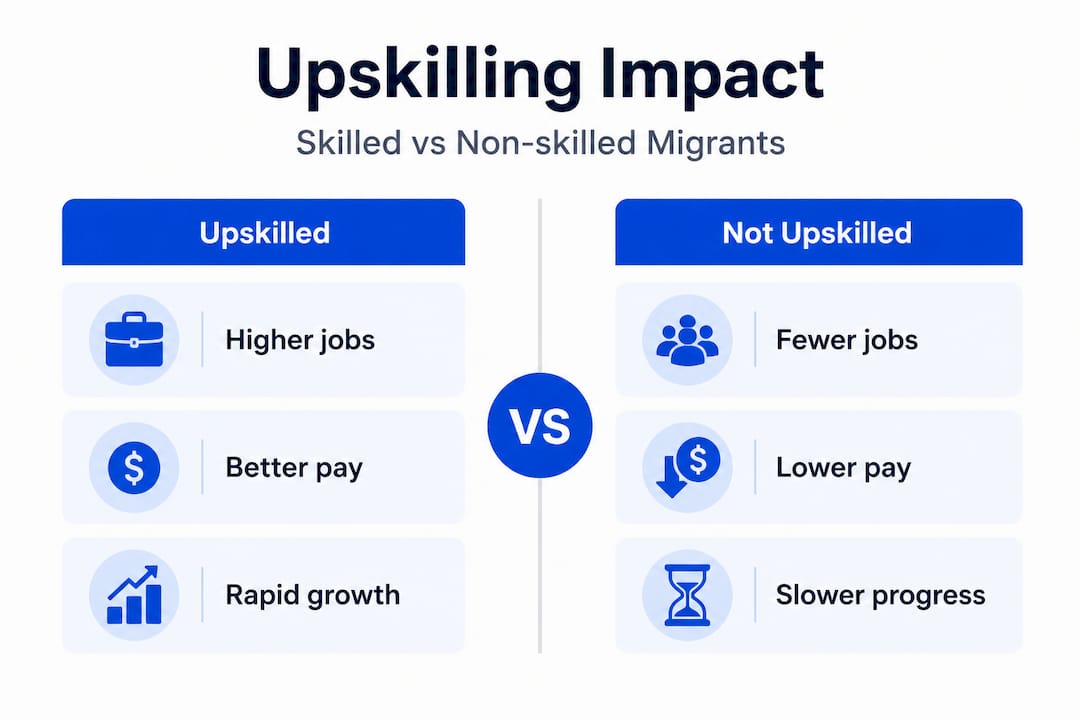
Beyond earnings, upskilling directly affects how your qualifications are assessed when you apply for a skilled visa. Most destination countries use occupation lists and points-based systems that reward recent, relevant skills. Upskilling boosts competitiveness for skilled migration by aligning your qualifications with international standards, which improves both recognition and your practical employability from day one.
Here is a straightforward sequence that upskilled candidates tend to follow when pursuing international success:
- Conduct a skills gap audit by comparing your current qualifications to the occupation requirements listed in your target country’s skills shortage list.
- Select targeted courses or certifications that fill the specific gaps, prioritising those with global recognition (AWS, Google, Microsoft, PMI, and similar bodies).
- Document and credential your learning formally, so assessors and employers can verify it.
- Have your qualifications assessed through the relevant authority in your destination country before you apply.
- Update your professional profile across LinkedIn and destination-specific job platforms to reflect your new capabilities.
- Apply for roles that list visa sponsorship and demonstrate skills alignment clearly in your application materials.
This is also where reading about comparing overseas career pathways pays off. What gets you into Australia differs from what opens doors in Singapore, and the specific occupation demands for engineering jobs overseas differ again from those in software or data.
Pro Tip: Before you enrol in any course, map your skills to the shortage occupation list (or equivalent) in your target country. Upskilling in an area that is not on that list may not improve your visa score at all, even if the skill is genuinely valuable in a general sense.
Brain drain or brain gain? Upskilling’s wider impact
While upskilling brings immense individual rewards, some worry about brain drain fuelling talent loss from sending countries. The concern is understandable. If the Philippines or India trains thousands of skilled professionals who then move to Australia or Canada, does the home country simply lose that investment?
The data tells a more nuanced and ultimately optimistic story. Migration opportunities incentivise upskilling, and the result is a net brain gain. More people train and acquire advanced skills than actually emigrate, which means the overall skill level of the domestic workforce rises even when some of those people eventually leave.
| Country | Professionals upskilled annually | Those who emigrate | Domestic net gain |
|---|---|---|---|
| Philippines | Large-scale | Significant but smaller | Positive |
| India | Very large-scale | Large but proportionally smaller | Strongly positive |
| Vietnam | Growing rapidly | Modest | Positive |
| Indonesia | Expanding | Small | Clearly positive |
The empirical evidence favours brain gain when you factor in increased education investment, remittances sent home, and the substantial proportion of migrants who eventually return with new networks, capital, and expertise. Return migration alone is an underrated economic force. A software engineer who spends five years in Singapore and then comes home brings back both savings and direct experience of international development practices.
The individual and collective benefits include:
- Higher remittance flows that support families and communities in home countries
- Knowledge transfer when professionals return with international exposure
- A larger pool of skilled workers in the domestic labour market, since most who upskill do not emigrate
- Foreign direct investment generated by diaspora networks
- Improved international reputation for a country’s workforce quality, making it more attractive to global companies
For individuals exploring software engineering jobs or marketing opportunities overseas, this context matters. You are not abandoning your home country by pursuing international credentials. You are participating in a cycle that benefits multiple economies simultaneously.
“Empirical studies consistently show that the prospect of migration encourages more people to invest in education and training than ultimately leave, creating a net skill surplus in origin countries.”
— SSRN Working Paper on Brain Drain vs Brain Gain
How to start your upskilling journey today
It is clear upskilling is both powerful and sustainable. The question shifts from “why” to “how.” Getting started is simpler than most professionals expect, provided you follow a structured path rather than grabbing at whatever course appears in your social media feed.
Skills requirements are evolving faster than most people realise. The projected 70% change in core skills by 2030 means that what qualifies as current today will be partially obsolete in just a few years. Continuous learning is no longer a personal preference. It is a professional survival strategy.
Here is a practical roadmap to launch your upskilling journey with clarity:
- Run a personal skills audit. List every technical and soft skill you currently have. Be specific. “Good with Excel” is not a skill description. “Proficient in data modelling using Excel Power Query” is.
- Research destination requirements. Look up the skilled occupation list for Australia, the Employment Pass criteria for Singapore, or the equivalent for your chosen destination. Identify exactly what skills and credentials the system rewards.
- Identify the gaps. Match your audit to the destination requirements and find where you fall short. Three to five targeted areas is manageable. Trying to fix everything at once is not.
- Choose globally recognised courses. Platforms like Coursera, edX, and LinkedIn Learning offer certifications from reputable institutions. Vendor certifications from AWS, Google Cloud, Microsoft Azure, and Cisco carry weight with international employers and assessors alike.
- Credential your skills formally. Completing a course matters less than having verifiable proof. Pursue formal certification wherever possible, not just course completion badges.
- Track the landscape in your target field. Browse tech and data job categories regularly to see which specific tools and platforms employers are listing in their requirements. This keeps your upskilling relevant rather than theoretical.
- Build evidence of your skills. Contribute to open-source projects, build a portfolio, write case studies, or take on freelance work that demonstrates your new capabilities in a real-world context.
The learning itself does not have to be full-time. Many professionals in the APAC region successfully complete internationally recognised certifications in six to twelve months while working full-time, by allocating just one to two hours per day consistently.
Pro Tip: Prioritise flexible, globally recognised qualifications over locally specific ones. A certification from a major global vendor or institution travels with you. A qualification that is only understood in one country may need to be reassessed every time you change destinations, adding cost and delay to your move.
Why doing nothing is riskier: The overlooked cost of not upskilling
You now know the evidence and have a practical roadmap. So why do so many qualified professionals still hesitate? In our experience working with professionals navigating international career moves across the APAC region, the most common reason is a belief that their current credentials are “good enough” to get them started, and they can upskill later once they arrive.
This thinking is seductive but genuinely dangerous. The job market in destination countries like Australia and Singapore is not pausing while you plan. Competition for AI job market insights and high-demand roles is intensifying month by month. Employers in these markets receive applications from candidates who have already upskilled, already hold relevant certifications, and already meet the visa criteria outright. Waiting to upskill until you have “made the move” often means you land in a competitive market less equipped than candidates who prepared before they arrived.
The hidden cost of stagnation is real. A missed application window, a failed skills assessment, or a year spent in a role below your actual capability level because your qualifications did not align on arrival. These are not hypothetical inconveniences. They are common outcomes for professionals who assumed upskilling could wait.
What we have seen work consistently is starting small and building incrementally. A single recognised certification completed before you lodge a visa application can shift your points score meaningfully. One targeted upskilling step taken now compounds into a significantly stronger position six months from now. The professionals who navigate international career moves successfully are almost never the ones who waited for the perfect moment. They are the ones who started earlier than felt strictly necessary.
“The greatest risk is not adapting at all.”
That is not a motivational platitude. In a job market where skills requirements shift at the pace we are currently seeing, inaction is itself a strategic decision, and a costly one.
Ready to accelerate your overseas career?
If you are serious about making an international career move, upskilling is only one piece of the puzzle. Understanding which destination suits your goals, navigating visa pathways, and connecting with roles that actively support relocation are equally critical steps.

BRIGENAI brings all of these elements together in one place. Through our relocation services, destination comparison tools, and daily-updated job board, you can identify exactly where your upskilled profile fits best. Our network of vetted overseas career advisors includes professionals who have made the same moves you are planning, and who can give you specific, grounded guidance rather than generic information. Explore our visa resources to understand how your qualifications map to skilled migration pathways across Australia, New Zealand, Singapore, and beyond. Your next move deserves a proper plan.
Frequently asked questions
Which skills are most in demand for overseas jobs?
Digital, data, AI, cybersecurity, and advanced technical skills are most sought after internationally, with critical skills gaps in these areas driving employer demand across the APAC region and beyond.
How does upskilling affect my visa eligibility?
Upskilling can help you meet the occupation and skills requirements that points-based visa systems reward, directly improving your chances of approval. Aligning qualifications with international standards through recognised certifications often makes the difference between a successful skills assessment and a failed one.
Will upskilling guarantee a higher salary overseas?
No upskilling path comes with guarantees, but upskilled skilled migrants consistently access higher-paying, more senior roles, and data from Australia shows median full-time earnings increased by approximately $10,000 for this group compared to those who did not upskill before arrival.
What if many professionals upskill and leave the country?
Research consistently shows that more professionals acquire skills than emigrate, producing a net brain gain for home countries through increased domestic skill levels, remittances, and eventual return migration.