

TL;DR:
- Landing a job overseas for Asia-Pacific professionals is accessible through visa sponsorship programs and strategic migration paths. Understanding destination tiers, employer requirements, and risks like exploitation is essential for building a successful international career. Proper planning, early document preparation, and ongoing support significantly improve the chances of a safe and rewarding move abroad.
Landing a job overseas as a foreigner from the Asia-Pacific region is not the exclusive privilege of the highly connected or the already wealthy. That idea has kept too many skilled professionals stuck. The reality is that visa sponsorship programmes, skills shortages across multiple countries, and structured migration pathways have collectively opened the door to global careers for ordinary professionals, tradespeople, nurses, engineers, and graduates willing to plan strategically. This guide covers exactly how those pathways work, which destinations offer the best opportunities, what the real risks look like, and how to move through the process with your eyes fully open.
Table of Contents
- Understanding the overseas job landscape for foreigners
- Popular routes and destinations for Asia-Pacific professionals
- Securing a visa-sponsored job: How the process works
- Risks, realities, and how to protect yourself abroad
- Practical relocation: Cost, living, and ongoing support
- What most guides miss about finding overseas jobs
- Next steps: Let us help you land your global role
- Frequently asked questions
Key Takeaways
| Point | Details |
|---|---|
| Visa sponsorship matters | Visa-sponsored jobs are essential for foreigners seeking legitimate and stable roles overseas. |
| Stepwise migration works | Building experience in mid-tier markets first makes Western career moves more viable. |
| Know the risks | Systems like Kafala offer both pathways and dangers—research and due diligence are crucial. |
| Plan financially | Relocation costs go beyond flights and visas, requiring comprehensive pre-move budgeting. |
| Ongoing support is key | Success abroad depends on continued access to support, tools, and trustworthy employers. |
Understanding the overseas job landscape for foreigners
Before you begin browsing job boards, it helps to understand the foundational mechanics of working abroad. For most foreigners, particularly those from the Asia-Pacific region, the critical concept is visa sponsorship. Visa sponsorship means an employer in a foreign country formally endorses your application to work there, often lodging visa paperwork on your behalf and accepting legal responsibility for your employment. Without sponsorship, most countries will not issue you a work visa regardless of your qualifications.
The types of roles that attract sponsorship are broader than most people assume. They include:
- White collar roles: IT, finance, engineering, project management, data science
- Healthcare and education: Nursing, aged care, teaching, allied health
- Skilled trades: Electricians, plumbers, mechanics, construction workers
- Essential services: Hospitality, retail management, logistics, food production
One of the most useful frameworks for Asia-Pacific professionals planning their first international move is the concept of stepwise migration. Research shows that stepwise migration is common for low-capital workers from the Asia-Pacific, who often start in mid-tier destinations such as the Middle East or Southeast Asia to build savings and work experience before pursuing Western countries. This is not a compromise path. It is a strategic one.
“The international job market is not a single ladder. It is a web of pathways, and knowing where to enter that web determines how far and how fast you can travel through it.”
Understanding country tiers also gives you a realistic sense of timelines and requirements. Here is a simplified overview:
| Destination tier | Examples | Typical visa requirements | Income potential |
|---|---|---|---|
| Mid-tier Asia | Singapore, Hong Kong, Malaysia | Skills-based, employer-tied | Moderate to high |
| Middle East | UAE, Saudi Arabia, Qatar | Employer-sponsored (Kafala) | High, tax-free |
| Western countries | Australia, Canada, UK, US | Points-based or employer nomination | High, regulated |
Starting your international career in Asia-Pacific with a clear tier strategy avoids the trap of applying indiscriminately and getting nowhere. And if you need help comparing your actual options, the best career pathways for moving abroad resource is worth bookmarking early.

Popular routes and destinations for Asia-Pacific professionals
Choosing the right destination is arguably more important than perfecting your CV. The country you target shapes your visa pathway, your salary ceiling, your quality of life, and the legal protections you receive as a foreign worker.
Here is a practical comparison of the main destination clusters:
| Destination | Key sectors | Visa pathway | Key consideration |
|---|---|---|---|
| UAE / Saudi Arabia | Construction, engineering, hospitality | Employer sponsorship (Kafala) | Tax-free income, tied contracts |
| Singapore | Finance, tech, healthcare | Employment Pass, S-Pass | High cost of living, competitive |
| Australia | Healthcare, trades, tech | TSS 482, skilled migration | Strong worker rights, pathway to PR |
| Canada | IT, healthcare, trades | LMIA sponsorship | Long winters, strong settlement support |
| UK | Finance, healthcare, tech | Skilled Worker Visa | Higher cost of living, salary threshold |
| US | Tech, research, academia | H-1B lottery | Highly competitive, uncertain outcomes |
When choosing a destination, work through these steps in order:
- Assess language compatibility: English-language destinations reduce friction significantly, particularly in client-facing or senior roles.
- Match your skills to demand: Research labour shortages. Australia’s skilled occupations list is updated regularly and gives you a direct read on what roles attract sponsorship.
- Evaluate visa possibilities: Some countries, like Australia, offer multiple visa streams. Others have narrow employer-tied pathways with limited mobility.
- Calculate real cost of living: A Singapore salary that looks impressive can shrink fast when you account for housing, transport, and schooling.
- Consider long-term settlement potential: If permanent residency is your goal, some destinations offer clear pathways. Others, like the UAE, do not.
One destination-specific issue that every Asia-Pacific professional heading to the Gulf must understand is the Kafala system. The Kafala system in UAE and the broader Middle East ties foreign workers to individual sponsors, creating real benefits in terms of employment access, but also genuine risks of exploitation. Reforms are ongoing, but domestic workers and lower-skilled migrant workers remain largely outside those protections. Knowing this before you sign a contract is not optional. It is essential.
Statistic to note: The International Labour Organization estimates that approximately 169 million people globally are international migrant workers. A significant and growing proportion of cross-border movement within the Asia-Pacific region flows initially toward mid-tier destinations before redirecting westward, consistent with what the career pathways by destination research consistently shows.
Securing a visa-sponsored job: How the process works
Many professionals stall at this stage because the process feels opaque. It is not. It follows a clear sequence, and understanding each step makes the timeline manageable.
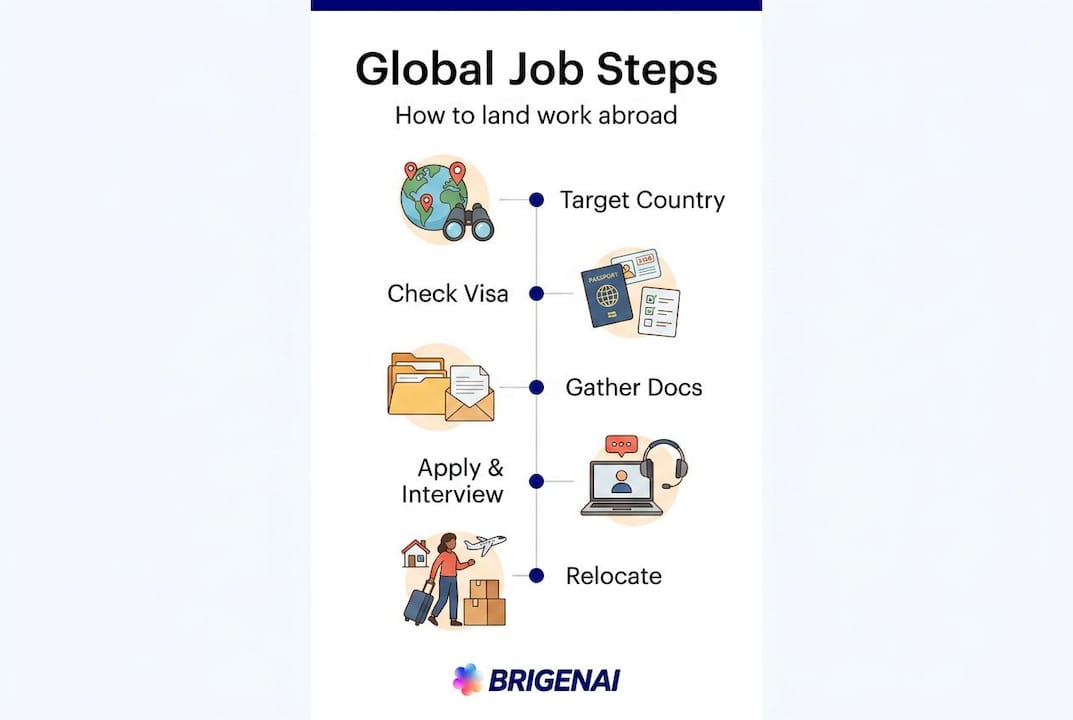
- Identify your target role and country: Be specific. “I want to work in IT in Australia” is far more actionable than “I want a job abroad.”
- Build a job-search strategy: Use international job boards, LinkedIn, professional associations, and platforms that curate sponsorship-eligible roles specifically.
- Tailor your application documents: Your CV format, cover letter style, and even how you present qualifications varies significantly by country. Australian CVs, for example, are shorter and more achievement-focused than many Asian formats.
- Screen employers for sponsorship willingness: Not every employer who likes your CV can or will sponsor a visa. Ask directly in early conversations whether the company holds a sponsor licence or is willing to apply for one.
- Receive a formal job offer: In most countries, a signed offer letter is required before the visa application can begin.
- Gather documentation: Typically includes police clearances, credential assessments, health checks, and employment history records. This stage takes longer than most people expect.
- Lodge the visa application: Either you or your employer lodges this, depending on the visa type and country. Processing times range from weeks to over a year.
- Prepare to relocate: Once the visa is granted, you typically have a window to enter the country and start work.
Realistic timelines matter here. For Australia’s Temporary Skill Shortage (TSS 482) visa, processing currently averages several months. UK Skilled Worker Visas are faster. US H-1B applications involve an annual lottery and can take years to resolve through the queue. Plan accordingly, and use the tools for expats available to track your requirements across each stage.
Pro Tip: Do not wait until you have a job offer to gather your documents. Police clearances, credential assessments, and certified translations can each take four to eight weeks. Start building your documentation folder the moment you begin your job search. Use the relocation checklist to track every item.
A note on stepwise migration: research confirms that starting in mid-tier countries helps workers accumulate the capital, international references, and professional credibility needed for Western visa applications. Two years of work experience in Singapore carries significantly more weight with an Australian employer than zero international experience. That is not a consolation. That is a competitive advantage.
Risks, realities, and how to protect yourself abroad
The overseas job market is full of genuine opportunity, and it also carries real risks that guides often gloss over. Knowing these risks does not make the journey harder. It makes it safer.
The most serious risks for foreign workers include:
- Tied contracts that restrict your ability to change jobs or leave the country without employer consent
- Passport confiscation by employers, which is illegal in most countries but still practised in some Gulf states
- Wage theft including unpaid overtime, withheld allowances, or salary reductions after arrival
- Recruitment fraud where agencies charge excessive fees for placements that do not materialise
- Legal restrictions on mobility under systems like the Kafala system, which limit workers’ options if an employer relationship turns hostile
Signs of an ethical employer include paying recruitment fees themselves (never passing them to the worker), providing written contracts before departure, being registered with relevant government bodies, and welcoming your questions about worker rights and dispute resolution processes.
“The cheapest visa path is rarely the safest one. The employer who offers to fast-track your paperwork for a fee is often the most dangerous one to trust.”
Practical protection steps:
- Register with your home country’s embassy upon arrival in a new country
- Keep certified copies of all your documents in a separate, secure location
- Understand the labour laws of your destination country, particularly around notice periods and dispute resolution
- Access relocation support services that include legal and immigration guidance before and after you arrive
Pro Tip: Before accepting any overseas offer, search the employer’s name alongside terms like “wage theft,” “visa fraud,” or “labour complaint” in both English and the local language. This two-minute check has saved workers from serious legal and financial hardship.
Practical relocation: Cost, living, and ongoing support
People routinely underestimate the cost of relocation and overestimate how quickly they will feel settled. Both miscalculations cause real stress in the first few months abroad.
True relocation costs to plan for include:
- Visa and application fees: These range from a few hundred to several thousand dollars depending on the visa type and country
- Credential assessment fees: Often required by Australian, Canadian, and UK authorities before your qualifications are recognised
- Flights and excess baggage: Particularly significant if you are relocating with family
- Initial accommodation deposit and rent: Most landlords require one to three months upfront in competitive markets
- Emergency fund: Three months of living expenses is the minimum; six months is significantly safer
- Health insurance: In countries without immediate access to public healthcare for new arrivals, private cover is not optional
Research shows that stepwise migration is in part a financial strategy. Professionals who spend time in lower-cost, higher-income destinations before relocating to expensive cities like Sydney or London arrive with far greater financial resilience.
Use the international relocation checklist to map your pre-departure tasks, and the compare cost of living tool to run the numbers on what your target salary actually covers after rent, transport, and food.
Ongoing support matters as much as pre-departure planning. Professional expat communities, employer-based onboarding programmes, and platforms that connect you with people who have already made your exact move are all underused resources. The first year abroad is the hardest. The people who thrive are almost always the ones who found their community early.
What most guides miss about finding overseas jobs
Most overseas job guides focus almost entirely on the search itself, as though getting the offer is the finish line. It is not even close to the finish line. It is the starting gun.
The real challenge for Asia-Pacific professionals is the long game: surviving the first year, building the right professional reputation in a foreign context, and navigating the legal, financial, and personal realities that come with being a foreign worker in someone else’s country. The job is the entry point. What happens after determines whether the move actually delivers on its promise.
The stepwise migration model challenges one of the most persistent myths in international career planning: that there is a single golden path from your home country to a Western career. There is not. Stepwise migration research is clear that many of the most successful international career moves happened through unconventional sequences, via Singapore or Dubai or Kuala Lumpur, rather than directly to London or Sydney. If your CV does not yet qualify you for a direct move to your dream destination, that is not a dead end. It is simply the current chapter.
The Kafala risks discussed earlier are real, but they do not define every Middle Eastern opportunity. Thousands of Asia-Pacific professionals have built significant savings and international credibility through Gulf postings, knowing the rules, taking precautions, and moving on when the time was right. Risk awareness is not the same as risk avoidance.
What we consistently see among professionals who build a global career successfully is that they treat their international move as an ongoing strategy, not a single decision. They adapt their plans as they gain experience, they build networks deliberately, and they invest in their own wellbeing and financial security as seriously as they invest in their job search.
Next steps: Let us help you land your global role
You now have a clearer picture of how overseas job markets actually work for Asia-Pacific professionals. The pathway is real, and it is more accessible than most people believe.

BRIGENAI exists to make every stage of this journey faster, safer, and better informed. Whether you are still comparing destinations, actively applying for roles, or already navigating life abroad, our tools are built for your exact situation. Start with the international relocation checklist to map your next 90 days, use our visa match tool to identify the pathways your qualifications open, or connect with vetted advisors through our relocation services hub to get guidance grounded in real experience.
Frequently asked questions
What are the most common sectors hiring foreigners with sponsorship?
IT, engineering, healthcare, education, hospitality, and skilled trades are among the sectors with the highest rates of visa sponsorship, though specific demand varies significantly by country and changes with local labour market conditions.
How can I avoid being exploited under tied visa systems?
Research employer reputation thoroughly, look for signs of ethical recruitment practices, and seek independent advice from expat support services or your home country’s embassy before signing any contract, particularly in countries operating the Kafala system where worker protections remain uneven.
Is stepwise migration a good career strategy for Asia-Pacific workers?
Yes, for many professionals it is the most practical route. Stepwise migration allows workers to build capital, international references, and employability in mid-tier markets before pursuing Western countries where qualification thresholds and cost of entry are higher.
What costs should I plan for when relocating for work?
At minimum, budget for visa and application fees, credential assessments, flights, initial accommodation deposits, and an emergency fund covering at least three to six months of living expenses in your destination country.
How long does it take to secure a visa-sponsored job offer?
The timeline varies considerably depending on your target country, visa type, employer, and role, but most professionals should allow several months from application to visa grant, with some pathways like the US H-1B taking considerably longer.