
Will AI Replace Junior Graphic Designers?
In large part, yes. Junior graphic design is one of the creative roles most affected by AI. It's rated High AI impact, with an AI Resilience Score of 38/100. (See how we rate AI risk.)
What AI Can Already Do
- Generate images and illustrations from a short text prompt.
- Create social media posts, banners and ads from brand templates.
- Resize and adapt one design into dozens of formats automatically.
- Remove backgrounds, retouch photos and suggest layouts instantly.
These are the tasks junior designers have traditionally done most. Many businesses now handle simple design work themselves with AI tools, and agencies need fewer juniors to produce the same volume.
What Still Needs a Person
- Creative direction: deciding what a brand should look and feel like.
- Understanding clients: turning vague briefs into designs that actually work.
- Judgment and taste: knowing which of 50 AI options is right, and why.
- Checking AI output: fixing errors, brand inconsistencies and legal risks.
Why Junior Graphic Designers Are at Risk
The biggest problem for junior designers is simple: almost everything they produce can now be generated on a screen. Here's why the role is so exposed.
Everything happens on a screen. A social post, a banner or a brochure layout is a digital file from start to finish. AI image tools now produce work of this kind in seconds. An electrician or nurse still has to show up in person; a junior designer's work never leaves the computer.
Most junior tasks follow a template. A typical week might mean adapting one campaign into 30 sizes, or applying the same fonts and colours to a new set of posts. This is exactly the kind of rule-based, repeatable work AI learns fastest.
The client can now do it alone. A café owner who once paid a freelancer for a menu or Instagram graphics can now make something "good enough" in Canva in ten minutes. That shift removes the small, cheap jobs that junior designers relied on to build experience.
Nothing legally requires a designer. No licence or sign-off is needed to publish a design, so there's no regulatory barrier slowing automation down, unlike in medicine, engineering or the trades.
What still protects designers is the work AI can't do well: understanding what a client really needs, making creative calls and taking responsibility for how a brand looks. That work sits at senior and art director level, which is why the risk is concentrated in junior roles.
What the Next 10 Years Look Like
In the next few years, expect fewer junior job ads and more competition for each role. Over ten years, design teams are likely to become smaller and more senior, with AI handling production and people focusing on strategy, concepts and quality control. Compare more secure options in our full list of careers AI can't replace.
What Do Junior Graphic Designers Do?
Junior graphic designers produce visual content under the direction of senior designers:
- Creating graphics for social media, websites, ads and print.
- Layout and typography for brochures, reports and presentations.
- Applying brand guidelines to keep designs consistent.
- Editing and resizing designs for different formats.
They work in design agencies, in-house marketing teams, publishers and as freelancers.
How Much Do Junior Graphic Designers Earn?
Junior graphic designers typically earn $38,000–$55,000 a year in the US. Pay depends on location, industry and portfolio quality, and in-house roles at larger companies often pay more than small agencies.
The usual progression is Junior Designer → Senior Designer → Art Director, and pay rises significantly at art director level. However, AI is making the first step harder: with fewer junior roles available, it takes longer to build the experience needed to move up.
Job Outlook for Junior Graphic Designers
US employment for graphic designers is projected to change by -1.7% by 2035, meaning slightly fewer jobs overall. Entry-level roles are likely to be hit hardest as AI tools take over routine production work. (See where our data comes from.)
Demand remains for designers who combine creativity with strategy, user experience, or motion and 3D skills. The strongest markets include the United States, the United Kingdom and Australia, though competition is high everywhere.
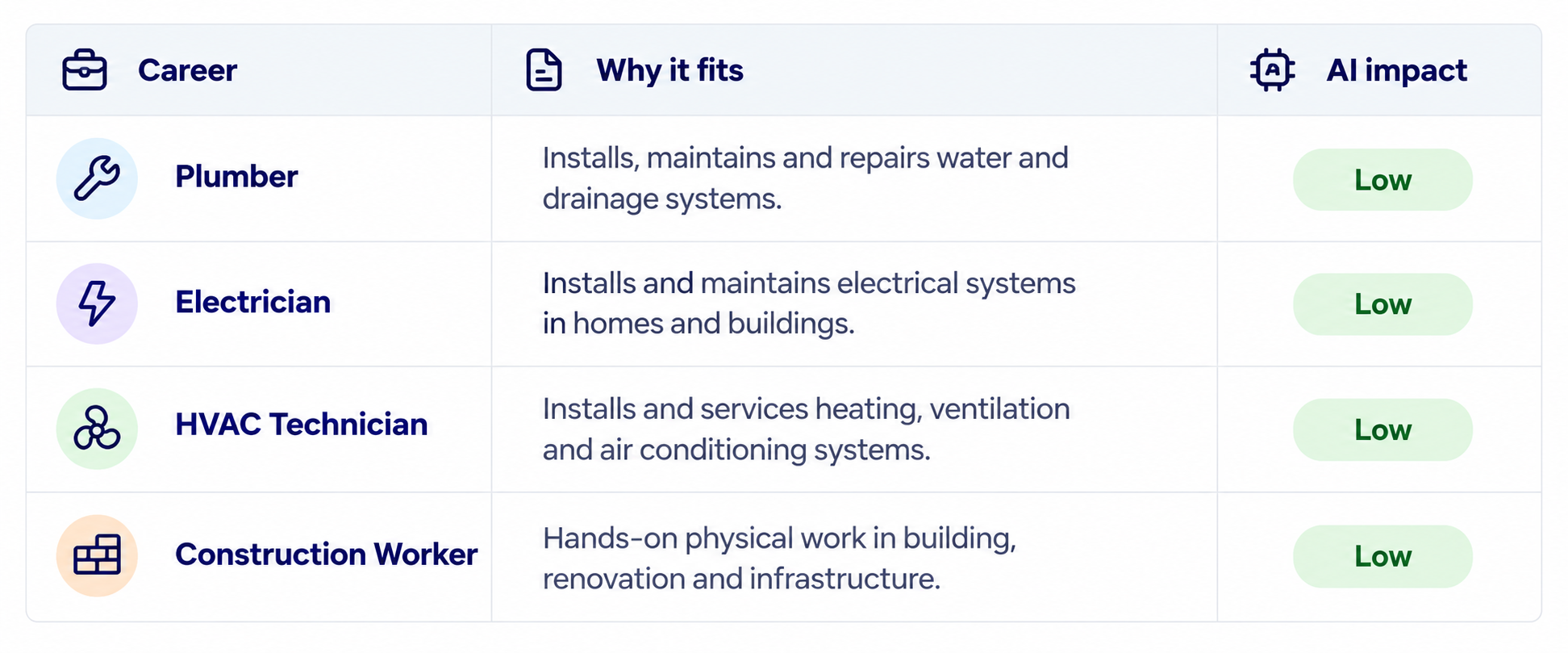
Where Can You Go From Here?
Your visual and creative skills are valuable. These careers build on them and are more resistant to AI:
- Architect (Moderate AI impact): applies visual design to real buildings and spaces.
- Tattoo Artist (Low AI impact): hands-on art for clients who want a human artist.
- Event Planner (Low AI impact): uses creativity and visual style in real-world experiences.
- Ceramic Artist (Low AI impact): handmade work where human craft is the value.
If none of these feel right, you can pivot to an AI-resistant career that matches your own skills and goals, with a step-by-step plan for making the switch.
How to Become a Junior Graphic Designer
If you still want to enter graphic design, go in with a clear plan to move beyond routine production work.
- Get trained. Most designers complete a diploma or degree in graphic or visual communication design, usually taking one to four years.
- Build a strong portfolio. Show original ideas and design thinking, not just polished templates.
- Learn AI design tools. Employers now expect designers to work with AI, not against it.
- Add a specialty. UX design, motion graphics, 3D or brand strategy are harder to automate.
- Aim for creative direction. Plan your path towards senior and art director roles from the start.
Qualifications by region
No licence is required to work as a graphic designer in Asia-Pacific or North America. Employers focus on your portfolio, though a recognised diploma or degree helps.
Asia-Pacific
- Australia: Diploma or Bachelor of Graphic or Visual Communication Design.
- New Zealand: Diploma or Bachelor of Design.
- Singapore: Polytechnic diploma or degree in design.
- Hong Kong: Higher Diploma or degree in design.
- Taiwan, China: Degree in visual communication design.
- Japan: Design school or university design programme.
- South Korea: Design degree, with optional national design certificates.
North America
- United States: Associate or bachelor's degree in graphic design, or a strong self-taught portfolio.
- Canada: College diploma or degree in graphic design.
Is It a Good Career?
Reasons it can still work:
- Senior creative and art direction roles still need human judgment.
- Design skills transfer to UX, marketing, architecture and many other fields.
- Freelance and remote work are possible.
Reasons to be cautious:
- Entry-level roles are shrinking.
- Freelance rates are under pressure from AI tools.
- Competition for junior jobs is high.
It suits creative people who are willing to specialise, learn AI tools and move quickly towards strategy or creative direction.
Still deciding? Ask yourself: what if you took a different path for 5 years? Pick a career and play through 5 years month by month, making a key decision every six months, with family, competition, health and economic surprises along the way.
FAQs
Will AI replace graphic designers in the next 10 years?
AI is likely to replace much routine design work, especially at junior level. Designers who lead creative strategy, understand clients and direct AI tools will remain in demand.
How much do junior graphic designers earn?
Typically $38,000–$55,000 a year in the US, with higher pay for senior designers and art directors.
How long does it take to become a graphic designer?
Usually one to four years, depending on whether you complete a diploma, a degree or build your skills independently.
Can I become a graphic designer at 40?
Yes, but plan carefully. Combining design with experience you already have, such as marketing or business knowledge, gives you an advantage over younger entry-level designers.
Not sure if your current job is at risk? Check your AI risk score for free and see which careers match your skills. brigenai helps you find a career that lasts, with AI tools and real people to guide your switch.






