
Recruitment consultants match candidates with employers and guide both sides through the hiring process. AI won't replace recruiters, but it's automating much of the early work: sourcing candidates, screening CVs and scheduling interviews. Consultants who build strong relationships, understand their industry and close difficult hires will remain in demand. The role is rated Moderate AI impact.
What Does a Recruitment Consultant Do?
Recruitment consultants work between employers and job seekers:
- Business development: winning clients and understanding their hiring needs.
- Sourcing: finding candidates through databases, networks and job ads.
- Screening: interviewing candidates and checking their fit.
- Negotiation: managing offers, salaries and start dates.
They work in recruitment agencies, executive search firms and in-house HR teams.
Will AI Replace Recruitment Consultants?
Not fully, but AI is taking over much of the process.
What AI can do: search candidate databases, screen CVs, write job ads, schedule interviews and answer candidate questions.
What AI cannot do:
- Build relationships. Clients and candidates trust people they know.
- Read people. Judging motivation, personality and culture fit is a human skill.
- Negotiate. Closing offers and managing expectations requires persuasion.
- Find hidden talent. The best candidates often come through personal networks.
Compare other ratings in our full list of careers AI can't replace.
How This Career Is Changing
- Less admin. Screening and scheduling are increasingly automated.
- Fewer generalist roles. Volume recruitment is most affected.
- More value in specialists. Recruiters with deep industry knowledge are harder to replace.
- Advisory focus. Clients want advice on salaries, markets and hiring strategy.
How to Stay Ahead
If you're already a recruiter:
- Specialise in an industry, such as healthcare, trades or technology.
- Move into executive search, where relationships matter most.
- Use AI tools to handle admin and spend more time with people.
- Build your personal brand and network.
If you're thinking of switching into recruitment: sales, customer service and industry experience are strong starting points. Many recruiters come from the industries they now recruit for. Similar people-focused roles include Real Estate Agent. A free career assessment can help you compare options.
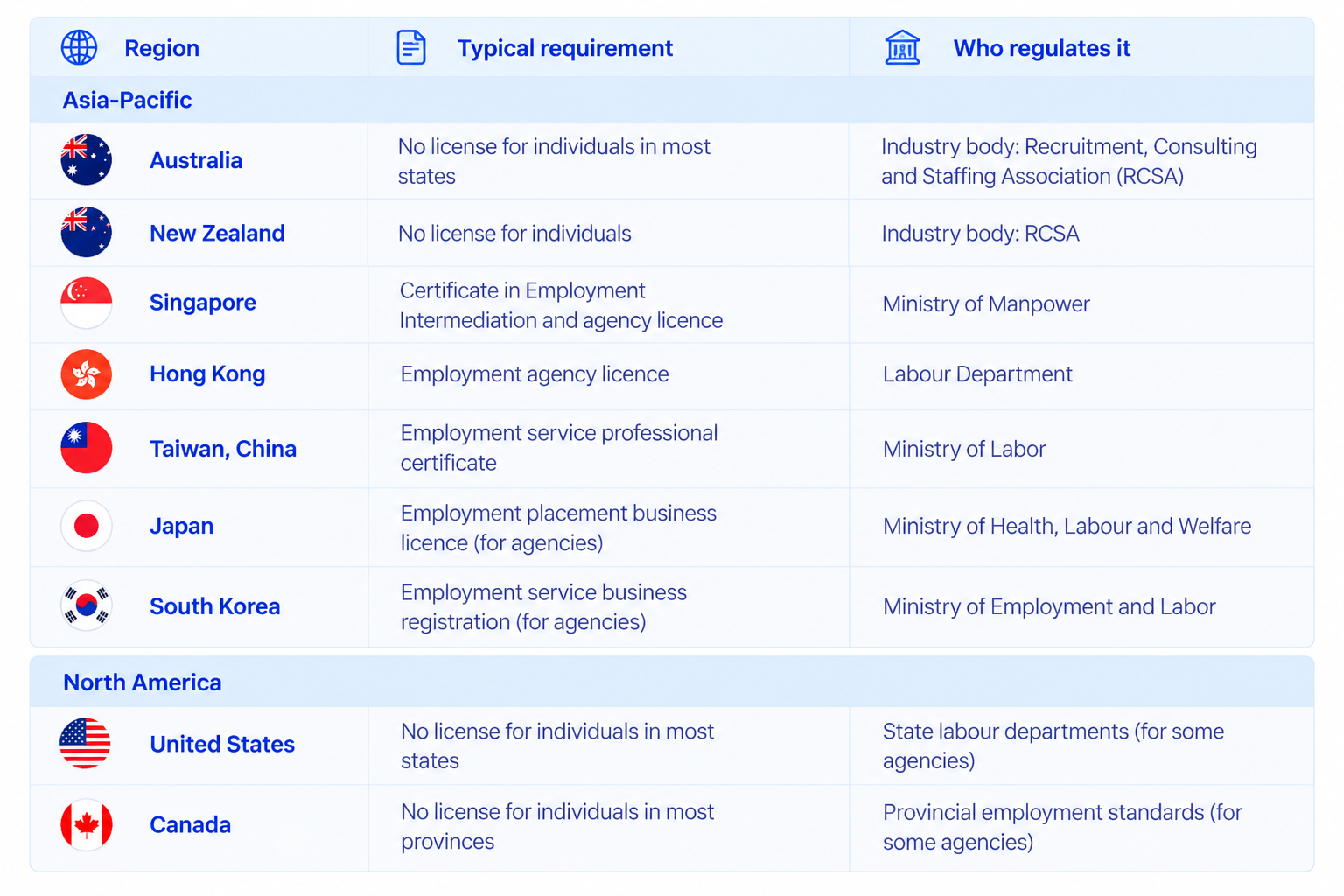
Requirements by region
Asia-Pacific
- Australia: No licence for individuals in most states. Industry body: Recruitment, Consulting and Staffing Association (RCSA).
- New Zealand: No licence for individuals. Industry body: RCSA.
- Singapore: Certificate in Employment Intermediation and agency licence, regulated by the Ministry of Manpower.
- Hong Kong: Employment agency licence, regulated by the Labour Department.
- Taiwan, China: Employment service professional certificate, regulated by the Ministry of Labor.
- Japan: Employment placement business licence (for agencies), regulated by the Ministry of Health, Labour and Welfare.
- South Korea: Employment service business registration (for agencies), regulated by the Ministry of Employment and Labor.
North America
- United States: No licence for individuals in most states. Some agencies are regulated by state labour departments.
- Canada: No licence for individuals in most provinces. Some agencies are covered by provincial employment standards.
Requirements change, so always check the rules in your region.
Is It Worth It?
Pros:
- Low barrier to entry
- High earning potential through commission
- Fast-paced, people-focused work
Cons:
- Income depends on targets and market conditions
- High pressure and turnover
- Routine recruiting is being automated
It suits confident, persuasive people who enjoy sales and building relationships.
FAQs
Will AI replace recruiters?
No, but it will automate much of the admin. Recruiters who build relationships and specialise will remain in demand.
Do I need a degree to become a recruiter?
Usually not. Sales skills and industry knowledge matter more.
Is recruitment a good career change?
Yes, especially if you can specialise in an industry you already know.
Not sure if your current job is at risk? Check your AI risk score for free and see which careers match your skills. brigenai helps you find a career that lasts, with AI tools and real people to guide your switch.






