

Picking a major is hard. Picking a major and a country at the same time is harder, especially when every university website says it is the right fit. AI tools will not make that call for you, but the good ones cut down the research time. They turn a vague idea into a shortlist you can actually check.
We looked at seven tools for two kinds of readers: students planning to study abroad, and undergraduates weighing a master's overseas. Six have been running for years and have a public track record. The seventh, brigenai, is our own and is labeled as such. We grouped them by the job they do (deciding a direction, finding programs, planning applications) instead of ranking them, and we only show a rating where a real public score exists.
Last updated: September 2026
Quick Comparison
- brigenai: Not yet rated (no public reviews). Best for choosing between countries, universities and careers. Free plan; paid from $9/mo. Focus on Australia, New Zealand, Singapore, Hong Kong and Taiwan.
- CareerExplorer: No public score found. Best for undecided undergrads choosing a field. Free results; paid detailed report. North America based.
- ChatGPT: 4.8/5 (App Store). Best for open-ended brainstorming and SOP outlines. Free; paid plans from about $8/mo. Global.
- Studyportals: 4.3/5 (Trustpilot, 123 reviews). Best for comparing programs and costs across countries. Free for students. Global.
- ApplyBoard: 3.8/5 (Trustpilot, only 2 reviews). Best for applying to schools in six destination countries. Free for students; application fees apply.
- Yocket: No TrustScore; 92% of 1,694 Trustpilot reviews are 4 or 5 stars. Best for Indian undergrads applying for a master's abroad. Free tools; Premium price not published.
- GradRight (SelectRight): No public score found. Best for STEM and MBA applicants to US master's programs. Free for students. India to US.
Why use AI to choose a major or university?
The honest answer is speed. A student comparing master's programs in four countries can spend weeks just collecting tuition figures, entry requirements and deadlines. AI tools handle that first pass: they sort, filter, and ask questions you had not thought of.
What they do not do is check facts for you. The European Commission's education site makes the same point in its guide to using AI for study choices. Treat the output as a starting point and confirm the details yourself. Every tool below works best that way.
Which path are you on?
- Planning to study abroad for a bachelor's: start with brigenai, CareerExplorer, Studyportals and ApplyBoard.
- An undergraduate planning a master's abroad: start with Studyportals, Yocket and GradRight, plus ChatGPT for drafts.
The tools are grouped in three steps: decide your direction, find programs and universities, then plan your applications.
Step 1: Decide your direction
These tools help when the question is still "what should I study, and where?"
1. brigenai (our tool)
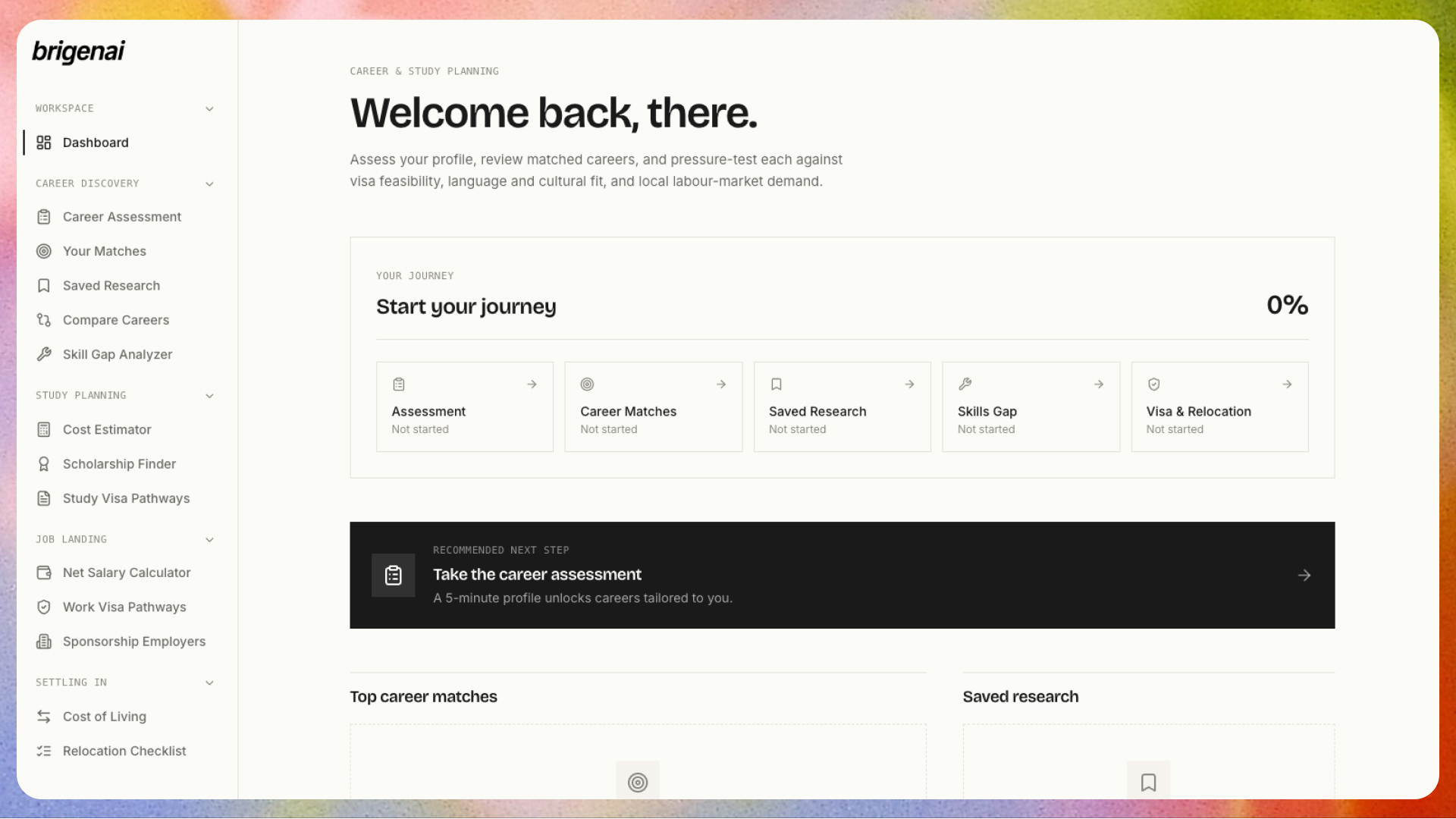
brigenai is a guide for studying, working and living abroad, built in two parts. The Toolkit has a free career assessment plus country and university match tools that score your fit and show the reasoning behind each score. The AI Guides (Uni Guide, Career Guide and Local Living Guide) let you chat about university life, careers and moving abroad, drawing on real stories from people who have made the move.
Rating: Not yet rated. There are no public reviews on Trustpilot, Capterra or GetApp, so we have not scored it.
Highlight: The country, university and career tools feed one profile, so you answer once and every result shows the factors behind its score.
Pros:
- The starter plan includes the career assessment, university match and country match
- University matches include tuition and where each degree leads
- There are cost of living and salary tools
- The guides support 30 languages
Cons:
- The guides focus on Australia, New Zealand, Singapore, Hong Kong and Taiwan, so students aiming for the US, UK or Canada get less
- You need an account to chat with an advisor
- The pricing page lists the Uni Guide under paid plans
- It has no public reviews yet, and the accuracy figures on its site are self-reported
Best For: Students still deciding between countries, universities and careers, especially those looking at Asia-Pacific destinations.
Target Region: Australia, New Zealand, Singapore, Hong Kong and Taiwan are the main focus.
Pricing: Free Starter plan; Standard is $9 a month and Premium is $32 a month (USD).
Conclusion: A sensible first stop if you want to compare country, university and career together, and the match tools cost nothing to try. Coverage outside Asia-Pacific is thinner than at the larger platforms below.
Official site: brigenai.com
2. CareerExplorer
CareerExplorer is a career test that started in Vancouver in 2012 under the name Sokanu. Penn Foster bought it in 2021. The assessment scores you on 186 traits across eight categories, including personality, interests and abilities, and then matches you to careers. It takes roughly 20 to 30 minutes, and the free version returns 12 career matches.
Rating: No public review score found on the review sites we checked, so we have not scored it.
Highlight: A long, science-style test that gives useful results without paying.
Pros:
- Your results stay in an account you can return to
- The interest report uses Holland codes
- Career profiles include education requirements
Cons:
- It tells you which careers fit, not which university to pick
- The detailed report costs extra
- The matching is algorithmic, not a conversation
Best For: Undergraduates who do not yet know which field to pursue for a master's.
Target Region: North America based, and the test is fully online.
Pricing: Free results; the detailed report is a paid upgrade, and its price is not listed on the public pages we reviewed.
Conclusion: Start here if your question is "what should I do" and not "where should I go." Pair it with a program search tool from Step 2.
Official site: careerexplorer.com
3. ChatGPT
ChatGPT is a general chatbot, not a study abroad product, but it is where many students start. Give it your grades, budget, interests and preferred countries, and it will suggest fields, explain how programs differ, and help outline a personal statement.
Rating: 4.8 out of 5 on the Apple App Store, from millions of ratings.
Highlight: It answers follow-up questions at any hour, on any part of the decision.
Pros:
- A free plan is available
- It handles messy, open-ended questions
- It turns rough notes into a first draft
Cons:
- It has no view of real admissions outcomes, so tuition, deadlines and entry requirements can be wrong
- Answers stay generic unless you describe your situation in detail
Best For: Students who want to think out loud before committing to a tool.
Target Region: Global.
Pricing: Free plan; paid plans start at about $8 a month (Go, which can include ads) and $20 a month (Plus) in the US.
Conclusion: Good for brainstorming, weak as a source of facts. Confirm every figure on the university's own page.
Official site: chatgpt.com
Step 2: Find programs and universities
Once you have a direction, these two help you see what actually exists.
4. Studyportals
Studyportals began in 2007 as Mastersportal, a site for finding master's degrees in Europe, and later added bachelor's, PhD and short course portals. The company says it now lists more than 220,000 programs from over 6,000 universities. You can compare tuition, entry requirements and scholarships in one place, and a free account unlocks Sophia, its AI study advisor.
Rating: 4.3 out of 5 on Trustpilot, from 123 reviews.
Highlight: The widest free program database on this list.
Pros:
- Free for students
- Covers bachelor's, master's and PhD levels
- Scholarship search is built in
- Programs from many countries sit side by side
Cons:
- It is a search tool first, so it narrows your options but does not help you choose between them
- The company also sells marketing and recruitment services to universities, so check whether a listing is promoted
Best For: Students comparing programs and costs across several countries, including undergraduates hunting for a master's.
Target Region: Global. It started with European master's programs.
Pricing: Free for students.
Conclusion: The best place to build a long list. Use Sophia for ideas, then verify details with the university.
Official site: studyportals.com
5. ApplyBoard
ApplyBoard is a Canadian company founded in 2015. International students use it to search and apply to schools in Canada, the US, the UK, Australia, Ireland and Germany from one account, and it says it works with more than 1,500 institutions. In June 2024 it added Abbie, an AI advisor built on Microsoft Azure's OpenAI service, to answer questions during the search and application.
Rating: 3.8 out of 5 on Trustpilot, but from only 2 reviews, so treat it as a thin signal.
Highlight: Searching and applying happen in the same place.
Pros:
- One application flow covering six destination countries
- An AI advisor for quick questions
- A large partner network
- Free for students
Cons:
- You only see partner institutions, not the whole market
- It earns money through revenue-sharing with schools and works through recruitment partners, so it is a commercial marketplace and not a neutral advisor
- In some cases an ApplyBoard fee is added to an application
Best For: Students who already lean toward one of those six countries.
Target Region: Canada, the US, the UK, Australia, Ireland and Germany.
Pricing: Free for students. You pay each school's application fee, and in some cases an ApplyBoard fee is added.
Conclusion: Useful when you want to submit applications without juggling separate portals. Less useful if you are still comparing countries.
Official site: applyboard.com
Step 3: Plan your applications
These two are for when you have a target and need to turn it into applications.
6. Yocket
Yocket started in India and now supports students applying to the US, UK, Canada, Germany, Australia and several other countries. Its free tools include AI-assisted university shortlisting. The paid Premium plan adds a counsellor for shortlisting, editing for statements of purpose and essays, visa mock interviews, and help with loans. It has nearly 1,700 reviews on Trustpilot.
Rating: No TrustScore. Trustpilot currently withholds Yocket's score after removing fake reviews, though 92% of its 1,694 reviews are 4 or 5 stars. Yocket advertises 4.6 out of 5 across Google and Trustpilot, which we could not verify.
Highlight: AI shortlisting backed by human counsellors and editors.
Pros:
- Free shortlisting tools
- One team covers essays, visa prep and financing
- A large body of public reviews to read
Cons:
- Premium is paid and its current price is not published
- Claims such as a guaranteed admission offer and better admit chances come from Yocket itself, not independent data
- Trustpilot's removal of fake reviews means you should read recent reviews with care
- The service is built around Indian applicants
Best For: Indian undergraduates planning a master's abroad, especially in the US.
Target Region: India origin, with many destination countries.
Pricing: Free tools; Premium is paid. A 2020 interview put it at about $500 per student for the full process, so treat that figure as outdated.
Conclusion: Worth a look if you want a person guiding the whole process. Read the recent Trustpilot reviews and ask for the current price before you pay.
Official site: yocket.com
7. GradRight (SelectRight)
GradRight, founded in 2019, runs SelectRight, an AI shortlisting tool for master's programs that launched in 2021. Its app listing says the tool is free for students and covers more than 20,000 STEM and MBA programs at over 1,000 US universities. GradRight also runs a loan platform that compares offers from more than 15 lenders, so financing comes up alongside the shortlist.
Rating: No public review score found on the review sites we checked, so we have not scored it.
Highlight: A free AI shortlist with loan comparison in the same account.
Pros:
- Free for students, according to its app listing
- The shortlist is built from your profile and goals
- Loan options are easy to compare
Cons:
- Narrow scope, limited to US master's programs in STEM and MBA
- Because it also sells loan products, keep that commercial link in mind when reading its recommendations
Best For: Indian STEM or MBA applicants targeting US programs.
Target Region: India to the US.
Pricing: Free for students, per its app listing.
Conclusion: A quick, no-cost way to test a US master's shortlist. Look elsewhere if you want other countries or fields.
Official site: gradright.com
How to choose the right tool
Start with the question you are actually stuck on.
- You don't know what to study: begin with a direction tool, brigenai or CareerExplorer, and use ChatGPT to talk it through.
- You know the field but not the country or school: use Studyportals to compare, then ApplyBoard if one of its six countries is on your list.
- You have a shortlist and need help applying: look at Yocket if you want human counsellors, or GradRight if you want a free US shortlist.
Budget matters too. Studyportals, the basic CareerExplorer test, brigenai's free plan and ChatGPT's free tier cost nothing, and you can get a long way with those. Paid help makes more sense once you are applying and every essay counts. If you want a personal recommendation across career, country and school, try brigenai's assessment tools or its career assessment.
FAQ
What is the best AI to use for choosing a university?
There is no single best tool, because the job changes as you go. Use a direction tool such as brigenai or CareerExplorer first, a program search such as Studyportals second, and an application service such as Yocket or GradRight last.
Can AI help me choose a major or a master's program?
Yes, mostly by narrowing the field. Assessments show which subjects fit your interests, and search tools filter programs by cost, country and requirements. The final choice still depends on things no tool sees well, such as your funding, your visa options and what you want life abroad to look like.
Is AI accurate for university recommendations?
Not reliably. General chatbots can get tuition, deadlines and entry requirements wrong, and even specialist tools work from listings that go out of date. Check every number on the university's own website before you act on it.
Are AI study abroad advisors free?
Some are. Studyportals, ApplyBoard and the basic CareerExplorer test are free for students, brigenai and ChatGPT have free plans, and GradRight's shortlist is listed as free. Yocket's counsellor plan is paid.
Should I still talk to a human counsellor?
For the application itself, usually yes. AI is good at the first pass, but a counsellor or an admissions officer can tell you what a program actually values, and you can ask them follow-up questions directly.
Conclusion
No single tool covers the whole decision. Direction tools tell you what to aim for, search tools show what exists, and application services help you get in. Pick the one that matches the stage you are at, keep the free options as your default, and confirm every fact on the university's own site.
If the first stage is where you are stuck, brigenai's tools are built for exactly that decision, and the career assessment is a quick way to start.
Disclosure: brigenai is our own product and appears in this list. We applied the same criteria to every tool, and the links to the other six go to each company's official site. Ratings and prices were checked in September 2026 and will change, so confirm them on each official site.