
Imagine booking a visa appointment three weeks in advance, taking the morning off work, arriving at the Immigration NZ office on time, and finding the door locked. No note. No email. No rescheduled slot for a fortnight. It sounds unlikely until you learn that the office was closed for a regional anniversary day the newcomer had never heard of, a regional anniversary day that doesn't appear prominently in standard calendar apps and wasn't mentioned anywhere in their onboarding paperwork.
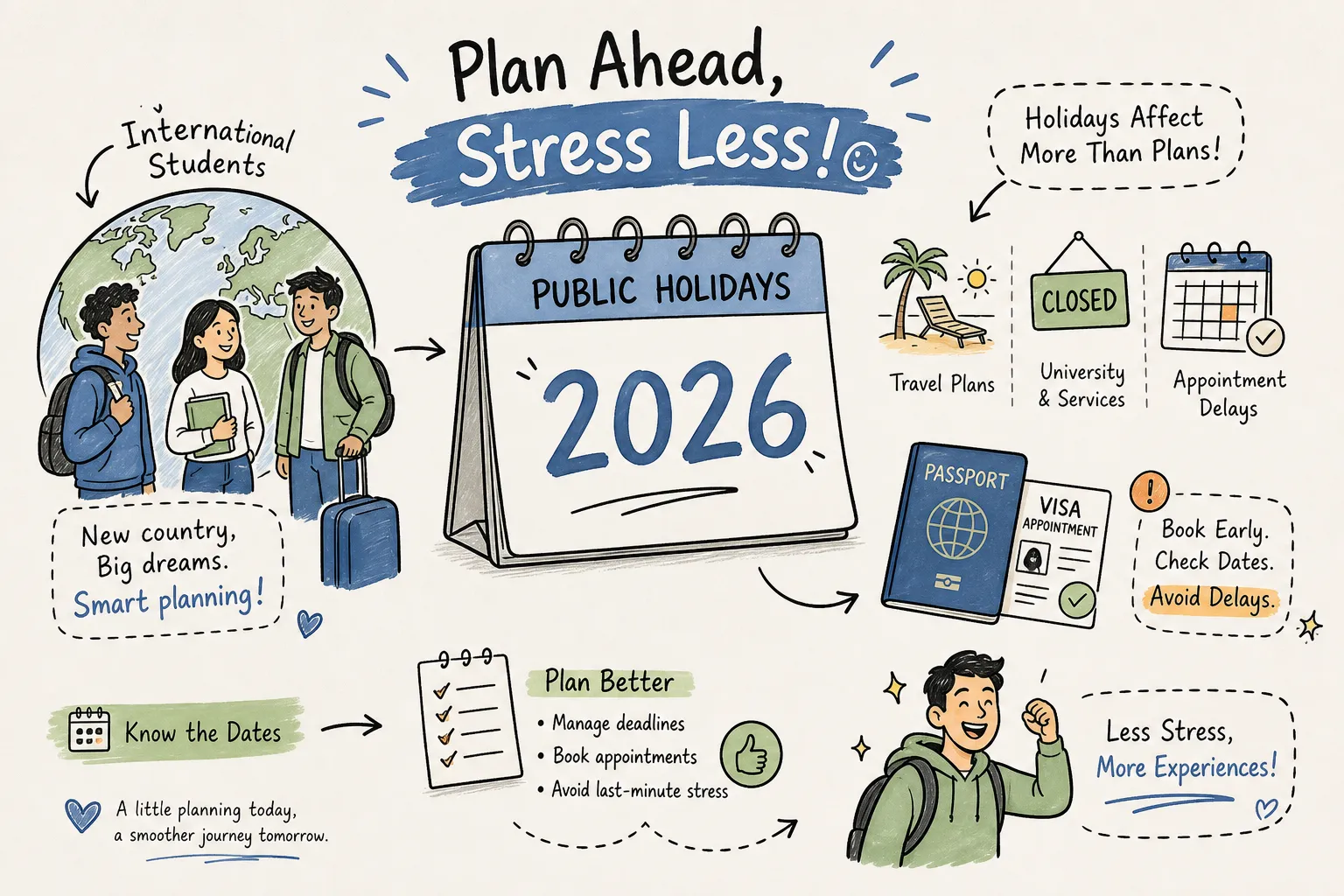
This kind of story comes up constantly in the international student and expat community. Public holidays 2026 aren't just days off for New Zealanders. For someone on a bridging visa, managing a part-time work roster or planning a home visit around university commitments, they're invisible deadlines. They close government offices, freeze visa processing queues, shut bank branches and reshuffle academic timetables without warning. Getting across the full 2026 public holiday calendar, both national and regional, is one of the most practical things you can do before the year runs away from you.
This article maps every national and regional public holiday date in NZ for 2026, explains how observed dates work, flags the closure windows that most affect visa appointments, and gives you specific strategies to protect your time and your pay entitlements.
NZ national public holidays 2026: dates, observed days and the weekend rule
The 11 national holidays and their confirmed 2026 dates
New Zealand has 11 national public holidays each year. For 2026, the confirmed dates are:
- New Year's Day, Thursday 1 January
- Day after New Year's Day, Friday 2 January
- Waitangi Day, Friday 6 February
- Good Friday, Friday 3 April
- Easter Monday, Monday 6 April
- Anzac Day, Saturday 25 April, observed Monday 27 April
- King's Birthday, Monday 1 June
- Matariki, Friday 10 July
- Labour Day, Monday 26 October
- Christmas Day, Friday 25 December
- Boxing Day, Saturday 26 December, observed Monday 28 December
For most practical planning purposes, the observed date is the one that matters. That's the date on which entitlements apply, government offices close and your pay rules change. The calendar date and the observed date don't always match, and in 2026 that distinction affects two of the most significant holidays on the list.
How Anzac Day and Boxing Day shift in 2026
Both Anzac Day and Boxing Day fall on a Saturday in 2026, which triggers NZ's Mondayisation rule. The practical outcome depends on your roster. Employees who normally work Saturdays observe the holiday on the Saturday itself (25 April and 26 December respectively). Employees who don't normally work Saturdays observe it on the following Monday: 27 April and 28 December.
This distinction matters most for part-time students on rotating rosters. If your hours change week to week, confirm whether Saturday is an "otherwise working day" for you before assuming which date applies. Ask your employer directly rather than waiting to find out when the payslip arrives.
The "otherwise working day" test explained simply
NZ employment law ties public holiday entitlements to one core question: would you normally have worked that day? If yes, you're entitled to a paid day off. If no, you're not automatically entitled to paid leave, though time-and-a-half still applies if you do work.
This test sounds simple but catches a lot of people out, particularly casual workers and students on variable hours whose "normal" working pattern isn't straightforward to define. If you're unsure, document your regular roster and ask your employer in writing before a holiday arrives.
Regional anniversary days 2026: the holidays that catch newcomers off guard
Month-by-month regional dates across NZ
On top of the 11 national holidays, each region observes its own anniversary day. The 2026 observed dates are:
- Wellington, Monday 19 January
- Auckland, Monday 26 January
- Nelson, Monday 2 February
- Taranaki, Monday 9 March
- Otago, Monday 23 March
- Southland, Tuesday 7 April (observed on Easter Tuesday)
- South Canterbury, Monday 28 September
- Hawke's Bay, Friday 23 October
- Marlborough, Monday 2 November
- Canterbury, Friday 13 November
- Westland, Monday 30 November
- Chatham Islands, Monday 30 November
A few of these deserve particular attention. Southland is observed on Easter Tuesday rather than a Monday near its actual anniversary date, placing it inside the Easter cluster. South Canterbury and Canterbury share the same underlying anniversary (16 December) but observe it on completely different dates due to different regional rules. Westland and the Chatham Islands both land on 30 November, which is easy to overlook if you're checking a calendar that doesn't distinguish between the two.
Why your city's anniversary day isn't always obvious
Regional anniversary days don't appear prominently in standard calendar apps, and they're not gazetted in the same way as national holidays. Someone who moved from Wellington to Christchurch mid-year might still have Wellington's date in their mental calendar, not realising Canterbury falls on an entirely different date. One expat who connected with brigenai scheduled a bank branch visit on Auckland Anniversary Day (26 January 2026), not realising it was a local statutory holiday. The branch was locked. The next available appointment was more than a week away, and the documentation they needed was time-sensitive.
Which services actually close on regional days
Regional anniversary days are statutory holidays, but closures aren't uniform across all services. Government offices, banks, council service centres and most professional services close. Some supermarkets and large retail chains stay open with modified hours. Hospitals and emergency services operate as normal. For international students who need WINZ appointments, IRD registrations or council housing support, a regional closure can push back critical paperwork by several business days at exactly the wrong moment.
Planning around public holidays 2026: visa appointments and embassy processing
Blackout windows around the big 2026 holiday clusters
Three clusters in 2026 create extended processing blackouts for Immigration NZ. The first is the New Year cluster (1, 2 January), with reduced INZ services running from 25 December through to 5 January. The second is the Easter, Anzac cluster: Good Friday (3 April), Easter Monday (6 April) and Southland's Easter Tuesday (7 April) compress an already short month into very few effective processing days, with Anzac Day observed (27 April) following less than three weeks later. The third is the Christmas, Boxing Day cluster (25, 28 December), which sits inside the broader reduced-service window.
Public holidays don't count as working days in INZ's processing-time calculations. That means a visa application lodged close to one of these clusters will wait longer in real calendar time, even if INZ's published processing timeframe stays unchanged. The queue moves, but more slowly.
Why processing times blow out before and after long weekends
The compounding effect is what most people don't anticipate. Staff push to clear a backlog before a closure, then return to find an even larger pile waiting. A visa application lodged on the Thursday before Easter can realistically sit untouched for 10 to 14 business days. One software engineering graduate who used brigenai submitted a post-study work visa on 22 December, not realising that processing would effectively pause until mid-January. The delay pushed back a job offer acceptance and nearly cost them the role entirely.
Practical timelines for booking interviews and appointments
Around the major public holidays 2026 closure windows, book INZ appointments three to four weeks ahead rather than the typical one to two weeks. If your visa process involves documentation from your home country's embassy in New Zealand, add at least one additional week buffer, particularly if that embassy also observes holidays from your home country's calendar.
The Easter cluster is especially high-risk. Good Friday falls on 3 April, Easter Monday on 6 April and Southland's Easter Tuesday on 7 April, which means the effective working days inside that window are limited to Tuesday 7 April and Wednesday 8 April for most offices. Anzac Day observed on Monday 27 April follows less than three weeks later, compressing April significantly for anyone with time-sensitive applications.
University timetables, bank closures and part-time work entitlements
Where 2026 holidays overlap with semester and exam periods
Good Friday (3 April) and Easter Monday (6 April) fall during Semester 1 for most NZ universities. At the University of Auckland, Semester 1 runs from 2 March to 29 June 2026. At Canterbury, it runs from 16 February to 20 June. Both institutions have mid-semester assessments near Easter, which means the holiday break can disrupt study momentum rather than provide genuine rest. Matariki (10 July) lands in the mid-year gap for some students but inside Trimester 2 for others, depending on the institution. Cross-check your specific academic calendar against the 2026 public holiday dates rather than assuming they align neatly.
Bank branches, government portals and physical services
Most banking is online, but some visa-related processes still require in-branch appointments, certified copies or notarised documents. On national and regional public holidays, all major bank branches close. MBIE, IRD and council service centres shut on the same days. International students who need IRD number registrations, student allowance documentation or council housing support should build two to three business day buffers around the 2026 holiday clusters. Submitting paperwork on the last business day before a closure is a high-risk move, not a safe deadline.
What part-time workers are owed on public holidays
If you work your regular shift on a public holiday, you must receive at least time-and-a-half for every hour worked. If that public holiday falls on what would normally be your working day, you're also entitled to an alternative holiday (a day in lieu) to use later. Students working in hospitality, retail and healthcare are the most likely to work public holidays and, in our experience supporting international students through brigenai, the least likely to know these entitlements apply to them. Your employer is required to apply these rules regardless of your visa type. The visa only governs how many hours you can work; it doesn't remove your Holidays Act entitlements.
Long weekends in 2026 and how to make them work for you
The 2026 dates that naturally create long weekends
Several 2026 public holiday dates fall in positions that create natural three-day weekends without taking any additional leave. Waitangi Day falls on a Friday (6 February), giving you Friday through Sunday. King's Birthday on Monday 1 June extends the standard weekend. Anzac Day observed on Monday 27 April does the same. Matariki on Friday 10 July creates another Friday-to-Sunday break. If you're planning domestic travel or a visit home, booking accommodation and flights two to three months ahead of these dates avoids peak pricing and sold-out routes.
The single-leave-day strategy for stretching breaks
Taking one annual leave day next to a public holiday can turn a three-day weekend into four or five days. Taking Thursday 9 July as leave converts Matariki weekend into a four-day break. Taking Friday 29 May as leave turns King's Birthday into a four-day window. For international students and expats planning trips home, this strategy maximises time away while minimising the annual leave balance used. Map these combinations at the start of the year and book early, before your colleagues arrive at the same idea.
Alternative holidays, day-in-lieu and how to use them
Every time you work on a public holiday that falls on your normal working day, you bank an alternative holiday. Students in hospitality and healthcare can accumulate several across a year. Alternative holidays don't expire at the year's end, but they should be scheduled proactively and by agreement with your employer. Left unscheduled, they can pile up and become difficult to use. Track them from the moment they're earned and confirm the balance in writing with your employer.
A smarter way to stay ahead of holiday disruptions year-round
Standard calendar tools show national holidays for one country at a time. They don't cross-reference your visa type, your home country's embassy closure schedule or your university's term structure. For someone managing a student visa renewal while working part-time and trying to remember whether Canterbury or Wellington observes an anniversary day next week, a generic calendar app simply doesn't have enough context to be useful.
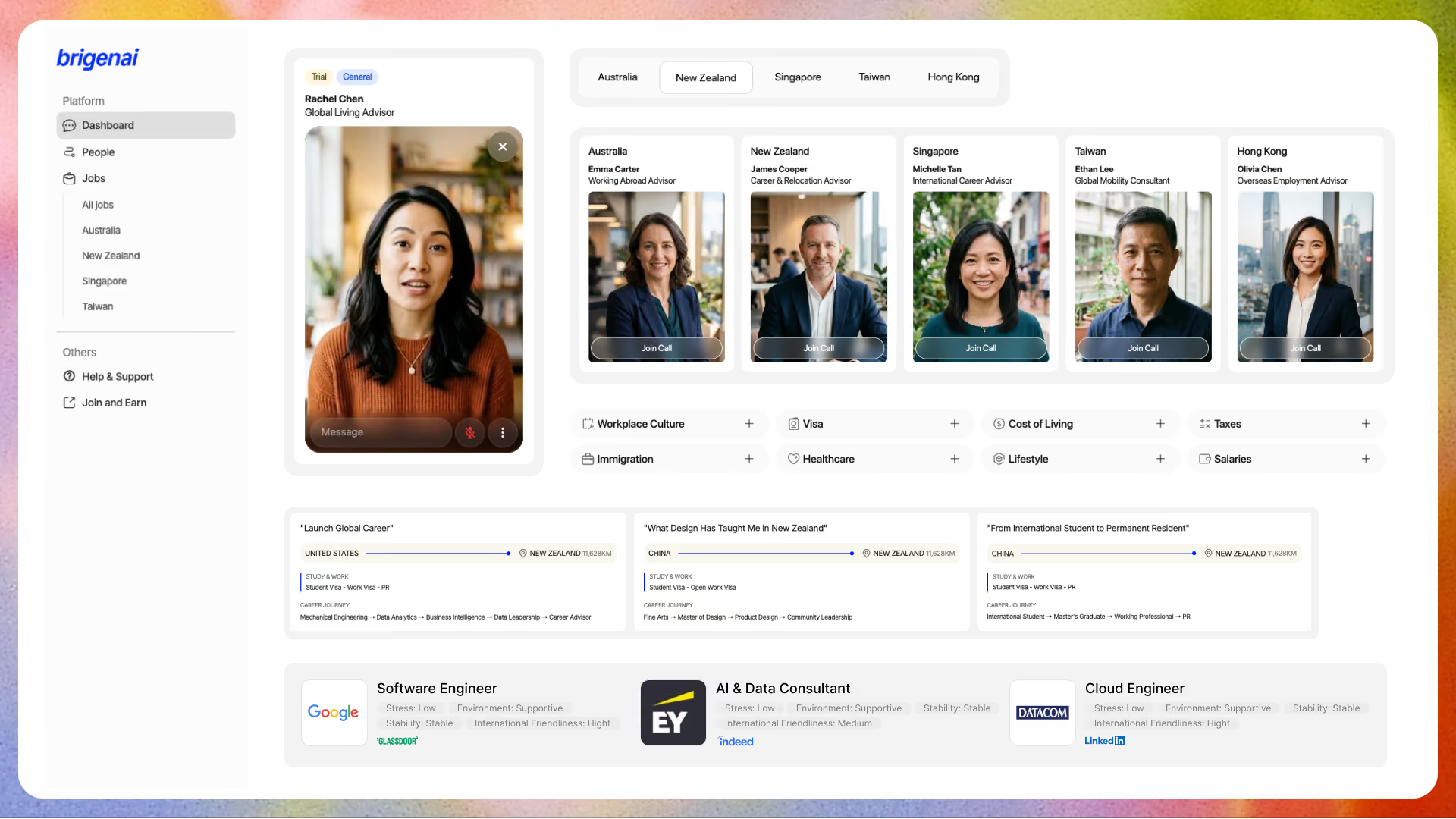
This is where brigenai was built to help. The platform brings together real, experience-based guidance for international students and expats, including holiday-aware planning tools tailored to your destination and visa type, reminders before office closure windows open, and advice drawn from people who've navigated exactly these situations. The nursing student from the Philippines who missed a Wellington Anniversary Day appointment and waited two weeks for another slot, and the graduate who lodged a post-study work visa on 22 December and didn't hear back until mid-January: these aren't edge cases. They're common enough that brigenai flags the relevant dates and buffer windows before you need to act, not after the door has already closed.
Public holidays 2026 are more than calendar markers. For international students and expats, they're the invisible architecture behind every appointment, application and payslip. The good news is that with the right information and a bit of forward planning, none of these dates have to catch you off guard. Bookmark the national and regional dates in this article, map them against your visa timeline and your academic calendar, and build in the buffer time before you need it. If you want a tool that does this planning work alongside you, get in touch with the brigenai team and start with your destination, your visa type and your 2026 public holiday calendar.