
What is AI hallucination and why does it matter?
AI hallucination, formally described as confabulation in some cognitive science literature, occurs when a language model generates outputs that are statistically plausible but factually incorrect. The model does not “know” it is wrong. It produces text based on learned associations between tokens, not on verified knowledge. This distinction matters enormously for professionals who rely on AI outputs for research, legal work, clinical decisions, or financial analysis.
The term “hallucination” is borrowed loosely from psychology, where it describes perception without external stimulus. In machine learning, the analogy holds: the model perceives a coherent output where none is grounded in reality. Deep learning anomalies of this kind are not edge cases. They are structural features of how large language models (LLMs) are trained and evaluated. Recognising this shifts the conversation from “how do we fix buggy AI” to “how do we redesign the systems that produce and reward these errors.”
Why do AI systems hallucinate?
The root cause of machine learning hallucinations sits inside the training objective itself. Most LLMs are trained to predict the next token in a sequence, optimising for statistical likelihood rather than factual accuracy. This creates a system that is extraordinarily good at sounding correct while being structurally indifferent to whether it actually is.

A NeurIPS 2025 study provides a precise mechanistic account: hallucinations occur when more frequent but inaccurate token associations outweigh faithful ones during decoding. The researchers proposed a tracing algorithm to identify the specific subsequences causing these errors. This is a significant finding because it suggests hallucinations are not random noise but traceable, structured failures in the association competition process.
Several compounding factors drive AI perception errors beyond the training objective:
Pro Tip: When evaluating an LLM for professional deployment, test it specifically on questions where the correct answer is “I don’t know.” A model that consistently guesses rather than abstains is exhibiting the exact evaluation-incentive problem the Nature 2026 study describes.
How do current approaches reduce hallucination?
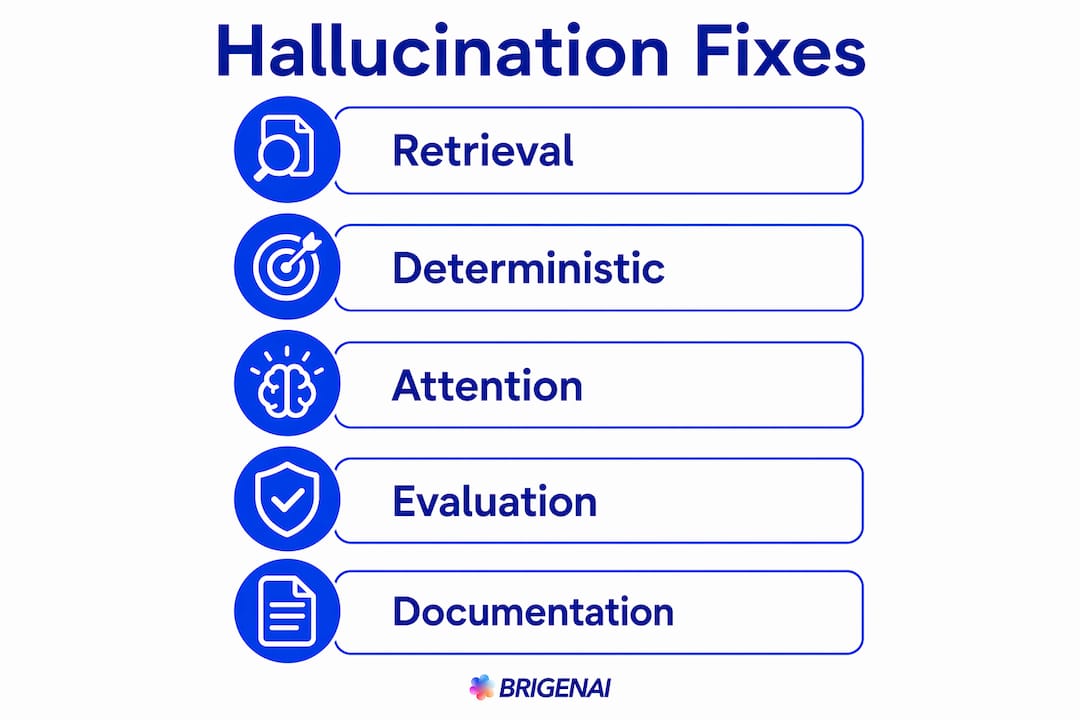
Mitigation strategies for AI-generated misconceptions fall into three broad categories: retrieval-based grounding, deterministic output constraints, and inference-time interventions. Each involves different tradeoffs between accuracy, fluency, and deployment complexity.
Retrieval-augmented generation (RAG) and Hyper-RAG
Retrieval-augmented generation grounds model outputs in external documents retrieved at inference time, reducing reliance on parametric memory. The Hyper-RAG method extends this by integrating hypergraph-driven retrieval, achieving a 12.3% accuracy improvement over direct LLMs and doubling retrieval speed compared to LightRAG on a medical dataset called NeurologyCrop. That accuracy gain is meaningful in clinical contexts where a single fabricated drug interaction could cause patient harm.
A 2026 preprint formalises this further, showing that hallucination risk in RAG systems can be upper-bounded by a measurable retrieval coverage metric. The formula is: Pr[hallucinate] ≤ 1 minus retrieval coverage plus residual leakage. This shifts engineering focus from chasing abstract accuracy scores to improving retrieval coverage, a concrete and measurable target.
Deterministic models for regulated industries
A fundamentally different approach removes probabilistic generation entirely. Artificial Genius’s deterministic models, deployed on Amazon Nova, produce outputs strictly from non-generative processes, achieving hallucination rates as low as 0.03% in finance and healthcare applications. The tradeoff is reduced fluency and flexibility. These models cannot generate novel text, but for compliance-critical outputs, that constraint is a feature rather than a limitation.
ApproachHallucination reductionBest suited forKey tradeoffStandard LLMBaselineGeneral tasksHigh hallucination riskRAGModerate to highResearch, knowledge workDepends on retrieval qualityHyper-RAGHigh (12.3% over LLM)Medical, technical domainsImplementation complexityDeterministic modelsVery high (0.03% rate)Finance, healthcare, legalLimited generative flexibilityAttention interventionsModerate (15.5% reduction)Multimodal AI systemsRequires inference-time access
Pro Tip: For AI tools used in professional workflows, always ask the vendor which mitigation approach is in use. A tool claiming “low hallucination rates” without specifying the method and benchmark is making an unverifiable claim.
Inference-time attention interventions offer a third path, reducing sentence-level hallucinations in multimodal models by 15.5% through attention modifications at inference time, without requiring model retraining. This is particularly relevant for vision-language models where AI perception errors in image interpretation compound text-based confabulation.
How do evaluation metrics shape hallucination rates?
The way AI models are scored directly determines how often they hallucinate. This is one of the least discussed but most consequential dynamics in the field.
Standard accuracy-based benchmarks assign points for correct answers and zero for abstentions. A model that guesses and gets 60% correct outscores a model that abstains on uncertain questions and gets 80% of attempted answers correct. The Nature 2026 evaluation study identifies this as a structural incentive for hallucination. Models trained and evaluated under these rubrics learn that guessing is always preferable to admitting uncertainty.
The proposed solution is open-rubric evaluation, which explicitly penalises incorrect answers and rewards appropriate abstention. Under this framework, a model that says “I am not confident enough to answer” on a genuinely ambiguous question receives a positive signal rather than a neutral one. Early results suggest this approach produces models with meaningfully better calibration, meaning their expressed confidence more accurately reflects their actual accuracy.
Current leaderboards, including those used for popular benchmarks like MMLU and TruthfulQA, do not fully incorporate abstention-aware scoring. This means published hallucination rates for major models may understate the true risk in deployment contexts where confident wrong answers cause real harm. Researchers designing evaluation frameworks should:
Managing hallucination risks in professional AI use
For researchers and professionals, the practical question is not whether AI systems hallucinate but how to build workflows that contain the damage when they do.
Citation hallucinations represent the highest-risk failure mode in academic and professional research. A model can generate a plausible-sounding author name, journal title, volume number, and page range for a paper that does not exist. The University of Illinois LibGuide is explicit: verification must include retrieval and validation of the actual referenced document, not just a secondary check of the citation format. Trusting AI-generated citations without retrieval is not a workflow. It is a liability.
Practical steps for managing hallucination risk in professional contexts:
Pro Tip: When deploying any LLM in a regulated industry, document the mitigation approach, the benchmark used to measure hallucination rates, and the retrieval coverage metric. This creates an audit trail that satisfies both internal governance and external regulatory scrutiny.
Key takeaways
AI hallucination persists because training objectives, decoding mechanisms, and evaluation frameworks all create structural incentives for confident fabrication over honest uncertainty.
PointDetailsRoot cause is structuralNext-word prediction and accuracy-based evaluation both reward guessing, making hallucination a design problem, not a bug.RAG reduces but does not eliminate riskHyper-RAG achieves 12.3% accuracy gains, but hallucination risk is bounded by retrieval coverage, not eliminated.Deterministic models suit regulated sectorsHallucination rates as low as 0.03% are achievable in finance and healthcare using non-generative output constraints.Evaluation design shapes model behaviourOpen-rubric scoring that penalises wrong answers and rewards abstention produces better-calibrated, less hallucinatory models.Citation verification is non-negotiableEvery AI-generated reference must be retrieved and validated independently before use in research or professional work.
Why the evaluation problem is the real problem
Most commentary on AI hallucination focuses on model architecture or training data quality. After working closely with LLM deployments across several professional contexts, I think this framing misses the deeper issue. The evaluation incentive problem is where the real leverage sits.
When a model is rewarded for guessing, it guesses. When it is penalised for abstaining, it never abstains. We have built scoring systems that actively select for overconfidence, and then we express surprise when models confidently fabricate. The NeurIPS 2025 subsequence association research is genuinely exciting because it gives us a mechanistic handle on where in the decoding process these errors originate. That is a tractable engineering target.
I am cautiously optimistic about Hyper-RAG and deterministic model approaches. They represent a pragmatic acknowledgement that fluency and factuality require different mechanisms, and that high-stakes applications should not sacrifice the latter for the former. What concerns me is the gap between research progress and deployment practice. Most organisations using AI tools for research or professional advice are still running base LLMs with no retrieval grounding and no abstention capability. The tools exist to do better. The adoption has not caught up.
The path forward requires collaboration between ML researchers, domain experts, and the engineers building evaluation frameworks. No single discipline has the full picture. Researchers understand the failure modes. Domain experts understand the consequences. Engineers control the incentive structures. Until those three groups are designing evaluation rubrics together, hallucination rates will remain higher than the published benchmarks suggest.
How Brigenai helps AI professionals work smarter abroad
Brigenai is built for professionals who use AI tools seriously, including those navigating the complexity of international career moves where bad information has real consequences. If you are an AI researcher or engineer considering opportunities in Australia, New Zealand, Singapore, or Taiwan, Brigenai’s platform aggregates verified, experience-driven intelligence on salaries, workplace culture, and relocation logistics so you are not relying on a hallucinating chatbot for life-changing decisions.

Explore Brigenai’s expat tools hub to access AI-powered resources designed specifically for professionals moving across borders. From salary benchmarking to cost-of-living comparisons, the platform grounds its outputs in real community experience rather than probabilistic guesswork.
FAQ
What is AI hallucination in simple terms?
AI hallucination is when a generative AI model produces false or fabricated information and presents it as factual. The model is not lying. It is generating statistically plausible text that happens to be incorrect.
Why do large language models hallucinate so often?
LLMs hallucinate because their training objective rewards predicting likely tokens, not accurate ones. Accuracy-based evaluation benchmarks compound this by penalising abstention, which incentivises models to guess rather than express uncertainty.
What is the most effective way to reduce AI hallucination?
Retrieval-augmented generation is currently the most widely deployed mitigation, with Hyper-RAG achieving 12.3% accuracy improvements over base LLMs. Deterministic models achieve hallucination rates as low as 0.03% but sacrifice generative flexibility.
Are AI-generated citations reliable?
No. Citation hallucinations are a high-risk failure mode where models fabricate plausible-sounding but non-existent references. Every AI-generated citation must be independently retrieved and verified before use in research or professional work.
Can hallucinations be eliminated entirely?
Current evidence suggests hallucination cannot be fully eliminated in generative models, but it can be substantially reduced through retrieval grounding, deterministic output constraints, and improved evaluation frameworks that reward appropriate uncertainty.