
TL;DR:
- Australian median full-time earnings are around $90,500 annually, reflecting typical worker income.
- Salaries vary significantly by occupation and region, with managers and professionals earning more.
- Living costs and taxes substantially impact disposable income, making thorough research essential.
Searching for Australian salary figures online is a fast way to confuse yourself. You’ll find numbers ranging from $65,000 to over $106,000 depending on which source you read, which measure they’re using, and whether they’re counting part-time workers in the mix. For professionals planning a relocation, that kind of spread isn’t just frustrating. It can genuinely lead to poor financial decisions, unrealistic expectations, and nasty surprises in the first few months after arrival. This guide cuts through the noise using official Australian Bureau of Statistics (ABS) data to give you an accurate, usable picture of what salaries, costs, and visa thresholds actually look like on the ground in 2026.
Table of Contents
- What is the average salary in Australia?
- How salary varies: Occupation, experience, and region
- Salary versus cost of living: What do you really take home?
- Visa salary thresholds and what skilled migrants and graduates earn
- What the numbers miss: Real pay, real life, real decisions
- Explore next steps with BrigenAI
- Frequently asked questions
Key Takeaways
| Point | Details |
|---|---|
| Average salary explained | The average Australian salary is about $83,800 per year, but figures vary by role and measurement method. |
| Earnings differ by job and location | Managers and professionals earn more, and ACT, NT, and WA offer higher average pay than other states. |
| Visa thresholds impact migrants | Skilled migrant visas require a minimum salary, rising to $79,499 from July 2026, with most expected to earn $90,000+. |
| Cost of living is significant | High expenses in cities like Sydney mean a $100,000+ household income is often needed for comfort. |
| Medial earnings offer clarity | Median salaries give a more accurate idea of typical pay for professionals planning a move. |
What is the average salary in Australia?
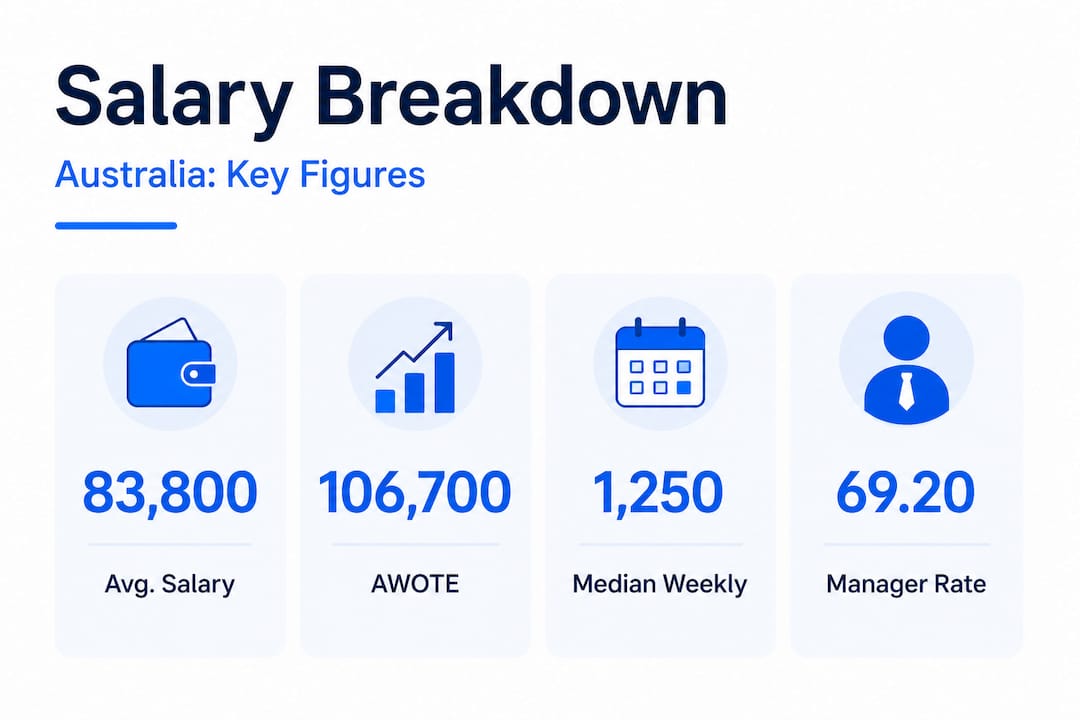
The phrase “average salary” gets thrown around loosely, but it actually refers to several different measurements. The ABS tracks three main figures: average weekly total cash earnings, Average Weekly Ordinary Time Earnings (AWOTE), and median weekly earnings. Each tells a different part of the story, and confusing them is exactly how people end up with wildly different figures.
Average weekly total cash earnings covers all employees, full-time and part-time combined. According to the ABS May 2025 release, this figure sits at $1,611.10 per week, which translates to roughly $83,800 per year. For full-time persons only, the figure jumps considerably to $2,130.60 per week. That’s already a significant gap worth understanding before you compare yourself to a headline number.
AWOTE strips out overtime and irregular payments, focusing only on ordinary time earnings for full-time adults. The ABS data for November 2025 shows AWOTE at $2,051.10 per week (seasonally adjusted), up from $2,010 in May 2025. That represents an annual increase of approximately 3.8%, which is meaningful in a high cost of living environment. Annualised, AWOTE comes to roughly $106,700, and this is the figure most commonly referenced in visa policy and employer benchmarking.
Median weekly earnings offer the most honest snapshot of what a typical worker earns, because unlike averages, medians are not dragged upward by high-income outliers. The ABS August 2025 data puts median weekly earnings at $1,425 for all employees, and $1,741 for full-time persons specifically. Annualised, that’s around $74,100 for all employees or $90,500 for full-time workers. These are the numbers that better reflect the earning reality for most people.
| Salary measure | Weekly figure | Approx. annual |
|---|---|---|
| Average (all employees) | $1,611 | $83,800 |
| Average (full-time only) | $2,131 | $110,800 |
| AWOTE (full-time adults) | $2,051 | $106,700 |
| Median (all employees) | $1,425 | $74,100 |
| Median (full-time only) | $1,741 | $90,500 |
For anyone planning a move to Australia, the median full-time figure is usually the most useful benchmark. It’s what a typical full-time worker actually earns, not what the entire labour market including casuals and part-timers earns. You can explore more salary data by industry to build a clearer picture of where your profession sits within these ranges.
How salary varies: Occupation, experience, and region
Average salary doesn’t tell the whole story. Where and what you do in Australia has a big influence on your actual earning potential, and for someone relocating from overseas, choosing the wrong city or underpricing yourself in the wrong sector can cost tens of thousands of dollars annually.

Occupation is the single biggest driver of salary variation. Based on the ABS May and August 2025 data, here is a breakdown of hourly earnings and weekly medians by occupation group:
| Occupation | Hourly rate (May 2025) | Median weekly (Aug 2025) |
|---|---|---|
| Managers | $69.20 | $2,072 |
| Professionals | $64.50 | $1,900 |
| Trades and technical | $46.50 | approx. $1,550 |
| Community and personal services | approx. $35.00 | approx. $1,200 |
| Clerical and admin | approx. $38.00 | approx. $1,300 |
Managers and professionals earn roughly 40 to 50 per cent more per hour than trades workers and clerical staff. For skilled migrants coming in under employer-sponsored visas, this matters because visa salary thresholds (discussed below) are calibrated around these professional-level benchmarks.
Geography shapes your salary almost as much as your occupation. The ABS May 2025 data shows significant state-by-state variation in average weekly total cash earnings:
- ACT: $1,820 per week (government and public sector concentration)
- Northern Territory: $1,818 per week (remote loading and resources sector)
- Western Australia: $1,710 per week (mining and energy sector)
- New South Wales: $1,631 per week
- Victoria: approximately $1,580 per week
- Queensland: approximately $1,530 per week
- Tasmania: $1,389 per week (lowest in the country)
The ACT and NT figures are high partly because both jurisdictions have a disproportionate share of well-paid government and resources sector roles. Western Australia’s strong mining and liquefied natural gas (LNG) industry pushes wages up there. Tasmania, by contrast, has a smaller economy and fewer high-skill industries, which pulls the average down significantly.
Pro Tip: Don’t just compare gross salaries by state. The moving to Australia guide covers how regional cost of living offsets those pay differences, and in many cases, a $1,500 weekly salary in Adelaide can stretch considerably further than $1,820 in Canberra once rent, transport, and childcare are factored in.
Urban areas generally pay more, but they also cost significantly more to live in. Before you decide that Sydney is the obvious choice, dig into Australia living costs for a realistic view of what that salary premium actually buys you.
Salary versus cost of living: What do you really take home?
Having a number for pay isn’t enough. What matters for your financial wellbeing is what lands in your account after tax, superannuation (super), and living expenses. The gap between gross salary and real purchasing power is where many new arrivals get a shock.
Living costs have been rising steadily. The Employee Living Cost Index rose 3.4% in the year to March 2025, with the biggest cost drivers being health expenses, housing, and food. For 2026, estimated monthly living costs run as follows:
- Single person: $2,500 to $4,000 per month depending on city
- Family of four: $5,500 to $7,500 or more per month
Sydney sits at the top of the cost spectrum, with rents for a two-bedroom apartment in the inner suburbs regularly exceeding $3,000 per month. Melbourne is close behind. Adelaide is notably the most affordable of the major capitals, with living costs running roughly 20 to 25 per cent lower than Sydney for comparable accommodation and lifestyle.
“Living costs for migrants in Australia are not uniform. A salary that feels comfortable in Adelaide can feel impossibly tight in Sydney. Your city choice is effectively a salary decision.”
Tax and superannuation reduce your take-home pay significantly. Australia’s income tax rates mean that most professionals earning between $80,000 and $120,000 lose between 25 and 32 per cent of gross pay in tax. On top of that, your employer contributes 11.5% of your salary into your superannuation fund. Super is your retirement savings, so it’s not lost money, but it’s also not accessible until you retire (with some exceptions for departing migrants). The practical effect is that a $100,000 gross salary typically results in roughly $68,000 to $72,000 in net take-home pay per year, before any living expenses.
Pro Tip: Use the ATO’s online income tax calculator alongside Australian living expenses data before you negotiate your salary. Knowing your after-tax income target is far more useful than anchoring to a gross figure. It also helps you compare global living costs when weighing Australia against other destinations.
A common mistake is assuming that hitting the AWOTE figure of $106,700 means a comfortable life anywhere in Australia. In Sydney with a family, that gross salary may leave only a few hundred dollars of discretionary income per month after rent, groceries, transport, and healthcare.
Visa salary thresholds and what skilled migrants and graduates earn
For those seeking work through migration, salary thresholds and visa rules shape what’s possible before you even start negotiating with an employer. Understanding these benchmarks early saves you from spending months pursuing roles that won’t qualify you for a visa.
The Core Skills Income Threshold (CSIT), formerly known as the Temporary Skilled Migration Income Threshold (TSMIT), is the minimum salary for employer-sponsored visas. According to current government figures, the CSIT is $76,515 per year up to June 2026, rising to $79,499 from July 2026. For specialist skills roles under the Specialist Skills Income Threshold (SSIT), the floor is $141,210 currently, rising to $146,717. These thresholds are indexed to AWOTE, meaning they’ll continue to rise with wage growth.
Here is what this means in practical steps if you’re pursuing an employer-sponsored visa:
- Confirm your nominated occupation appears on a relevant skilled occupation list.
- Verify the employer will sponsor you at or above the CSIT ($76,515 minimum, rising to $79,499).
- Ensure the salary offered matches what Australian workers in the same role earn (market salary rate requirements apply).
- Account for location and sector when benchmarking, since a $77,000 offer in Tasmania is legally compliant but financially very different from a $77,000 offer in Canberra.
- Factor in progression potential: many visa holders renegotiate salaries after year one once they’ve demonstrated local market value.
Skilled migrants typically earn more than the threshold once settled. Realistic annual salary expectations for experienced professionals sit between $90,000 and $120,000, with tech, finance, engineering, and healthcare roles frequently exceeding that band. Recent graduates starting out can expect $60,000 to $75,000, though software engineering graduates often command $70,000 to $95,000 from their first role due to strong demand in the Australian market.
You can check salary data for professionals across specific roles, or review Australian visa occupations and STSOL visa occupations to understand which roles support visa sponsorship pathways.
What the numbers miss: Real pay, real life, real decisions
Here’s something most salary guides won’t tell you. The numbers from the ABS are reliable, well-constructed, and updated regularly. But taken in isolation, they can still mislead you into poor decisions.
The ABS itself uses multiple salary methodologies precisely because no single measure captures reality cleanly. Averages are pulled upward by high earners. The labour force includes a large proportion of part-time workers, roughly 41% of all employees, which drags all-employee averages downward compared to full-time benchmarks. There are also significant gender gaps in the data: male employees average $1,871 per week in total cash earnings, compared to $1,372 for female employees. That’s not just a policy problem. It means that depending on your sector, gender composition of the workforce can materially affect benchmark negotiations.
What we consistently see on the BRIGENAI platform is that professionals who make strong relocation decisions are those who combine the official data with sector-specific intelligence and realistic cost modelling. The person who researches Australian salary breakdowns by occupation and industry, then stress-tests their budget against realistic Sydney or Melbourne rent, then works backward to identify their minimum acceptable salary offer is the person who negotiates confidently and settles successfully.
Most salary guides stop at the headline figure. Your decision can’t afford to. The smarter move is to treat official data as the foundation and then layer in lived experience, local knowledge, and professional sector context from people who’ve actually made the move. That’s precisely where the gap between a generic salary article and a real relocation plan becomes most visible. Our move-to-Australia guide covers exactly that territory.
Explore next steps with BrigenAI
You’ve now got a clear, evidence-based picture of Australian salaries, regional variations, cost of living pressures, and visa thresholds. The natural next question is: what does this mean specifically for your situation?

BRIGENAI brings together AI-structured data and real professional experience to help you move from research to action. Our relocation services cover everything from salary benchmarking in your specific field to connecting you with vetted advisors who have navigated the same migration journey. Use our destination tools to compare country costs across the Asia-Pacific region, or speak directly with our career advisors who specialise in helping skilled migrants and graduates position themselves competitively in the Australian market. Your relocation doesn’t have to be a guessing game.
Frequently asked questions
How much do professionals actually earn in Australia?
Typical professional salaries range from $90,000 to $120,000 per year, with higher earnings common in management, technology, and specialist healthcare roles. Software engineering graduates often start between $70,000 and $95,000 even without experience.
What is the minimum salary for a skilled migrant visa?
The minimum salary for employer-sponsored visas is the CSIT at $76,515 per year currently, rising to $79,499 from July 2026. Specialist skills roles carry a much higher threshold of $141,210, rising to $146,717.
Is the cost of living manageable on the average Australian salary?
It depends heavily on your city and household size. Living costs in Sydney are substantially higher than Adelaide or regional areas, and a $100,000 or higher household income is often needed for comfortable living in the major capitals, particularly for families.
How do taxes and superannuation impact take-home pay?
Income tax reduces gross pay by approximately 25 to 32 per cent for most professional salaries, and employer superannuation contributions of 11.5% sit on top of your salary. Together, these significantly affect the net income you actually live on from day to day.
Are salary averages or medians a better measure for migration planning?
Median earnings are more reliable for planning, because averages are skewed upward by high earners and distorted by the high proportion of part-time workers in Australia’s labour force. Use the median full-time figure as your primary benchmark when evaluating job offers.