
You did everything you were supposed to do. Good grades, a couple of internships, maybe even a STEM degree that was supposed to make this easier. And you're still refreshing your inbox, watching your OPT clock run down, sending out applications to postings that quietly disappear the moment you mention needing sponsorship. If it feels like the US job market just isn't opening the door for you right now, you're reading it correctly. It isn't just you, and it isn't just bad luck.

The harder question is what to do next. Keep grinding the US search and hope the numbers turn in your favor? Go home? Or look seriously at a third option: building your career somewhere else entirely, in a country that actually wants international graduates. That third option gets dismissed too quickly, usually because it sounds like giving up. It isn't. For a lot of people, it's the faster path to actually starting a career instead of waiting on a lottery.
Why the US job search feels so much harder right now
It's worth naming clearly what you're up against, because it isn't just you struggling to interview well.
The H-1B path was never generous, but it's gotten tighter. The annual cap sits at 85,000 visas for the entire country, with only 20,000 of those set aside for master's degree holders, against a pool of registrations that runs far higher. It's a lottery, not a merit contest, so a strong resume doesn't buy you better odds. On top of that, a new $100,000 fee now applies to H-1B petitions filed for workers based outside the US, which, while it doesn't apply to most F-1 students changing status while still in the country, has made a lot of employers more cautious about sponsorship in general. Add in OPT and STEM OPT processing delays, and you end up with a job search that's racing a clock most domestic candidates never have to think about.
None of this means you did anything wrong. It means the odds sitting between you and a US job offer are structural, not personal, and they're not something you can out-work your way past. That's exactly the kind of problem worth stepping back from rather than absorbing as a reflection of your ability.
Before you widen the search, get clear on what you actually need
Looking at other countries only helps if you know what you're optimizing for. Sit with these before you start comparing places.
What's your actual runway? If your OPT is expiring in three months, you need a country with a fast, low-friction way to start working, not a multi-year visa process. If you've still got a year or more, you can afford to be pickier.
Does your field travel well? Tech, engineering, healthcare, and finance are in demand almost everywhere. Something narrower and US-market-specific will need more digging into who's actually hiring internationally in that field.
And what are you actually trying to build, a stepping-stone job to keep your visa status and resume moving, or a country you could see yourself settling in long-term? Those point you toward different countries, because "easiest to get into" and "best long-term path to residency" aren't always the same place.
Stop guessing off forum posts, check the actual visa and hiring data
This is where most people go wrong when they widen their search. They'll hear "Canada's good for grads" or "Dubai's booming" from a friend of a friend and start applying blind, without checking whether their specific degree, field, or budget actually lines up with that country's current visa rules. Country-level advice like that ages fast and rarely accounts for your specific situation.
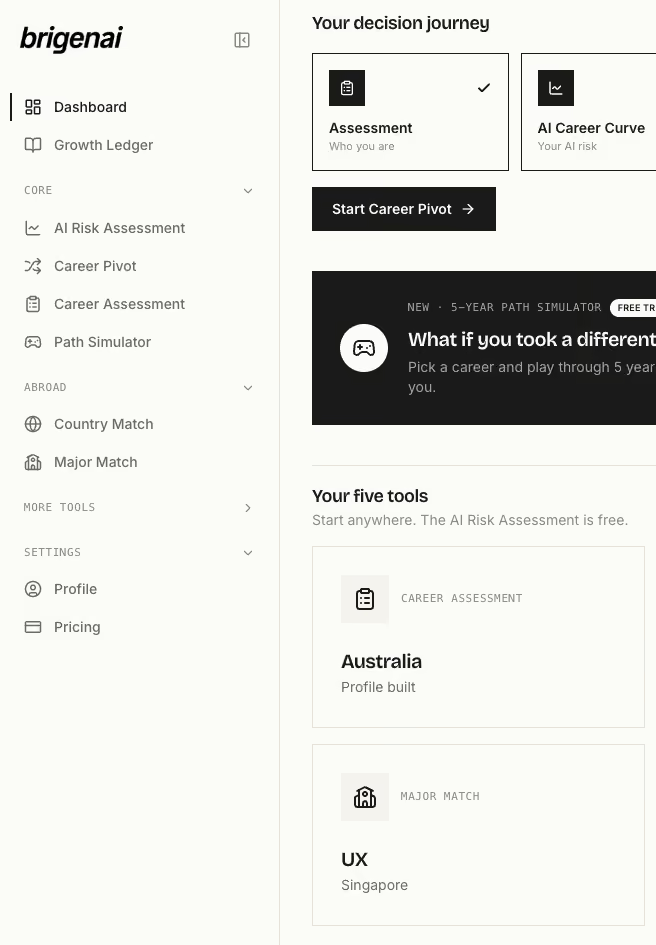
This is exactly the kind of decision brigenai's free Career Assessment is built for. It looks at your background, field, and goals and matches them against real visa pathways and job market data, rather than a generic "best countries for expats" list. If you're not sure which country even fits your situation, Find Your Dream Country can help narrow it down, and once you've got a shortlist, the Work Toolbox has salary calculators and work visa research specifically for Australia, New Zealand, Singapore, Hong Kong, and Taiwan, five markets that are genuinely set up to hire international graduates rather than treating you as an edge case.
Five countries where international grads are a normal hire, not an exception
Here's a realistic look at how each of these places actually works for someone job-hunting from outside, not a "best places to live" ranking, but the actual mechanics of getting a job.

Australia hands recent graduates a Temporary Graduate (subclass 485) visa that comes with full, unrestricted work rights, no employer sponsorship needed just to start working. That's a real advantage if you're used to the US system, where the visa and the job offer are tangled together from day one. It isn't free anymore; application fees for the primary applicant doubled to roughly AUD 4,600 as of March 2026, so budget for that upfront. But once you're on it, you're applying for jobs the same way a local graduate would, which takes a huge amount of pressure off the search itself.
New Zealand rolled out a new graduate visa structure in November 2026 that gives most recent graduates open work rights, either a shorter six-month window for lower-level qualifications or up to a full year for bachelor's degree holders and above. It's a smaller job market than Australia's, so it tends to suit people targeting specific in-demand fields like healthcare, IT, or engineering rather than a broad open-ended search.
Singapore is a strong fit if you're in finance, tech, or a similarly high-paying field, since the Employment Pass requires a job offer meeting a minimum monthly salary, roughly SGD 6,000 for most sectors and SGD 6,600 for financial services as of 2026, scaled up further for older or more senior applicants. That threshold is a real filter for entry-level roles, so it rewards people who've already got a competitive offer in hand rather than those still casting a wide net.

Hong Kong runs one of the more accessible arrangements on this list through its IANG visa: no job offer or salary requirement to get the initial 24-month visa itself, which lets you land, get a Hong Kong address, and job hunt from inside the market rather than applying cold from overseas. Renewals later on do require ongoing employment, and salaries below roughly HKD 18,000-20,000 a month can complicate that renewal, so it's a strong short-term landing spot that still needs a real job within a couple of years.
Taiwan just became one of the easier places on this list to test the waters. Starting January 1, 2026, international graduates from Taiwanese universities can work, full-time or part-time, for up to two years after graduation without needing a separate work permit at all, no salary floor, no industry restriction. It's explicitly a bridge rather than a long-term visa, so you'll still need to move onto a formal work visa afterward, but as a place to gain local experience and figure out your next move without the usual sponsorship hurdle, it's about as low-friction as this list gets.

Matching the country to your actual situation
None of these is universally "the best" one, it depends on what you're solving for.
If your runway is short and you need to start earning fast without a job offer lined up first, Hong Kong's IANG or Taiwan's new post-graduation work window are the lowest-friction options, since neither requires sponsorship just to begin.
If you already have, or can realistically land, a strong offer in a well-paying field, Singapore's structure works in your favor rather than against it.
If you'd rather job hunt with the safety net of a visa that's already yours, no sponsorship strings attached, Australia's 485 visa is hard to beat, even with the higher fee.
And if your field is narrower and more specialized, New Zealand is worth a closer look precisely because its smaller market means less competition for the roles that do match your background.
The part worth remembering
Not getting picked in the H-1B lottery, or watching your OPT clock run out without an offer, isn't a verdict on whether you're employable. It's one country's specific, numbers-driven visa system saying no, which is a very different thing. Plenty of graduates who couldn't crack the US market are building solid careers in Sydney, Auckland, Singapore, Hong Kong, and Taipei right now, in the same fields they trained for.
If you're ready to figure out which of these actually fits your background and timeline, brigenai's free Career Assessment is a reasonable place to start, or browse the rest of the Tools hub for visa research, salary calculators, and cost of living comparisons across all five markets. Everything's free, nothing requires signing up, and you'll come away with something more useful than a forum post: an actual, data-backed sense of where your degree and your timeline can get you hired.