

Key findings
Artificial intelligence has become the most-cited reason for US job cuts in 2026, yet total layoffs are falling and the damage is concentrated in specific roles and age groups rather than spread across the whole workforce.
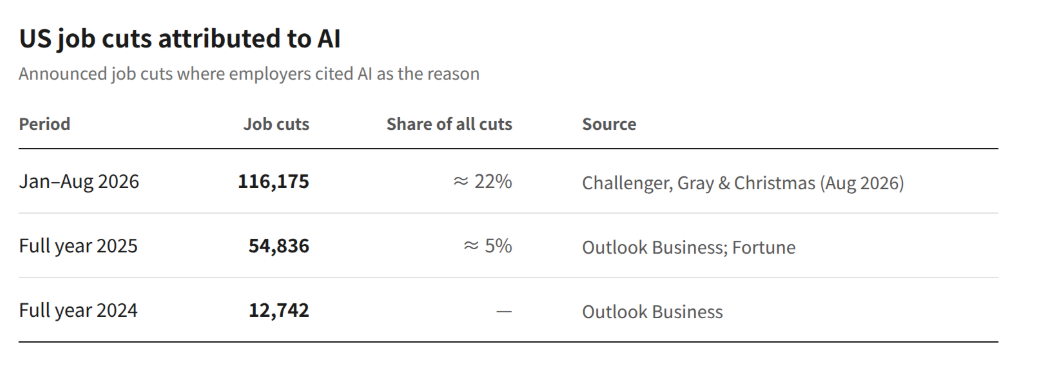
- 116,175 US job cuts were attributed to AI in January–August 2026, about 22% of all announced cuts and more than double the 54,836 recorded for all of 2025 (Challenger, Gray & Christmas, Aug 2026).
- Total US layoffs fell 41% over the same period, to 529,914 from 892,362 a year earlier (Challenger, Aug 2026). AI is changing who gets cut, not how many.
- AI-linked cuts peaked in May at 38,579 (40% of that month's total) and dropped to 3,462 in August (Challenger, Aug 2026; IBTimes UK).
- Technology is the hardest-hit sector, with 155,126 US cuts year to date, up 52% on 2025 (Challenger, Aug 2026).
- Young workers carry the heaviest load. Stanford researchers found employment for 22–25-year-olds in AI-exposed jobs fell 13% relative to other groups since late 2022, while older workers in the same jobs held steady or grew (The Register).
- Not every "AI layoff" is really about AI. Economists at Yale and Oxford Economics warn that some companies use AI as a more investor-friendly explanation for cuts driven by weak demand or past over-hiring (Fortune).
The headline and the reality
In 2026, "AI layoff" stopped being a prediction and became a line item in corporate announcements. From March through July, employers named artificial intelligence as the top reason for US job cuts five months running, according to outplacement firm Challenger, Gray & Christmas (Challenger, Aug 2026).
The headlines that followed suggested a labour market in freefall. The underlying data tells a narrower and more useful story. Layoffs overall are down sharply from 2025, and the jobs being lost to AI cluster in a recognisable set of tasks: customer support, back-office processing, administrative work and entry-level coding.
This report pulls together the most reliable figures available as of 1 October 2026. It covers how many jobs have been cut, which companies made the cuts, which occupations and age groups are most exposed, and where the evidence is weaker than the headlines imply. Every figure links to its source.
The numbers: AI-attributed job cuts
AI-attributed job cuts in the US have grown roughly ninefold in two years, from 12,742 in 2024 to 116,175 in just the first eight months of 2026. The figures below come from Challenger, Gray & Christmas, which has tracked AI as a stated layoff reason since 2023.
A spring surge, then a summer retreat
AI's share of monthly cuts climbed quickly in the first half of the year. It rose from 7% in January to 10% in February, 25% in March and 26% in April, then hit roughly 40% in May (Outlook Business). May's 38,579 AI-linked cuts were the highest monthly figure since Challenger began tracking the category (IBTimes UK).
The wave then eased. AI accounted for 14,029 cuts in June, or 31% of that month's total (Challenger, Jun 2026), and 10,970 in July, when it led all reasons for a fifth consecutive month (Challenger). In August it slipped to fourth place with 3,462 cuts, its lowest monthly total since December 2025. Restructuring took the top spot (Challenger, Aug 2026).
Fewer layoffs overall
The rise in AI-attributed cuts has happened while total layoffs fell. US employers announced 529,914 cuts from January to August 2026, down 41% from 892,362 in the same period of 2025. Excluding government, where 2025 was inflated by federal workforce reductions, the decline is 15% (Challenger, Aug 2026).
Hiring intentions have moved the other way. Announced hiring plans reached 119,825 through August, 37% above the same period last year, with technology, aerospace and defence, and automotive leading (Challenger, Aug 2026). Andy Challenger, the firm's chief revenue officer, summed up the summer data by saying AI is "shifting the labor market, it is not dismantling it" (Challenger, Jul 2026).
Technology takes the hardest hit
Technology companies announced 155,126 US job cuts through August, a 52% increase on the 102,239 recorded a year earlier. The sector accounts for 29% of all 2026 cuts, more than any other industry (Challenger, Aug 2026).
Globally, tracking firm TradingPlatforms counted 160,377 technology job losses this year from company announcements and WARN filings. It linked 90,065 of them, more than half, to AI restructuring, automation or strategic pivots toward AI (Compare the Cloud).
The companies: who cut, and which roles
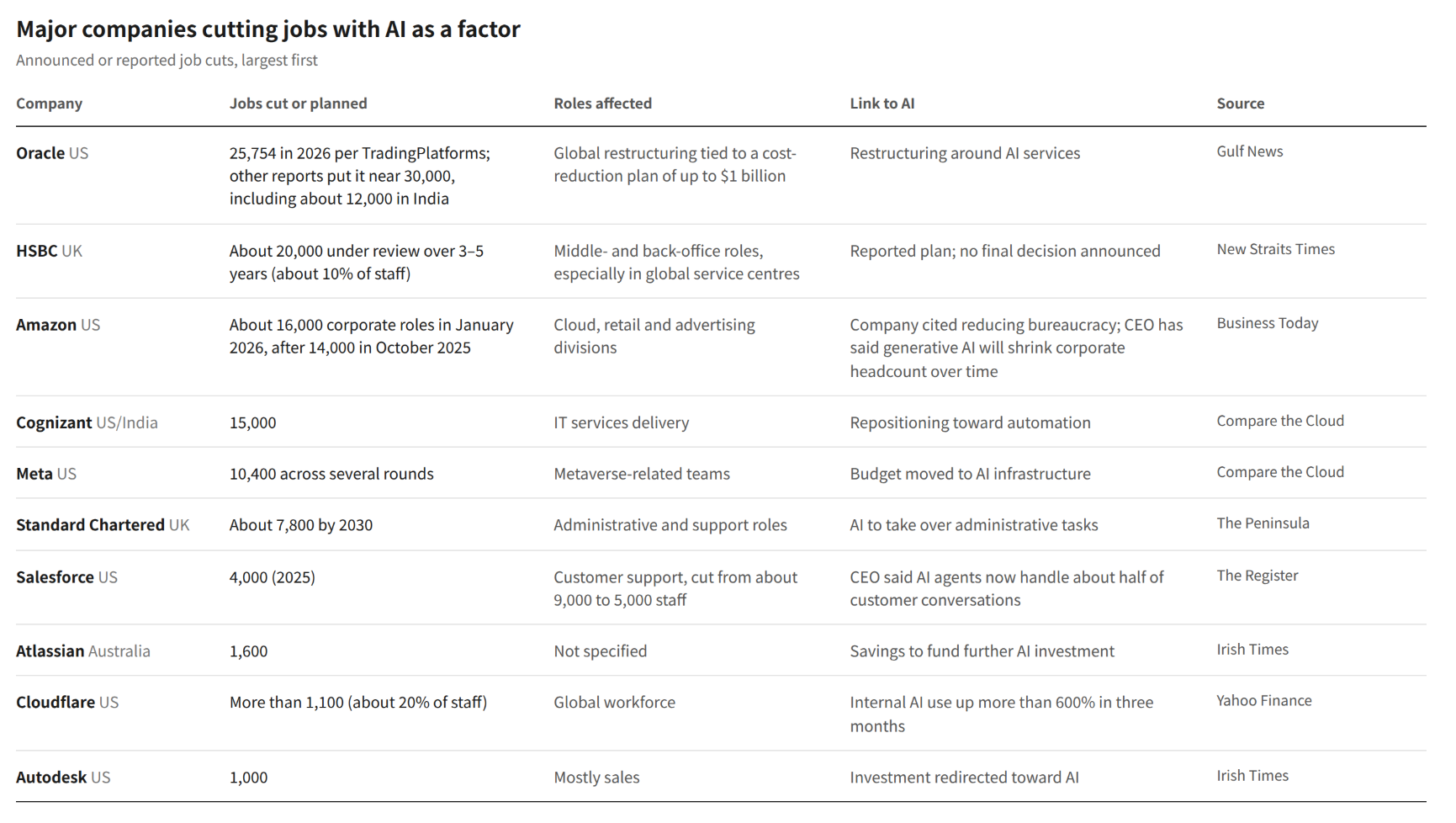
Four companies have each passed 10,000 AI-linked job cuts in 2026: Oracle, Amazon, Cognizant and Meta (Compare the Cloud). The table below lists the largest announcements, sorted by size, together with the roles affected and how directly each company tied the cuts to AI.
The pattern behind the numbers
The clearest cases share one feature: the eliminated roles involve high volumes of repeatable, text-based work. Salesforce is the most explicit example. Chief executive Marc Benioff said on a podcast that he had reduced support headcount from 9,000 to about 5,000, and the company said it no longer needed to backfill support engineer roles (The Register; TechRadar).
The same company shows the other side of the ledger. Benioff later said Salesforce planned to hire 3,000 to 5,000 salespeople, arguing that AI cannot replace face-to-face selling (Storyboard18). The work that disappeared was routine support. The work that grew relied on relationships.
Banking is following a similar logic. HSBC's review reportedly targets non-client-facing operations (New Straits Times / Reuters), and its finance chief has pointed to customer service, know-your-customer checks and transaction monitoring as areas for AI deployment (Zacks). In Germany, Commerzbank's chief executive has said AI could save the bank around €350 million in the coming years (Outlook Business).
The occupations: who is most exposed
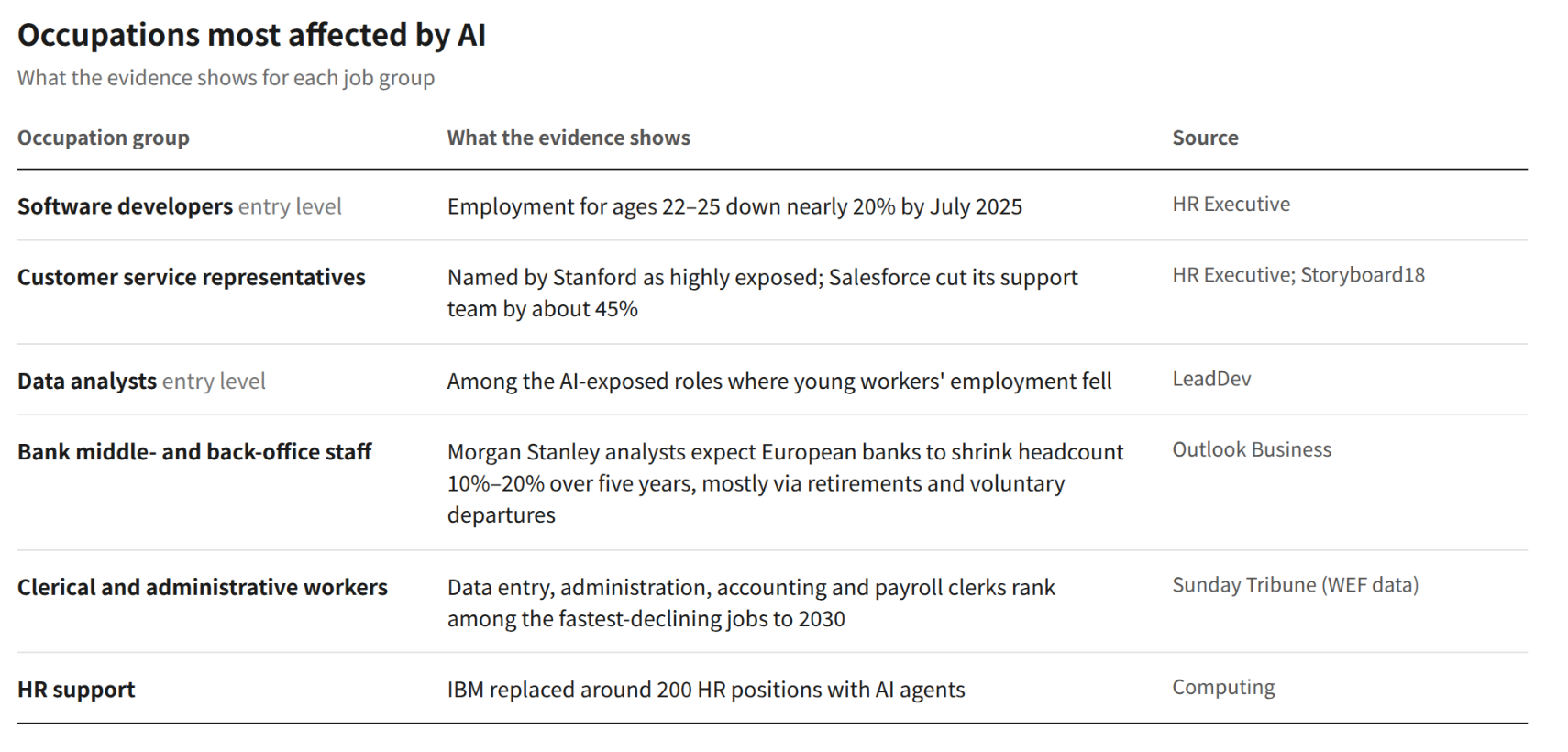
The strongest evidence points to one finding: AI is not wiping out whole occupations, but it is changing who gets hired into them, and early-career workers are losing out first.
The age gap inside the same job
In August 2025, Erik Brynjolfsson, Bharat Chandar and Ruyu Chen of the Stanford Digital Economy Lab published Canaries in the Coal Mine? Six Facts about the Recent Employment Effects of Artificial Intelligence. The paper draws on anonymised ADP payroll records covering millions of workers at tens of thousands of US firms, through July 2025 (LeadDev).
Their central result: since late 2022, employment for workers aged 22 to 25 in the most AI-exposed occupations fell 13% relative to other groups (The Register). For young software developers the drop was close to 20% (HR Executive). Over the same period, employment for older workers in those high-exposure jobs grew by 6% to 12% (Gulf News).
The authors offer an explanation. Younger employees mainly bring textbook knowledge from their education, which AI can reproduce, while experienced staff rely on tacit knowledge built up on the job. The researchers also found entry-level declines were concentrated in roles where AI automates work, with smaller effects where it augments workers (LeadDev).
Occupations with the strongest evidence of pressure
The World Economic Forum's declining-jobs list
The World Economic Forum's Future of Jobs Report 2025, based on a survey of more than 1,000 large employers representing over 14 million workers, lists the roles employers expect to shrink fastest by 2030 (BusinessDay). They include postal clerks, bank tellers, data entry workers, cashiers, administrative clerks, bookkeeping and payroll clerks, stock-keeping workers, graphic designers, claims adjusters, legal secretaries and telemarketers (Sunday Tribune).
Not every item on that list is driven by AI alone. Robotics, digitisation and economic pressures also play a part. But the common thread is work built on routine processing of information.
The counter-evidence: is AI being over-credited?
Several economists argue that AI is being blamed for more layoffs than it actually causes. The research firm Forrester has a name for the practice: "AI-washing" (Fortune).
What the economy-wide data shows
The Yale Budget Lab examined Bureau of Labor Statistics survey data from ChatGPT's release through November 2025. It found no significant change in the mix of occupations or in how long AI-exposed workers stayed unemployed (Fortune). The lab concluded that fears about AI's current effect on jobs remain largely speculative at the level of the whole economy (Allwork.Space).
A later Yale analysis found layoffs rising in the US information sector since December 2025, but said the increase could not be tied directly to AI (Irish Times).
Why companies might over-attribute
Oxford Economics noted that the roughly 55,000 AI-linked US cuts in the first 11 months of 2025 made up only 4.5% of the total, compared with 245,000 attributed to market and economic conditions. The firm suspected that some companies present layoffs as a positive technology story when the real cause is earlier over-hiring (Fortune).
Martha Gimbel, executive director of the Yale Budget Lab, made a similar point. In her view, citing AI lets executives avoid telling investors they struggled with tariffs, lower immigration and policy uncertainty (Allwork.Space).
Investors are not always convinced
The stock market does not reliably reward AI-framed cuts. A Financial Times analysis found that fewer than half of layoff announcements over the past year lifted the share price the next day. Companies that cited AI underperformed the Nasdaq by nearly 10% over the following 30 trading days (Irish Times).
There are also doubts about whether the technology will deliver. Gartner has forecast that more than 40% of agentic AI projects will be cancelled by the end of 2027, citing costs, unclear value and weak risk controls (The Register).
How to read both sides together
The two bodies of evidence are not contradictory. Company announcements show real, concentrated job losses in specific roles. Economy-wide statistics show those losses have not yet changed the overall shape of the labour market. Both can be true at once, and the gap between them is where individual career risk actually sits.
What is growing: hands-on and human-centred work
The jobs holding up best share the opposite traits of those being cut: physical work, care for people, and relationships that rely on trust.
In the Stanford data, employment in hands-on occupations such as home health aides stayed stable or rose while AI-exposed roles for young workers declined (Gulf News). In the Challenger data, 46% of announced US hiring plans in 2026 came from manufacturing industries, with aerospace and defence, and automotive, among the leading sectors (Challenger, Aug 2026). Andy Challenger raised an open question about those plans: whether employers will find workers with the right skills to fill them.
The global outlook to 2030
The World Economic Forum projects that structural change will create 170 million jobs worldwide by 2030, equal to 14% of current employment, while displacing 92 million, or 8%. The result is a net gain of 78 million jobs (World Economic Forum).
Employers surveyed expect the fastest growth in technology roles such as AI, big data and cybersecurity, in green energy occupations, and in care and education. They also expect about 39% of today's core skills to change by 2030 (European Commission Digital Skills and Jobs Platform).
The net number is positive, but it hides a transition problem. The people losing clerical or support roles are rarely the same people who will fill new cybersecurity, nursing or skilled trade positions without retraining.
Where does your career sit?
The data in this report points to a clear conclusion: a job title alone does not tell you your AI risk. Two software developers at the same company can face very different outcomes depending on their experience, and two customer-facing roles can diverge depending on whether the work is routine support or relationship-based selling.
Three questions matter more than the title:
- How much of your day is routine information processing? Drafting standard replies, entering data, checking documents against rules and producing first-draft code are the tasks companies are automating first.
- How much of your value comes from experience rather than training? The Stanford findings suggest that judgement built on the job protects workers better than knowledge learned in a classroom.
- Does your work depend on physical presence, care or trust? Hands-on, care-based and relationship-driven roles have held up best so far.
Brigen's career assessment applies these factors to your own role, experience and skills. It shows where your career sits on the risk spectrum and which durable career paths fit your profile if you are considering a change.
Methodology and limitations
This report compiles publicly available data as of 1 October 2026. Readers should keep four limitations in mind.
- US-centric data. Challenger, Gray & Christmas is the most systematic tracker of AI-attributed layoffs, but it covers US-based employers only. No comparable tracker exists for Europe or Asia, so figures for HSBC, Standard Chartered and other non-US firms come from individual company announcements and news reports.
- Self-reported reasons. Challenger records the reasons companies give in their announcements. It does not independently verify them, and some announcements cover cuts spread over several years (Challenger, Aug 2026).
- Secondary aggregators. Company totals for Oracle, Cognizant and Meta come from TradingPlatforms, which compiles announcements and WARN filings. Different trackers report different totals for the same company. Oracle, for example, appears as 25,754 in one count and about 30,000 in another.
- Plans versus completed cuts. Some figures, notably HSBC's, describe cuts under consideration rather than confirmed layoffs. The Stanford findings measure relative employment changes through July 2025 and do not by themselves prove AI caused them, though the authors say the pattern is consistent with that explanation.
This report will be updated as new monthly Challenger data is released.
Sources
Primary data and reports
- Challenger, Gray & Christmas, Job Cut Announcement Report, August 2026 (released 3 September 2026)
- Challenger, Gray & Christmas, Job Cut Announcement Report, July 2026 (released 6 August 2026)
- Challenger, Gray & Christmas, Job Cut Announcement Report, June 2026
- Challenger, Gray & Christmas, July 2026 report summary
- World Economic Forum, The Future of Jobs Report 2025, Chapter 2: Jobs outlook (published 7 January 2025)
Research coverage
- The Register, Stanford study on AI and recent graduates (26 August 2025)
- LeadDev, Young devs see steepest job losses in AI-exposed roles (27 August 2025)
- HR Executive, Stanford researchers tracked millions of jobs
- Gulf News, AI's job winners vs losers
- Fortune, Yale Budget Lab report and AI-washing (2 February 2026)
- Fortune, AI-washing and forever layoffs (10 February 2026)
- Fortune, Sam Altman on AI-washing (19 February 2026)
- Allwork.Space, Yale report on companies hiding behind AI (3 February 2026)
- Irish Times, Is AI really responsible for recent job cuts? (19 August 2026)
- European Commission Digital Skills and Jobs Platform, Future of Jobs Report 2025 summary
- BusinessDay, WEF Future of Jobs coverage
- Sunday Tribune, The 15 professions most affected by AI (19 February 2025)
Company and industry reporting
- Outlook Business, AI overtakes all other reasons for US job cuts
- Outlook Business, European banks could cut up to 20% of jobs
- IBTimes UK, AI layoffs reach record pace
- Gulf News, Tech layoffs near 154,000 in 2026
- Compare the Cloud, AI drove more than half of 2026's tech layoffs
- Oman Observer, AI-related layoffs by company
- Business Today, Tech layoffs 2026: over 71,000 jobs gone (7 April 2026)
- Yahoo Finance, Layoffs accelerate in May 2026
- New Straits Times / Reuters, HSBC flags 20,000 job cuts (19 March 2026)
- Zacks, HSBC eyes AI-led workforce reduction
- The Peninsula / AFP, Standard Chartered to cut jobs due to AI (19 May 2026)
- The Register, Salesforce cuts 4,000 support jobs (2 September 2025)
- TechRadar, Salesforce replaces support roles with AI
- Storyboard18, Salesforce cuts 4,000 jobs (1 September 2025)
- Storyboard18, Salesforce plans to hire 5,000 sales staff (20 October 2025)
- Computing, Salesforce confirms 4,000 AI-driven job cuts