
You finish a free career assessment and the result says your Holland code is "Investigative/Social." It sounds meaningful, but it doesn't tell you whether that profile leads anywhere in Australia, whether your degree would be recognised in New Zealand, or which visa a data analyst or a nurse would actually use.
Career tests describe you. They don't check whether a country will let you work in the careers they suggest. This guide covers the step that comes after the test: turning your results into a shortlist, checking that shortlist against real visa and credential rules, and deciding whether studying or working comes first.
What a Free Career Assessment Actually Tells You
Most free tests measure one of three things: your interests (what draws you), your personality (how you work), or your aptitude (what you pick up quickly). Interest tests are the most common, and most of them are built on the Holland/RIASEC model, which sorts careers into six types: Realistic, Investigative, Artistic, Social, Enterprising, and Conventional. The U.S. Department of Labor's O*NET Interest Profiler is the best-known example, and it links each interest pattern to specific occupations.
Personality quizzes are fun and can help you reflect, but they are a weaker basis for a decision like choosing a master's program overseas. Whichever test you use, treat your top two or three codes as starting points to check against real requirements.
If you haven't taken a test yet and want help choosing one, brigenai's comparison of free career tests covers the main options. The rest of this guide assumes you already have a result in hand.
Step 1: Turn Your Results Into a Shortlist of Roles
Start with the top five to ten careers your result surfaces, then sort them into two piles.
The first pile is regulated professions: nursing, engineering, teaching, law, and similar fields where you often need registration or a recognised qualification before you can practise. The second pile is open-entry roles, such as marketing, data analysis, or software development, where employers mostly care about skills and experience.
The split matters because the next steps look very different. A regulated role usually means checking a registration body and possibly bridging study. An open-entry role usually means checking whether the occupation and salary meet visa rules. If a role on your list is unfamiliar, a page like brigenai's cybersecurity analyst job field shows what the work involves before you invest time researching visas for it.
Step 2: Check Whether the Role Has a Visa Route
Most free tests never check this. A career can be a strong match on paper and still have no practical visa route for your profile.
Australia. Employer-sponsored work runs mainly through the Skills in Demand visa (subclass 482). Under its Core Skills stream, your occupation must be on the Core Skills Occupation List and the nominated salary must meet the income threshold. If you're weighing this route, brigenai's guide on how to move to Australia for work explains the practical options.
New Zealand. The Green List sorts in-demand jobs into two tiers. Tier 1 jobs lead to the Straight to Residence visa, while Tier 2 jobs lead to the Work to Residence visa. Each role listing shows the qualification, registration, and pay rate you'd need to meet, so a good career match still has to clear those conditions. brigenai's explainer on what the Green List is is a good starting point.
Singapore, Hong Kong, and Taiwan. Work pass and visa rules in these markets depend heavily on your role, salary, and employer, and they change often. Check the official immigration site for the exact category, and use country pages such as brigenai's Singapore and Taiwan guides to understand the job market around it.
Occupation lists and thresholds are updated regularly, so confirm the current version on the official government site before you commit to a plan.
Step 3: Check Credentials and Local Requirements
Credential recognition is the barrier people discover last, and it can add months or years to a plan. A nursing qualification, an engineering degree, or a teaching certificate from your home country may need assessment, registration, or extra coursework before you can work in the same role abroad.
New Zealand's Green List makes this concrete, because qualification and registration requirements are attached to individual roles. Whether an overseas qualification is enough varies by occupation, and brigenai's article on whether you need New Zealand qualifications for Green List roles walks through how that plays out.
Your test result stays useful, but check it against the country's requirements before you act on it.
Step 4: Decide Whether to Study First or Work First
Once you know which roles have a realistic route, the study-or-work question gets easier to answer.
Working first makes sense if you already hold a qualification the destination accepts and your role has an employer-sponsored route. Studying first makes sense if your credential won't transfer, if you're changing fields, or if a local qualification opens a graduate work pathway. In Australia, for example, graduates may be eligible for post-study work options, so brigenai's overview of the post-study work visa in Australia is worth reading before you choose a program.
If you're leaning toward study, look at programs through the lens of the career you shortlisted, not just rankings. brigenai's university match recommends programs based on your field, budget, and career goals.
A Worked Example (Illustrative)
Consider a hypothetical graduate whose test result comes back Investigative/Enterprising, pointing toward data analysis and business consulting. She doesn't stop at the list. She sorts the roles into regulated and open-entry, finds that data analysis is open-entry, then checks whether the occupation appears on the destination's occupation list and whether typical salaries meet the visa threshold. She also compares a direct job search against a one-to-two-year master's that would add local experience.
The test gave her a direction, and the rest was country-specific research, which free tests don't cover.
Where brigenai Fits
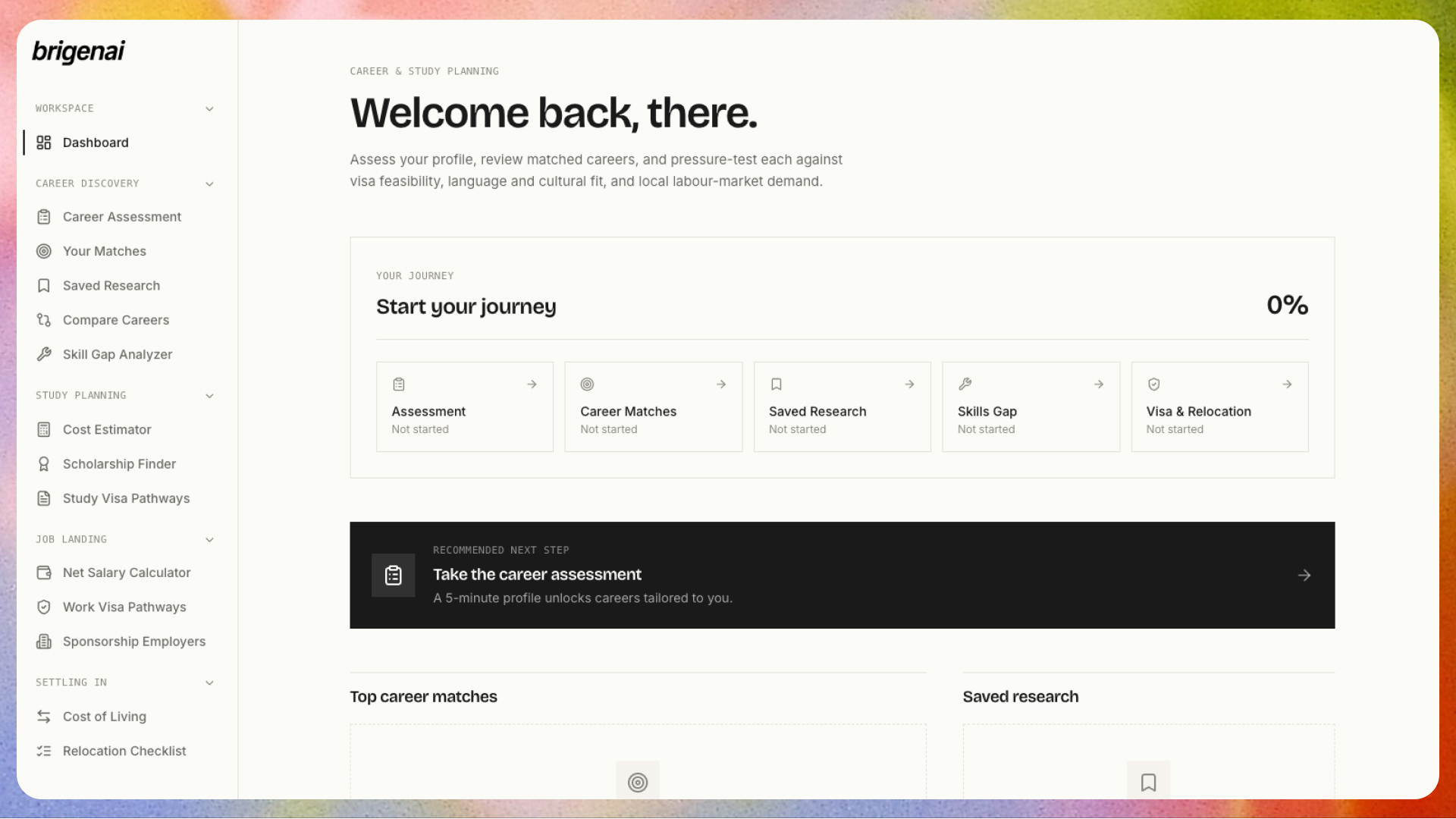
Most free tests give you a career list and end there. brigenai's Career Assessment is free, comes in a 90 second quick version and a 7 minute deep version, and returns ranked career matches, a career profile, salary ranges, and a skill gap breakdown. Because the platform is built around Australia, New Zealand, Singapore, Hong Kong, and Taiwan, you can take those results straight into Country Match, which ranks the five destinations against your budget, education, language ability, and immigration goals, and gives a feasibility report with realistic PR odds and a rough timeline.
Use it as a second step, once you've thought about which careers you want to test. If you'd like more context first, brigenai's guide to using career assessments for working, studying, or immigrating abroad explains how to read the results, and how to choose the right career path before studying abroad covers the study side in more depth.
FAQ
Are free career assessment tests accurate?
Interest-based tests built on the Holland/RIASEC model have decades of research behind them, while many personality quizzes have less support for career matching. Either way, accuracy has limits: a free test describes your interests and tendencies, and it can't confirm whether a career is open to you in another country.
Can a career assessment tell me which country to move to?
No, a standard career assessment can't tell you which country to move to, because it doesn't account for visas, credential recognition, or local demand. You need a second step that checks your matched careers against each destination's rules, which is what tools like brigenai's Country Match are designed to do.
Should I study or work first when moving abroad?
It depends on whether your existing qualification is accepted and whether your role has an employer-sponsored route. If your credential transfers and your occupation is in demand, working first can be faster. If it doesn't, or you're changing fields, studying locally may open a clearer pathway.
How many career assessments should I take?
Two or three is enough. Running tests that use different approaches, such as one interest-based and one values or personality-based, shows you where results overlap, and that overlap is usually your strongest direction.
What should I check after getting my results?
Check three things in order: whether your matched roles are regulated or open-entry, whether they have a visa route in your target country, and whether your credentials will be recognised. Each country publishes its own occupation lists and requirements, so confirm them on official government sources.