

TL;DR:
- Workplace culture influences employee retention more than salary, as 83% stay mainly because of it. Key elements like trust, communication, and work-life balance directly impact team performance and engagement. Developing cultural intelligence helps professionals thrive internationally by reading and adapting to diverse workplace dynamics.
Most professionals assume salary drives career decisions. The data tells a different story. 83% of employees stay with their organisation primarily because of its culture and people, not their pay cheque. For professionals navigating culture and workplace dynamics across borders, this insight changes everything. Understanding what makes a workplace culture tick, and how to read it before you join, is the most underrated career skill you can develop. This article gives you the frameworks, research, and practical tools to do exactly that.
Table of Contents
- The core elements defining workplace culture
- How culture influences team performance and engagement
- Leading and shaping culture in diverse workplaces
- Navigating culture shocks and adapting to new workplace environments abroad
- Practical strategies to foster a thriving workplace culture
- Why culture is the ultimate career navigation tool for global professionals
- Explore tools and services to support your cultural and career journey
- Frequently asked questions
Key Takeaways
| Point | Details |
|---|---|
| Culture drives retention | Professionals stay mainly because of workplace culture and strong peer relationships rather than salary alone. |
| Leadership shapes culture | Managers and leaders directly influence culture through their actions, communication, and recognition practices. |
| Psychological safety fuels performance | A safe, inclusive environment where people can speak openly boosts motivation and team success. |
| Adaptation eases relocation | Structured support and intercultural training effectively reduce culture shock for international professionals. |
| Recognition inspires loyalty | Frequent, meaningful appreciation integrated into daily work significantly increases engagement and retention. |
The core elements defining workplace culture
Culture is not a ping-pong table or a values poster on the wall. It is what employees actually experience every day: the way decisions get made, how disagreements are handled, whether your manager backs you up or throws you under the bus. It is the gap, or the alignment, between what a company says it stands for and what actually happens at 4pm on a Friday.
The top factors impacting culture are work-life balance (47%), immediate peers (37%), and communication and transparency (33%). These are not abstract ideals. They are the daily texture of your working life, and they compound over time into either engagement or quiet resignation.
Here is what the core elements of workplace culture actually look like in practice:
- Work-life balance: Whether late-night emails are expected or genuinely discouraged
- Peer relationships: Whether your colleagues collaborate or compete at your expense
- Communication norms: Whether feedback is direct, indirect, frequent, or almost nonexistent
- Manager behaviour: Whether your direct manager advocates for you or manages upward only
- Company values in action: Whether stated values influence real decisions around hiring, promotion, and conflict
The common cultural failures organisations face are predictable: lack of recognition, poor communication from leadership, and misalignment between espoused values and lived experience. Exploring workplace insights for your career move before accepting a role abroad can help you spot these misalignments early, before they cost you a year of your career.
How culture influences team performance and engagement
Understanding the elements is one thing. Seeing their measurable impact on performance is what makes the case undeniable.

High-performing teams scored 38 to 50 points higher across culture dimensions including trust and psychological safety, according to RW3 CultureWizard’s 2026 research. Psychological safety, the belief that you can speak up, ask a question, or flag a mistake without being punished, is not a soft concept. It is the structural condition that allows teams to learn faster, solve problems more creatively, and retain their best people.
The performance gap between strong and weak cultures is stark:
83% of employees rating their culture as good or excellent are motivated to produce high-quality work, compared to just 45% in poor cultures.
That is not a marginal difference. It is the difference between a team that ships great work and one that does the minimum to stay employed.
Several factors either build or erode psychological safety in practice:
- Trust in leadership: Employees who trust their managers take more initiative and report problems earlier
- Clarity of expectations: Ambiguity breeds anxiety; clear communication reduces it
- Inclusion in decision-making: Being consulted, even informally, signals that your perspective matters
- Consistent recognition: Acknowledgement reinforces the behaviours that make teams function well
One underappreciated issue is the leadership perception gap. Senior leaders often believe culture is strong because their own experience of the organisation is positive. Employees two or three levels down may experience something entirely different. Reviewing international hiring process tips can help you ask the right questions during interviews to probe whether the culture a company describes matches what people on the ground actually feel.
Leading and shaping culture in diverse workplaces
Leaders do not just influence culture. They are the primary mechanism through which culture either strengthens or deteriorates. Managers account for 70% of variance in employee engagement, which means every decision a manager makes, every email they send, and every conversation they avoid is a cultural act.
Culture management differs from conventional management in a specific way: it requires culturally selective hiring, deliberate socialisation of new employees, and peer-led supervision rather than top-down control alone. This is especially relevant in multicultural teams, where shared assumptions cannot be taken for granted.
Here is a practical framework for leaders shaping culture across diverse teams:
- Hire for cultural contribution, not just cultural fit. Fit can mean sameness. Contribution means someone adds a perspective the team currently lacks while still aligning with core values.
- Onboard with intention. The first 90 days set expectations. Structured introductions, clear communication norms, and early wins build belonging faster than any orientation document.
- Conduct regular culture audits. Ask employees whether the values on the wall match the decisions being made. Anonymous pulse surveys work, but direct conversations work better.
- Model the behaviour you want to see. Psychological safety starts with a leader who admits mistakes, asks questions, and credits others publicly.
- Recognise consistently, not just at performance review time. Frequent, specific acknowledgement is more motivating than a bonus mentioned once a year.
Pro Tip: Watch how your leaders behave under pressure. When a project fails or a deadline is missed, do they problem-solve or assign blame? That reaction reveals more about the real culture than any values statement ever will.
You can review a skills list for cultural fit to identify which competencies signal genuine cultural intelligence, and explore relocation services if you are preparing to lead or join a team in a new country.
Navigating culture shocks and adapting to new workplace environments abroad
Even professionals with strong cultural intelligence hit a wall when they relocate. Culture shock is not weakness. It is a predictable neurological response to an environment where your unconscious assumptions about how things work are suddenly wrong.
Culture shock phases last 3 to 12 months, and HR check-ins, intercultural training, and buddy programmes meaningfully reduce disorientation during that window. The four phases move from honeymoon (everything is exciting and novel) to frustration (small daily frictions become exhausting) to adjustment (you start building new habits) and finally acceptance (the new environment feels genuinely navigable).
What catches most professionals off guard is not the big cultural differences. It is the invisible ones: whether it is acceptable to push back on a senior colleague, how much silence is comfortable in a meeting, whether socialising after work is optional or quietly mandatory.
| Challenge | What it looks like | Practical response |
|---|---|---|
| Communication style | Direct feedback feels harsh; indirect feedback feels vague | Ask your manager explicitly how feedback is typically delivered |
| Hierarchy expectations | Flat structures can feel disrespectful; steep ones can feel stifling | Observe how colleagues interact with senior staff before acting |
| Social norms | After-work drinks may be cultural currency | Participate selectively but consistently early on |
| Recognition styles | Public praise is motivating in some cultures, embarrassing in others | Watch how high performers are acknowledged before seeking it |
Notably, 69% of international assignment failures cite partner or family resistance as a key factor. The professional’s adaptation is only half the equation. Preparing your support network for the transition is just as important as preparing yourself.
Pro Tip: Even basic language skills in your new country signal respect and accelerate trust-building with local colleagues. You do not need fluency. You need effort.
Use an international relocation checklist to prepare systematically, and explore expat tools and resources designed specifically for professionals making cross-border moves.
Practical strategies to foster a thriving workplace culture
Insight without action is just interesting reading. Here is what actually moves the needle on building a positive work environment, whether you are a team leader, an HR professional, or an individual contributor trying to make your workplace better.
- Build recognition into the daily rhythm. Not annual reviews. Not quarterly shout-outs. Daily, specific acknowledgement of what people do well. Employees feeling inspired are 6 times more likely to produce great work and 14 times more likely to stay, yet only 21% of workplaces integrate recognition into the daily experience.
- Create space for honest dialogue. Psychological safety does not happen by announcing it. It happens through clear communication and active listening that makes people feel genuinely heard.
- Remove invisible barriers. Bureaucratic processes that block progress without explanation destroy morale faster than any single bad manager. Audit what frustrates your team and fix the fixable ones visibly.
- Co-create team goals. Ownership follows involvement. When people help shape the target, they care more about hitting it.
- Encourage peer recognition. Manager praise matters, but peer acknowledgement often feels more authentic and more immediate.
Culture is not what you promise during hiring. It is what you do when things go wrong, when resources are tight, and when no one is watching.
For professionals considering a move abroad, understanding how to unlock career growth internationally starts with knowing how to read and contribute to the culture you are entering. And for organisations building diverse teams, reviewing international hiring best practices ensures you are not just hiring globally but integrating effectively.
Why culture is the ultimate career navigation tool for global professionals
Here is the perspective most career advice misses entirely: culture is not just something that happens to you at work. It is a navigation instrument. And most professionals have never been taught to use it.
When you evaluate a new role, you probably look at the title, the salary, and the growth potential. What you should also be mapping is the cultural terrain. Does this organisation’s communication style match how you process feedback? Does the hierarchy align with how you make decisions? Does the recognition model match what actually motivates you? These questions are not soft. They predict whether you will thrive or burn out within 18 months.
Managers’ behaviours under pressure reveal the true culture of an organisation. Employees watch reactions far more than they read values statements. This is especially true for professionals relocating internationally, where the gap between stated culture and lived culture can be wider because the familiar cultural cues you relied on at home no longer apply.
Cultural intelligence, the ability to read, adapt to, and contribute meaningfully to unfamiliar cultural environments, is arguably the most transferable career skill of the next decade. It is not about becoming someone else. It is about expanding your range. A professional who can operate effectively in a flat Singaporean tech team, a hierarchical Japanese corporation, and a collaborative Australian consultancy is genuinely rare and genuinely valuable.
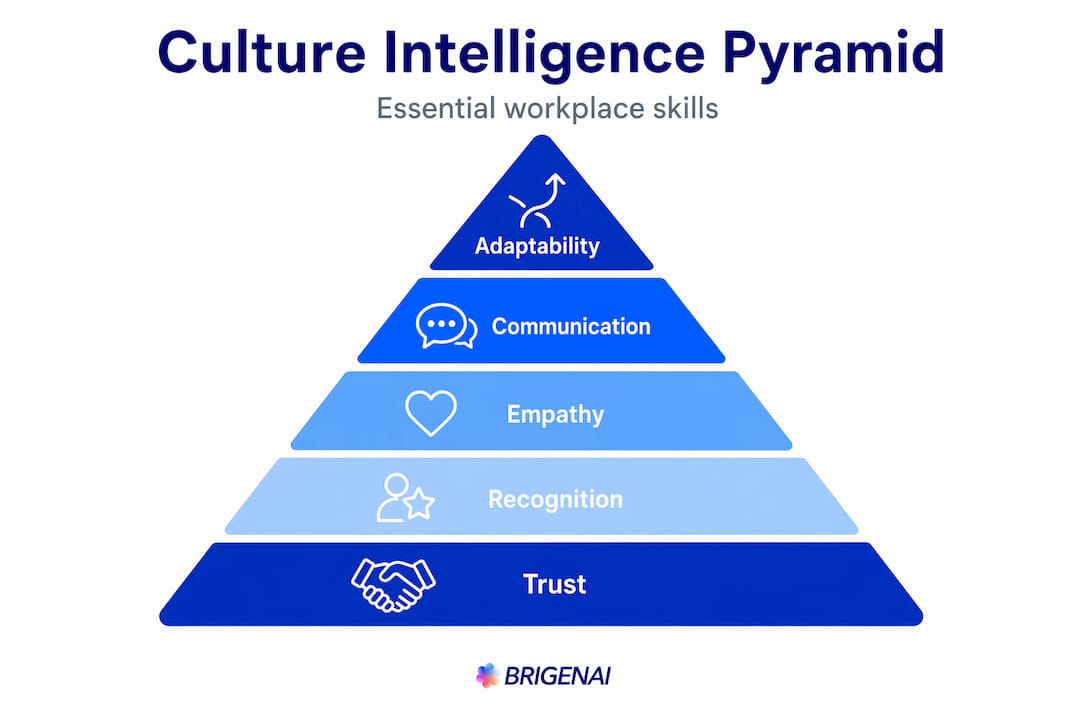
The organisations that lose talent despite offering strong salaries and good benefits almost always have the same problem: they stopped investing in communication and recognition. They assumed culture would maintain itself. It never does. Culture requires deliberate, ongoing attention, especially as teams grow, change, and diversify.
For professionals charting Asia-Pacific career moves, developing cultural intelligence is not optional. It is the difference between landing a role and actually building a career.
Explore tools and services to support your cultural and career journey
Navigating a new workplace culture is far easier when you have the right preparation behind you. BRIGENAI brings together AI-powered tools, curated checklists, and real-world insights to help you move with confidence, not guesswork.
Whether you are preparing for your first international role or refining your approach to cultural adaptation, BRIGENAI’s resources are built for exactly this. Use the international relocation checklist to prepare for the practical and cultural realities of your move. Browse the skills list for visa and employment to identify where your cultural and professional competencies align with opportunities in your target country. And explore the full expat tools hub for resources that cover everything from cost of living to workplace dynamics across Australia, New Zealand, Singapore, Taiwan, and beyond.
Frequently asked questions
What are the key factors that make workplace culture important for employee retention?
The top factors are culture and people, work-life balance, communication transparency, and immediate peer relationships. Together, these create the trust and daily experience that keep employees engaged long-term, with 83% of employees staying primarily because of culture rather than compensation.
How can leaders effectively shape a positive workplace culture?
Leaders shape culture through consistent daily actions, not annual statements. Managers account for 70% of variance in employee engagement, which means how a manager communicates, recognises effort, and responds to mistakes defines the culture their team actually experiences.
What strategies help employees adjust to culture shock during international relocation?
Structured HR check-ins, intercultural training, mentorship programmes, and buddy systems all reduce disorientation during the adjustment period. Culture shock phases typically last 3 to 12 months, so proactive support during this window significantly improves both retention and performance.
Why is psychological safety crucial in the workplace?
Psychological safety allows employees to raise concerns, ask questions, and take risks without fear of punishment, which directly enables learning and collaboration. Psychological safety grows through clear communication, active listening, and consistent empowerment from leadership.