

Malaysia surprises most professionals who research it seriously. The assumption that affordable living means compromising on quality simply does not hold here. Kuala Lumpur offers modern infrastructure, world-class healthcare, and a vibrant international community at a fraction of what you would pay in Singapore or Hong Kong. Yet many skilled migrants still arrive with budgets built on guesswork rather than real data. This guide breaks down exactly what you can expect to spend on housing, food, transport, healthcare, and leisure, so you can plan with confidence rather than hope.
Table of Contents
- Understanding Malaysia’s housing market and rental prices
- Daily expenses: food, transportation, and utilities
- Lifestyle, leisure, and healthcare costs
- Comparing Malaysia’s living cost with regional cities
- What skilled migrants really need to plan for: beyond the numbers
- Get trusted help planning your move to Malaysia
- Frequently asked questions
Key Takeaways
| Point | Details |
|---|---|
| Housing is affordable | Rental costs in Malaysia are lower than Singapore and offer flexible options for professionals. |
| Daily expenses are manageable | Food, transport, and utilities are budget-friendly in urban and suburban areas alike. |
| Healthcare offers value | Malaysia provides high-quality healthcare at accessible costs for skilled migrants and expats. |
| Malaysia boosts purchasing power | Living costs are up to 40% lower than in Singapore, making your salary go further. |
| Plan beyond just the numbers | Budget for relocation expenses, lifestyle factors, and settling in to avoid financial surprises. |
Understanding Malaysia’s housing market and rental prices
Housing will be your biggest monthly outlay, and it is worth getting this right before you commit to anything. The good news is that Malaysia offers genuine variety across price points, locations, and property types, which means you can tailor your living situation to your lifestyle and budget rather than simply taking what is available.
In Kuala Lumpur, a modern one-bedroom apartment in a central location such as Mont Kiara or Bangsar typically rents for between MYR 2,000 and MYR 3,500 per month. A two-bedroom unit in the same areas ranges from MYR 3,000 to MYR 5,500. Move slightly further out to areas like Cheras or Kepong and those prices drop noticeably. Penang sits in a similar range, with Georgetown apartments running MYR 1,500 to MYR 3,000 for a two-bedroom. Johor Bahru is notably cheaper still, with comparable properties often available for MYR 1,200 to MYR 2,200 per month.
| City | 1-bed (MYR/month) | 2-bed (MYR/month) |
|---|---|---|
| Kuala Lumpur (central) | 2,000 – 3,500 | 3,000 – 5,500 |
| Penang (Georgetown) | 1,200 – 2,200 | 1,500 – 3,000 |
| Johor Bahru | 900 – 1,600 | 1,200 – 2,200 |
Beyond standard apartments, Malaysia has a strong market for serviced residences. These are fully furnished units, often in mixed-use towers, that include cleaning services, a gym, and a pool. They cost 20 to 40 per cent more than unfurnished apartments but can make sense for professionals arriving without furniture. Landed properties, meaning terraced or semi-detached houses, are popular with families relocating together and offer significantly more space, though they are concentrated in suburban areas.
As noted in Singapore rental comparisons, urban rental prices in Malaysia are considerably lower than Singapore’s, with modern apartments available across a range of budgets. This gap becomes very real when you look at global cost comparisons across the Asia-Pacific region. Before signing any lease, always check current currency exchange rates so your home-country salary conversion is accurate.
Pro Tip: Negotiate for a fully furnished rental that includes Wi-Fi and utilities in the monthly rate. Landlords in Malaysia are often willing, and it simplifies your budgeting considerably during the first six months.
- Lease terms are typically 12 months, with a two-month deposit plus one month advance.
- Many condominiums include gym, pool, and security in the monthly fee.
- Utilities are rarely included in standard rentals, so clarify this upfront.
Daily expenses: food, transportation, and utilities
Once you have locked in housing, your next priority is understanding what daily life actually costs. Malaysia is well-known for affordable food, but the range is wide depending on your habits.
Local hawker centres and coffee shops (known as kopitiams) are where Malaysians eat most meals. A full lunch or dinner here runs between MYR 6 and MYR 12 per person. Mid-range restaurants catering to expats and professionals typically charge MYR 20 to MYR 50 per person. Kuala Lumpur’s growing collection of Western-style restaurants and brunch spots can push individual meal costs to MYR 60 and above. Grocery shopping at local markets is very affordable, though imported and international brands at supermarkets like Jaya Grocer or Ben’s Independent Grocer cost noticeably more.

| Expense | Local option (MYR) | Western/expat option (MYR) |
|---|---|---|
| Meal out (per person) | 6 – 12 | 40 – 80 |
| Monthly groceries | 300 – 500 | 700 – 1,200 |
| Monthly transport (public) | 80 – 150 | 80 – 150 |
| Monthly Grab (ride-share) | 200 – 400 | 200 – 400 |
Public transport in Kuala Lumpur is genuinely useful. The LRT, MRT, and monorail networks cover most professional districts, and a monthly pass runs around MYR 100 to MYR 150. For areas not well-served by rail, Grab is the dominant ride-share option and is significantly cheaper than taxis in most other regional capitals. Car ownership is common and affordable by regional standards, though traffic congestion in Kuala Lumpur is real and worth factoring in.
Utilities for a standard two-bedroom apartment typically run MYR 100 to MYR 200 per month for electricity and water combined, thanks partly to government subsidies. Broadband internet is fast and competitively priced, with plans starting around MYR 80 to MYR 130 monthly for 500 Mbps to 1 Gbps speeds. As salary comparisons across the region confirm, Malaysia’s daily expenses for food and transport are considerably lower than other regional business hubs. When managing your currency, compare MYR buyback rates regularly to maximise what your money is worth.
- Budget MYR 800 to MYR 1,500 monthly for food if you eat a mix of local and international.
- A basic monthly car loan for a Perodua or Proton runs around MYR 500 to MYR 700.
- Mobile plans with 30 to 50 GB data cost MYR 40 to MYR 80 monthly.
Lifestyle, leisure, and healthcare costs
Beyond the essentials, the lifestyle you maintain in Malaysia will shape your total monthly spend significantly. The good news is that leisure options are broad and pricing is accessible even at the premium end.
Gym memberships at mid-tier fitness chains like Celebrity Fitness or True Fitness run MYR 100 to MYR 200 per month. Premium international gyms in Kuala Lumpur city centre can reach MYR 300 to MYR 400. Golf, tennis, and swimming clubs are well-established and often more affordable than equivalent facilities in Australia or Singapore. Cinema tickets cost MYR 14 to MYR 25, and Kuala Lumpur’s restaurant scene has genuinely expanded in recent years.
For families with school-age children, international schooling is the most significant lifestyle expense. Annual fees at reputable international schools range from MYR 30,000 to MYR 90,000 per child depending on curriculum (British, American, or IB) and school reputation. Private tuition is widely used and costs MYR 50 to MYR 200 per hour depending on the subject and level.
Malaysia’s healthcare system is one of Southeast Asia’s most underrated advantages for skilled migrants. Private hospitals like Pantai, Sunway Medical, and Prince Court deliver care that matches international standards at a fraction of the cost found in Singapore or Australia.
As noted in Singapore lifestyle comparisons, Malaysia offers world-class healthcare at lower costs compared to neighbouring countries. A private GP consultation costs MYR 50 to MYR 150. Specialist visits run MYR 150 to MYR 400. For reference, a straightforward surgery that costs SGD 20,000 in Singapore may cost MYR 15,000 to MYR 30,000 in Malaysia, which is still material savings. Before you finalise any move, it is worth reviewing relocation expense tips to ensure healthcare and insurance costs are properly accounted for in your budget.
Pro Tip: Annual health insurance packages for expats in Malaysia start from around MYR 3,000 to MYR 6,000 per year and can dramatically reduce out-of-pocket costs for specialist care and hospitalisation.
- Gym: MYR 100 to MYR 400 monthly.
- International school fees: MYR 30,000 to MYR 90,000 annually.
- Private health insurance (expat): MYR 3,000 to MYR 6,000 per year.
Comparing Malaysia’s living cost with regional cities
Numbers mean more when you have context. Here is how Malaysia’s cost of living stacks up against the key regional alternatives that professionals typically consider.
| City | Monthly rent, 2-bed (USD) | Meal out (USD) | Monthly transport (USD) |
|---|---|---|---|
| Kuala Lumpur | 700 – 1,200 | 3 – 18 | 25 – 50 |
| Singapore | 2,500 – 4,500 | 8 – 35 | 80 – 120 |
| Hong Kong | 2,800 – 5,000 | 7 – 30 | 60 – 100 |
| Taipei | 900 – 1,800 | 4 – 20 | 35 – 60 |
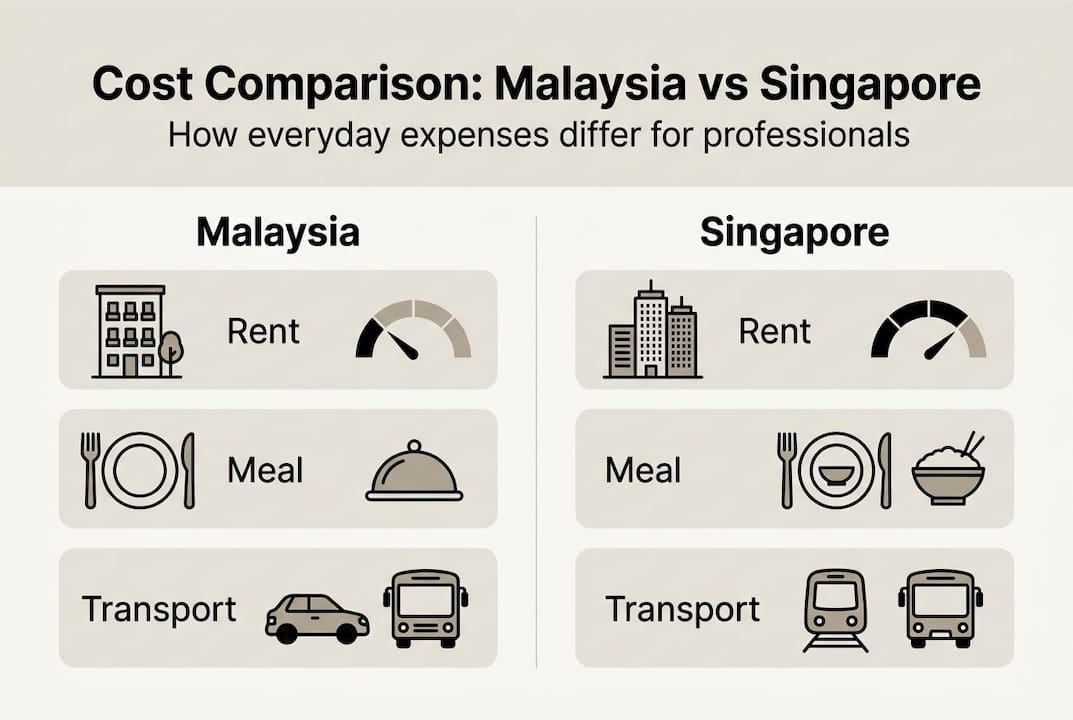
Malaysia’s cost of living is up to 40% lower than Singapore, enabling professionals to maximise their purchasing power considerably. That gap is not just about rent. When you factor in food, transport, and healthcare together, the difference compounds quickly. A professional earning MYR 12,000 per month in Kuala Lumpur can live very comfortably, whereas the equivalent salary in Singapore would feel tight in the same category of lifestyle.
It is also worth noting that global cost comparisons give professionals genuine clarity around budgeting for relocation, particularly when salary packages across different countries are not straightforward to compare. Always check salary benchmarks for your specific profession in Malaysia rather than relying on general averages, since tech, finance, and engineering professionals often see quite different relativities.
Here are the steps for evaluating your own scenario:
- Identify your core lifestyle requirements (location, property type, schooling needs).
- Use regional cost benchmarks to set a realistic monthly budget.
- Cross-reference Singapore salary comparison data if you are weighing up both destinations.
- Review Singapore expense data to understand exactly what you are saving by choosing Malaysia.
- Build a 12-month cash flow model before you commit, accounting for both the lower costs and any salary adjustment.
One often-overlooked factor is purchasing power parity. A senior engineer in Kuala Lumpur earning MYR 15,000 monthly has considerably more disposable income than a counterpart in Singapore earning SGD 8,000, once you account for rent, food, and transport differences.
What skilled migrants really need to plan for: beyond the numbers
Cost comparison tables are useful. They are not, however, the full picture. The professionals we have seen plan their moves most successfully are the ones who treat financial data as a starting point rather than a conclusion.
One recurring gap is what we call the settling-in cost lag. Many migrants budget accurately for ongoing monthly expenses but underestimate the cash required in the first 60 to 90 days. Rental deposits, initial furniture purchases, visa fees, professional registration costs, and the inevitable stream of small purchases add up fast. As relocation budgeting guidance consistently shows, most people underestimate upfront relocation costs by 30 to 50 per cent.
There is also a genuine trade-off between urban convenience and suburban savings that is worth thinking through honestly. Living in Mont Kiara or Bangsar puts you close to international schools, expat communities, and corporate offices, but you will pay a 40 to 60 per cent rental premium over outer suburbs. The suburban option is genuinely liveable in Malaysia, especially with a car, but it requires intentional planning rather than a reactive decision driven by initial budget pressure.
Pro Tip: Build a dedicated settling-in fund of at least MYR 15,000 before you arrive. Cover it separately from your monthly budget, and you will avoid the financial stress that catches many newly arrived professionals off guard. You can explore relocation services insights to understand what support is available during this period.
Get trusted help planning your move to Malaysia
Planning a move to Malaysia involves a lot of moving parts, and having the right data makes the difference between a stressful transition and a confident one.

BRIGENAI brings together Malaysian cost benchmarks, salary data for Malaysia, and a network of vetted advisors who have actually made the move themselves. Whether you need a destination cost comparison, a detailed salary breakdown for your profession, or access to relocation expertise from professionals who have navigated the same journey, BRIGENAI connects you with the right tools and the right people. Stop guessing at your budget and start building it on real, structured data from people who have been there.
Frequently asked questions
How much should a single professional budget each month in Kuala Lumpur?
A typical single professional in Kuala Lumpur should budget between MYR 3,000 and MYR 6,000 per month, factoring in rent, utilities, transport, and lifestyle. Urban rental prices and daily costs sit well below comparable regional capitals.
Is healthcare expensive for expats living in Malaysia?
Healthcare in Malaysia is high-quality and relatively affordable, with international insurance packages costing considerably less than in many neighbouring countries. Malaysia offers world-class healthcare at lower costs than Singapore or Australia.
What are the typical upfront expenses for relocating to Malaysia?
Upfront expenses usually include rental deposits, relocation fees, and initial utility setup, so budget at least MYR 8,000 to MYR 15,000 before arrival. Thorough relocation budgeting must account for both financial and lifestyle trade-offs.
How do Malaysian living costs compare to Singapore?
Malaysia’s cost of living is up to 40% lower than Singapore, enabling professionals to maximise their purchasing power across rent, food, and healthcare.
What is the best way to manage currency exchange when moving to Malaysia?
Compare ringgit exchange and buyback rates regularly to get the most value from your conversions before and after relocating. Reviewing current MYR rates before any large transfer can save you a meaningful amount.