
Relocation trends in 2026 are defined by a fundamental shift in what drives people to move: affordability, family stability, and corporate mobility strategy have overtaken pure career ambition as the primary forces shaping where professionals choose to live and work. The role of relocation trends 2026 extends well beyond logistics. These patterns determine which cities attract talent, which visa pathways fill fastest, and which employers win the competition for skilled workers willing to cross borders. Whether you are a mid-career professional weighing an international offer or a student mapping your first move abroad, understanding 2026 relocation patterns is the clearest advantage you can give yourself before making a decision that reshapes your life.
What are the main drivers behind relocation trends in 2026?
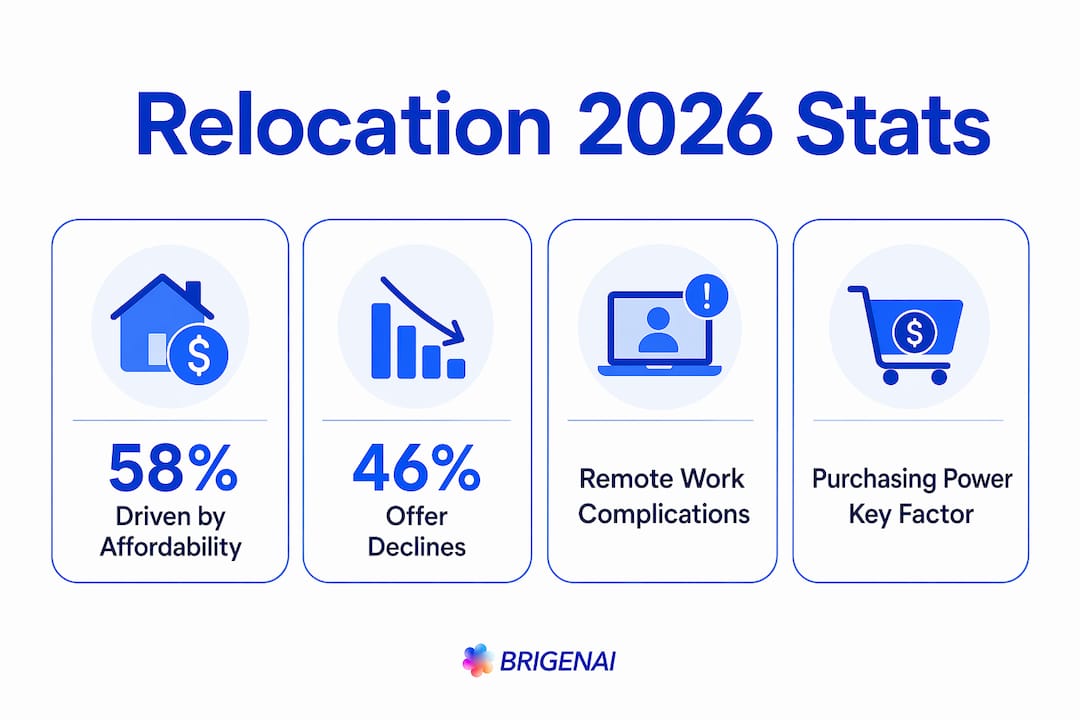
Affordability is the single most powerful force behind 2026 relocation patterns. The PODS Moving Mindset Study found that 58% of movers cite affordability as their primary reason for relocating, overtaking career progression for the first time. This signals that professionals are no longer accepting high-cost postings simply because the job title is impressive.
Housing market dynamics compound the affordability problem in a specific way. The so-called “lock-in effect” traps homeowners in properties with low fixed-rate mortgages, making short-distance moves financially irrational. This suppresses overall mobility volumes while simultaneously pushing those who do move toward longer-distance, higher-impact relocations. Redfin’s 2026 analysis confirms that lifestyle and family priorities now surpass job-driven motivations across most demographic groups.
Family considerations have become a decisive filter at the point of offer acceptance. School quality, proximity to extended family, and partner employment prospects are no longer secondary concerns that professionals mention politely before accepting. They are the reasons offers get declined. This shift has direct consequences for employers designing relocation packages and for professionals negotiating the terms of an international move.

Economic and political uncertainty adds another layer of complexity. Geopolitical instability in several regions has made professionals more selective about destination countries, favouring markets with stable governance, clear immigration pathways, and predictable cost structures. For international career planners, destinations such as Australia, New Zealand, and Singapore continue to attract interest precisely because they offer regulatory clarity alongside quality of life.
Key affordability and lifestyle factors driving relocation decisions in 2026:
Pro Tip: Before evaluating any international role, calculate your purchasing power parity in the destination city, not just the headline salary. A 20% pay rise that disappears into higher rent and school fees is not a pay rise at all.
How are corporate relocation programmes evolving in 2026?
Corporate mobility is growing in volume and budget, but the programmes themselves are under pressure to deliver more than a moving allowance. The Atlas Van Lines 59th Annual Corporate Relocation Survey reports that 54% of organisations saw increased relocation volume in 2025, with 61% expecting budgets to grow further in 2026. That growth in investment has not translated into smoother outcomes, because the barriers to acceptance have grown alongside the budgets.
“Despite rising budgets, relocation offer acceptance is increasingly constrained by real-life factors such as housing and family needs.”
The data on declined offers is striking. 46% of companies reported an increase in declined relocation offers in 2025, with family and housing concerns cited as the primary reasons. School moves specifically appear in the top five reasons for declining a relocation offer, according to the Atlas Van Lines survey. This means employers who design packages without addressing school placement support, temporary housing, and spousal career assistance are leaving offers on the table.
The most effective corporate programmes in 2026 share four characteristics:
Organisations that treat relocation as a strategic investment in workforce mobility, rather than a transactional cost, report higher acceptance rates and better retention of relocated employees in the 12 months following a move. For professionals evaluating an international offer, asking directly about each of these four elements is not unreasonable. It is due diligence.
What role does sustainability and regulatory change play in global mobility?
Global mobility in 2026 is no longer a discrete transaction managed by HR. It is an ongoing compliance and risk management function, and the Lewis Silkin analysis of 2026 trends frames it precisely that way. Digital border controls, heightened tax scrutiny, and social security compliance requirements have transformed what was once a paperwork exercise into a genuine risk management discipline.
Sustainability has entered the mobility equation in a way that surprises many professionals. The Cartus Global Talent Mobility Survey 2026 found that over half of companies now have business-wide sustainability policies that directly influence their mobility programmes. This affects everything from the mode of transport approved for international moves to the types of accommodation considered acceptable under corporate policy.
Regulatory and sustainability factors professionals must account for in 2026:
Pro Tip: If your employer’s relocation offer involves any period of remote work before your visa is finalised, get written clarity on your tax residency status during that interim phase. This is one of the most common and costly compliance oversights in international assignments.
Contingency planning has become a standard feature of well-managed mobility programmes. Lewis Silkin recommends that organisations build geopolitical and operational risk scenarios into their mobility frameworks, not as a theoretical exercise but as a practical response to the frequency of regulatory changes across key destination markets. For professionals, this means asking your employer what happens to your assignment if visa conditions change or if a bilateral agreement is suspended.
Understanding the international career transition workflow for your target destination is the most practical way to get ahead of these compliance requirements before they become problems.
How do relocation trends influence career planning for professionals?
The relocation trends impact 2026 career decisions in ways that go beyond choosing a city. The future of relocation trends points toward greater complexity, not less, as remote work integration, phased immigration processes, and multi-stage assignments become standard rather than exceptional. Cartus notes that international assignments now frequently involve a remote work phase during immigration processing, which creates governance complexity for both employer and employee.
Self-managed relocations carry specific risks that professionals underestimate. Cartus warns that lump sum approaches reduce employer visibility into the move, increase employee stress, and produce inconsistent outcomes. A lump sum sounds like flexibility. In practice, it often means the employee absorbs cost overruns, compliance gaps, and logistical failures that a managed programme would have caught.
The table below maps the most common relocation scenarios professionals face in 2026 against the key planning considerations for each:
Relocation scenarioKey planning considerationPrimary risk if ignoredCorporate-sponsored international assignmentConfirm all four package elements (housing, school, spouse support, COLA)Offer decline or early returnSelf-managed lump sum moveBudget for 20-30% cost overrun; seek independent tax adviceFinancial stress and compliance gapsPhased relocation with remote work periodClarify tax residency from day one of remote workDual tax liabilityStudent or early-career first international moveResearch visa occupation lists before choosing a destinationIneligibility for skilled migration pathwaysFamily relocation with school-age childrenBegin school placement research 6 months before move dateEnrolment delays and family disruption
Mobility programme measurement remains inconsistent across organisations. Cartus research shows that success metrics post-move are rarely standardised, meaning professionals often have no benchmark for evaluating whether their employer’s support is adequate. The practical response is to ask specific questions before accepting: What does success look like at 6 months? Who is my point of contact if the housing arrangement falls through? What support exists for my partner?
For students and early-career professionals, the importance of relocation trends lies in understanding which destination markets are actively recruiting in your field. Australia and New Zealand publish skilled occupation lists that directly determine visa eligibility. Choosing a destination without checking whether your occupation appears on that list is the single most avoidable mistake in international career planning. Reviewing top relocation job platforms for your target market early in the planning process gives you a realistic picture of demand before you commit to a direction.
For mid-level professionals weighing international moves, the career development calculus has shifted. The question is no longer simply “does this role advance my career?” It is “does this move work for my life at this stage, and does the employer’s package reflect that reality?”
How Brigenai helps you navigate 2026 relocation realities
Brigenai is built specifically for professionals and students who need more than a generic moving checklist when planning an international career move.
The platform combines AI-powered career matching with real-world insights from people who have actually lived and worked in markets like Australia, New Zealand, Singapore, and Taiwan. Brigenai’s international relocation checklist walks you through every compliance, housing, and career step in sequence, so nothing falls through the gaps. The AI-powered job match tool aligns your skills and experience with genuine demand in your target market. For visa planning, the skills list resource shows you exactly which occupations qualify for skilled migration in Australia and New Zealand. If you are ready to move from research to planning, Brigenai gives you the structure to do it with confidence.
FAQ
What is the top driver of relocation decisions in 2026?
Affordability is the leading motivator, cited by 58% of movers in the PODS Moving Mindset Study, overtaking career progression as the primary reason for relocating.
Why are more professionals declining corporate relocation offers?
46% of companies reported an increase in declined offers in 2025, with family considerations, school moves, and housing market realities cited as the dominant reasons for refusal.
How does remote work complicate international relocation in 2026?
Remote work phases during immigration processing create dual tax liability risks and governance complexity. Professionals must clarify their tax residency status from the first day of any remote work arrangement before a visa is confirmed.
What should students check before choosing an international destination?
Students should verify that their occupation appears on the destination country’s skilled migration list before committing to a move. Australia and New Zealand publish updated occupation lists that directly determine visa eligibility for skilled workers.
How can professionals evaluate whether a relocation package is adequate?
Ask four specific questions: Does the package include a cost-of-living adjustment? Is temporary housing provided beyond 30 days? Is there spousal career support? Is school placement assistance included? A package that omits any of these four elements carries a measurable risk of early return or offer decline.