
Remote work abroad is the practice of performing your job from a foreign country while remaining employed by or contracted to an organisation based elsewhere, and it requires the right visa, employer consent, and tax compliance to be legal. The term “digital nomad” is widely used to describe this lifestyle, but the formal industry term is international remote work, which carries specific legal and financial obligations that casual usage tends to obscure. This remote work abroad guide covers every layer you need to understand: visa and work authorisation, cross-border tax rules, practical relocation steps, and how to choose the right destination in 2026.
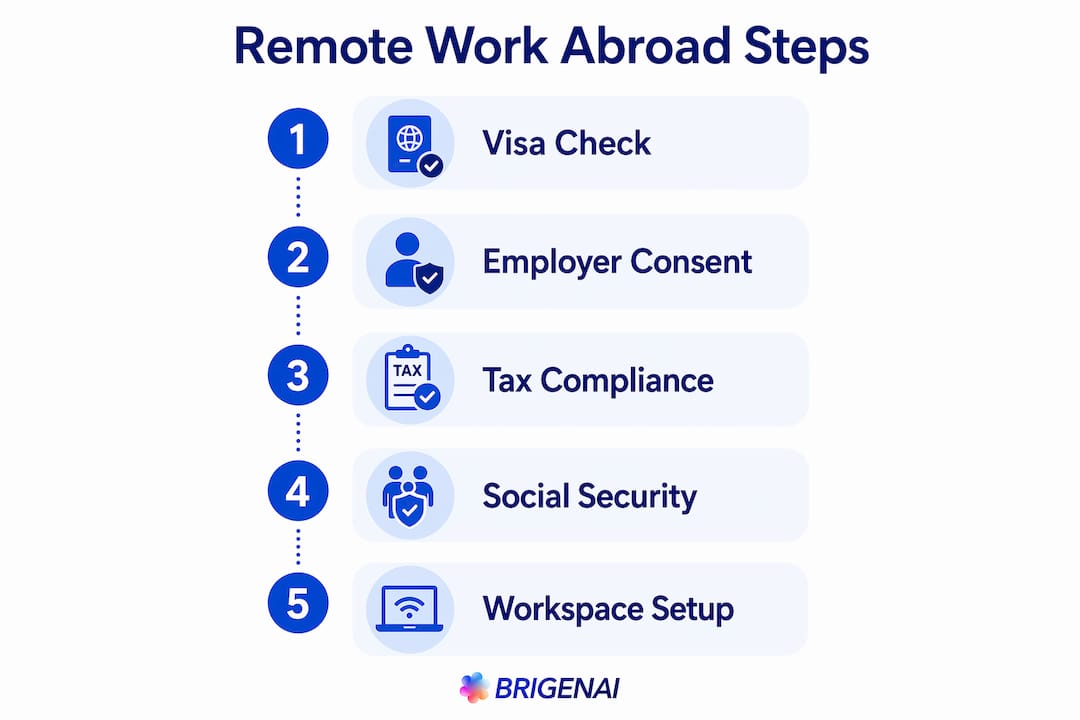
What legal requirements must you meet to work remotely abroad?
Working remotely overseas is not simply a matter of packing a laptop and booking a flight. Employees cannot work abroad without explicit employer permission, a valid visa, and full compliance with local tax and employment laws. Ignoring any one of these three requirements exposes both you and your employer to serious legal risk.
The most common mistake professionals make is assuming a tourist visa covers remote work. It does not. Tourist visas prohibit economic activity in the host country, and working on one, even for a foreign employer, can result in deportation, fines, or a ban on future entry. Most countries now offer dedicated digital nomad visas, which legally permit you to work remotely for overseas clients or employers while residing locally.
Your employment classification also matters. Visa, contract structure, and tax paperwork must all align for you to remain compliant. Employees and independent contractors face different obligations, and misclassification is one of the most common triggers for compliance failures. If your employer has no legal entity in your destination country, an Employer of Record (EOR) is the cleanest solution.
An EOR service allows a company to legally employ you in a foreign country without establishing a local entity, handling payroll, tax withholding, and immigration support on your behalf. This removes the compliance burden from both sides of the arrangement. For students and early-career professionals, this structure is increasingly how multinational employers bring on international talent.
Pro Tip: Before you accept a remote role abroad, ask your employer directly whether they have an EOR arrangement or a local entity in your destination country. If neither exists, you may be personally liable for local employment taxes.
How do taxes and social security obligations work when working remotely overseas?
Tax compliance is the most technically demanding part of international remote work, and it is the area where most people get into trouble. The core principle is straightforward: physical presence in a country for a sustained period can create tax residency, regardless of your visa status.
The widely applied threshold is 183 days. Stay in most countries for more than 183 days in a calendar year and you become a tax resident there, which means you may owe local income tax on your worldwide earnings. A digital nomad visa does not exempt you from this rule. Visa status and tax residency are entirely separate legal concepts, and conflating them is a costly error.
For US citizens and permanent residents, the rules add another layer. The Foreign Earned Income Exclusion (FEIE) allows you to exclude up to $132,900 of foreign-earned income from US federal tax in 2026, provided you meet either the Physical Presence Test or the Bona Fide Residence Test. The Physical Presence Test requires 330 full days outside the US within any 12-month period. Missing even one day can disqualify your entire claim for that period.
Here is a practical sequence for managing your tax obligations:
Social security obligations are separate from income tax and often overlooked. Totalisation agreements between countries prevent you from paying social security contributions in two places simultaneously, but not all country pairs have these agreements in place. Where no agreement exists, dual contributions may apply.
Tax conceptWhat it means for you183-day ruleStaying beyond this threshold triggers tax residency in most host countriesFEIE (US)Excludes up to $132,900 of foreign income from US federal tax if tests are metPhysical Presence TestRequires 330 full days outside the US within a 12-month periodTotalisation agreementsPrevent double social security contributions between treaty countriesTax treatiesReduce or eliminate double taxation on income between signatory countries
Pro Tip: Use a dedicated travel-tracking app such as TravelMath or a simple spreadsheet to log every entry and exit date. Precise day counts are the difference between qualifying for major tax exclusions and losing them entirely.
You can compare income taxes by country on Brigenai to understand your likely tax exposure before you commit to a destination.
What practical steps help you transition smoothly to remote work abroad?
The logistical side of working remotely overseas rewards preparation and punishes improvisation. A structured pre-departure checklist prevents the most common disruptions to your work and wellbeing.
Before you leave, confirm your health insurance covers you internationally. Most domestic policies do not extend abroad, and a single hospitalisation without cover can be financially devastating. Most digital nomad visa programmes require proof of private health insurance as a condition of approval, so this is not optional. Alongside insurance, gather certified copies of your passport, employment contract, tax identification numbers, and any professional licences you hold.
Setting up a productive workspace is non-negotiable. Coworking spaces in cities like Lisbon, Chiang Mai, and Medellín offer reliable fibre internet, professional environments, and built-in communities of other remote workers. If you work from accommodation, test your internet speed on the first day and have a backup location identified before your first important meeting.

Time zone management is where many remote workers underestimate the strain. A four-hour overlap with your team is workable; a twelve-hour gap requires deliberate scheduling. Tools like Slack and Zoom work best when your team agrees on core hours for synchronous communication, with everything else handled asynchronously. Document your availability clearly in your calendar and set response time expectations with your manager before you relocate.
Cultural adjustment takes longer than most people expect. Learning even basic phrases in the local language signals respect and opens doors that remain closed to those who do not try. Joining local professional groups, attending community events, and using platforms that connect expats with locals all accelerate integration. The professionals who thrive abroad are those who treat the host country as a home, not a backdrop.
Pro Tip: Use Brigenai’s international relocation checklist to work through documentation, insurance, banking, and workspace requirements before your departure date.
How to choose the best countries and visas for remote work abroad in 2026?
Choosing a destination is not just about lifestyle preference. The best countries for remote work combine a favourable visa programme, manageable tax treatment, affordable cost of living, and reliable infrastructure. Here is how the leading options compare in 2026.
Portugal’s Digital Nomad Visa remains one of the most popular in Europe, requiring proof of income at roughly four times the Portuguese minimum wage and private health insurance. Georgia offers a “Remotely from Georgia” programme with no minimum income threshold and a flat 1% tax rate for qualifying freelancers, making it one of the most tax-efficient options available. The UAE has no personal income tax, a straightforward remote work visa, and world-class infrastructure, though the cost of living in Dubai is significantly higher than in Tbilisi or Kuala Lumpur.
Malaysia’s DE Rantau programme targets digital professionals with a minimum monthly income requirement and offers a 12-month stay, renewable once. It is particularly attractive for those targeting Southeast Asian markets. The UAE, Portugal, and Malaysia all require proof of income and private health insurance as baseline conditions for visa approval.
Tax treatment varies sharply. Georgia’s flat rate for qualifying freelancers is exceptional. Portugal taxes foreign-sourced income under its Non-Habitual Resident (NHR) regime at a flat 20% for qualifying professions, though recent reforms have narrowed eligibility. The UAE’s zero personal income tax is straightforward, but visa status does not automatically prevent tax residency from being triggered in your home country if you retain ties there.
Use Brigenai’s salary and cost-of-living data to benchmark your purchasing power in each destination before you decide. A $5,000 monthly income stretches very differently in Tbilisi compared to Dubai or Lisbon.
CountryVisa programmeMin. income req.Tax advantagePortugalDigital Nomad Visa~4x min. wageNHR flat rate (20%) for qualifying rolesGeorgiaRemotely from GeorgiaNone1% flat tax for qualifying freelancersUAERemote Work VisaProof of employmentZero personal income taxMalaysiaDE Rantau~USD 24,000/yearPreferential treatment for foreign income
Key takeaways
Successful international remote work requires legal visa authorisation, employer consent, precise tax compliance, and deliberate logistical planning before you ever board a flight.
PointDetailsVisa and employer consentYou need both a valid work-authorised visa and written employer approval before working abroad.Tax residency vs visa statusStaying 183+ days triggers tax residency in most countries, regardless of your visa type.FEIE and day trackingUS citizens must log every travel day precisely to qualify for the $132,900 Foreign Earned Income Exclusion.EOR as a compliance toolAn Employer of Record removes the need for a local entity and manages payroll and tax obligations automatically.Destination selectionCompare visa income thresholds, tax treatment, and cost of living before committing to a country.
What I have learned after years of watching people get this wrong
Most people who struggle with remote work abroad do not fail because they chose the wrong country or the wrong job. They fail because they treated compliance as an afterthought. I have seen professionals spend months building a remote lifestyle abroad, only to receive a tax assessment from a host country they assumed they had no obligations to. The assumption that a digital nomad visa equals tax freedom is the single most expensive misconception in this space.
The second pattern I see constantly is poor record-keeping. You do not need to be a tax lawyer to protect yourself. You need a spreadsheet with entry and exit dates, copies of your visa approvals, and a clear paper trail of your employment arrangement. That is it. The professionals who handle cross-border compliance well are not necessarily the most sophisticated. They are the most organised.
My honest advice: communicate proactively with your employer before you move, not after. Many employers are willing to support international remote work when approached with a clear plan that addresses their compliance concerns. Arriving with a proposal that includes your visa type, your EOR recommendation, and your tax filing approach puts you in a completely different conversation than simply asking “can I work from abroad?”
Finally, do not underestimate the value of community. The work abroad resources available today are far better than what existed even three years ago. Use them. Talk to people who have done what you are planning. The practical knowledge that comes from someone who has actually navigated the DE Rantau application or filed a FEIE claim is worth more than any generic guide.
How Brigenai simplifies your move abroad
Planning international remote work means juggling visa research, tax obligations, salary benchmarking, and relocation logistics at the same time. Brigenai brings all of that into one place.
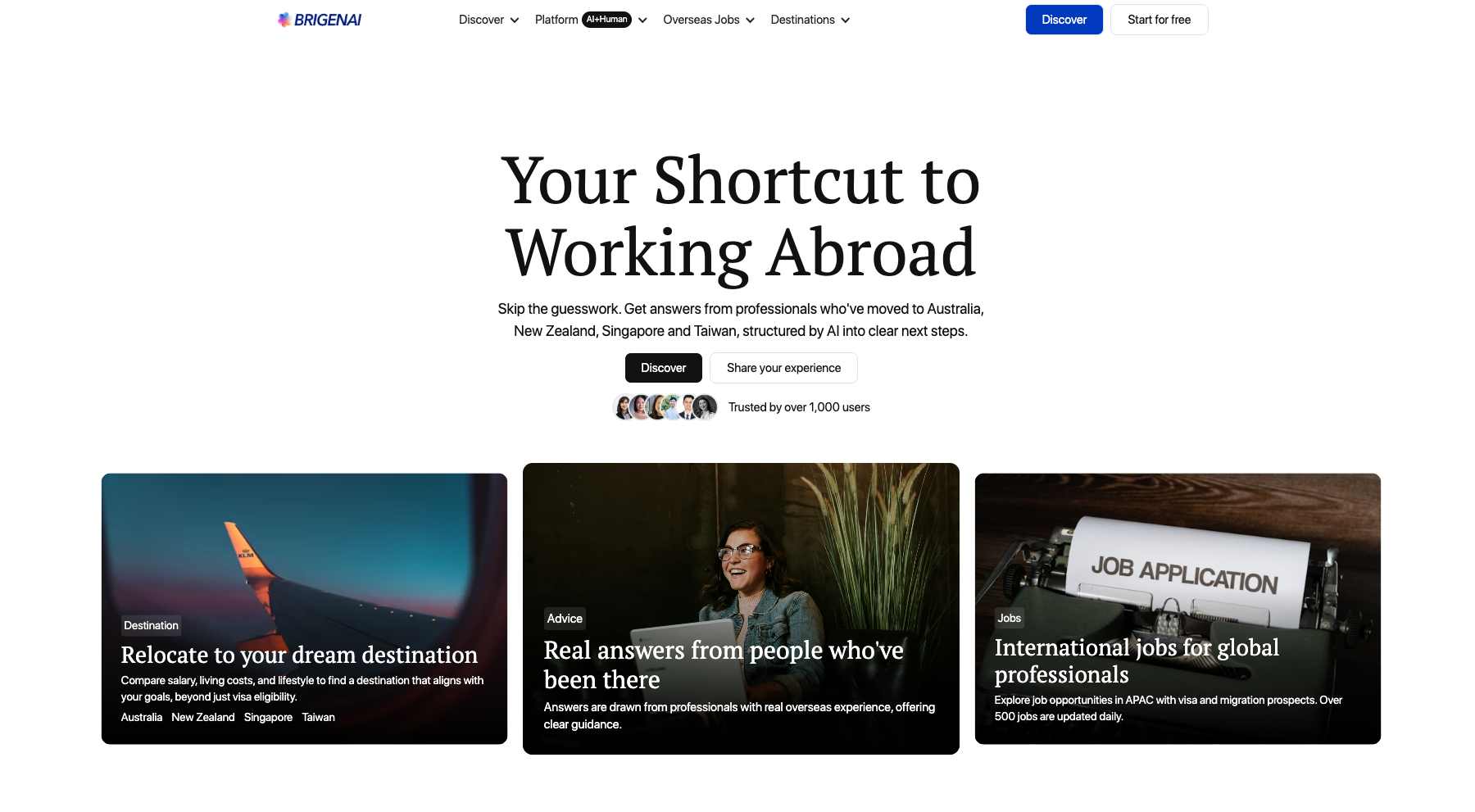
Brigenai’s AI-powered platform provides localised intelligence on salaries, cost of living, workplace culture, and migration processes across key destinations including Australia, New Zealand, Singapore, and Taiwan. Whether you need to benchmark your income against local market rates, understand your visa and immigration options, or work through a structured relocation checklist, Brigenai gives you the clarity to move with confidence. Start planning your international career with real data and community-backed insights at Brigenai.
FAQ
What is remote work abroad?
Remote work abroad is the practice of performing your job from a foreign country while employed by or contracted to an organisation based elsewhere. It requires a valid work-authorised visa, employer consent, and compliance with both home and host country tax laws.
Do I need a special visa to work remotely overseas?
A tourist visa does not permit remote work in most countries. You need a dedicated digital nomad visa or work authorisation that explicitly allows you to perform economic activity for a foreign employer while residing locally.
How does the 183-day rule affect my taxes?
Staying in most countries for more than 183 days in a calendar year triggers local tax residency, meaning you may owe income tax there on your worldwide earnings. This applies regardless of your visa type or whether your employer is based overseas.
What is an Employer of Record and do I need one?
An Employer of Record is a third-party organisation that legally employs you in a foreign country on behalf of your actual employer, managing payroll, tax withholding, and compliance without requiring your employer to establish a local entity. You likely need one if your employer has no legal presence in your destination country.
How do I find remote jobs that allow working abroad?
Start with platforms that specialise in international remote roles and filter for positions that explicitly permit overseas working. Brigenai’s international work platforms guide lists the leading options for 2026, and pairing that with a polished CV optimised for global roles via SparkCV strengthens your application significantly.