

Understanding job markets abroad means identifying where genuine demand for your skills exists, what cultural and regulatory forces shape hiring decisions, and how to align your career strategy with those realities before you relocate. International labour market analysis, the formal term for this process, goes well beyond scanning job boards. It requires reading government shortage occupation lists, tracking sector-specific hiring data, and decoding workplace cultures that differ sharply from your own. The global unemployment rate sits at 4.9% in 2026, yet that figure masks a gap of 408 million people seeking work against available openings. That gap tells you the overall market is tight, but sector and country selection can completely change your odds.
What are the current trends shaping global job markets?
The headline number for 2026 is deceptive. AI-related job postings grew 17% in March 2026 even as overall postings fell by 22 to 25% across major economies. This divergence is the single most important signal for professionals evaluating international employment trends: the market is not shrinking uniformly. It is redistributing. Roles tied to automation, machine learning, and data infrastructure are accelerating, while mid-level administrative and process-driven positions are contracting across the United States, the United Kingdom, and parts of Western Europe.
Healthcare, engineering, and technology remain the three sectors with the most consistent cross-border demand. Nurses and allied health professionals are actively recruited in the UK, Australia, and the UAE, driven by ageing populations and chronic domestic training shortfalls. Germany faces a structural shortage of skilled tradespeople and engineers that its domestic education system cannot fill fast enough. Singapore is building out its financial technology and biomedical sectors with deliberate speed, creating sustained demand for professionals with niche technical credentials.

The table below gives a practical snapshot of sector demand by region for 2026.
RegionHigh-demand sectorsNotable driverAustralia and New ZealandHealthcare, construction, agricultureAgeing population, infrastructure spendUnited KingdomNHS nursing, fintech, engineeringPost-Brexit skills gapsGermany and DACHEngineering, IT, skilled tradesStructural workforce shortfallUAE and Gulf statesFinance, construction, hospitalityMega-project pipeline, Expo legacySingapore and TaiwanSemiconductor, biomedical, fintechGovernment-led industrial strategyCanadaHealthcare, tech, natural resourcesImmigration-led growth targets
Regional labour markets also diverge on stability. OECD countries generally offer stronger worker protections, predictable visa frameworks, and transparent salary benchmarking. Emerging markets in Southeast Asia and the Gulf offer faster career progression and, in some cases, tax advantages, but with less regulatory predictability. Knowing which environment suits your risk tolerance is as important as knowing which sector suits your skills.
Pro Tip: Prioritise talent-hungry sectors over national unemployment rates when assessing your real prospects abroad. A country with 6% unemployment but a critical nursing shortage is a far better target for a healthcare professional than a country with 3% unemployment and a saturated tech market.

How do cultural and workplace norms affect career success abroad?
Cultural fluency is not a soft skill. It is a hard competitive advantage in international job markets, and professionals who underestimate it consistently underperform against equally qualified candidates who have done the cultural homework. Adapting your mindset to target-country norms is one of the most reliable predictors of career progression abroad, according to global career research.
The contrasts are sharper than most people expect. Consider these differences across major destination markets:
Language requirements add another layer. Employers in Germany, France, and Japan routinely require local language proficiency even for roles where English is used internally. In Germany, B2-level German is a practical minimum for most non-tech roles. In Japan, business-level Japanese is expected outside of a narrow band of multinational firms. Language investment is not just about communication. It signals commitment to integration, which employers in these markets weigh heavily.
CV formatting is another area where cultural ignorance costs candidates interviews. German employers expect a photo, a detailed Lebenslauf, and references from previous managers. Australian employers expect no photo, a concise two-page document, and a focus on measurable outcomes. UK employers sit between these two conventions. Getting this wrong signals that you have not done basic research on the market you are entering.
Pro Tip: Before applying to roles in a new country, read at least five job descriptions from local employers in your sector. The language they use, the qualifications they list, and the order in which they list them will tell you more about cultural expectations than any generic guide.
Which countries offer the best opportunities for international professionals?
No single country is the best destination. The right market depends on your sector, your visa eligibility, your language skills, and your financial expectations. That said, five destinations consistently appear at the top of international career research for 2026.
Australia runs a points-based skilled migration system with occupation shortage lists that are updated regularly. Healthcare, construction, and information technology dominate the current shortage categories. The labour market is transparent, English-speaking, and well-regulated. Salary benchmarking is publicly available, and the cost of living in cities like Melbourne and Sydney is high but offset by strong wage floors.
Canada is pursuing aggressive immigration targets to address demographic decline. The Express Entry system prioritises skilled workers in healthcare, technology, and trades. Provincial Nominee Programmes add flexibility for professionals willing to settle outside major urban centres. The market is competitive in Toronto and Vancouver but considerably more accessible in Alberta and the Atlantic provinces.
United Kingdom offers a Skilled Worker visa with a points-based threshold. The NHS actively recruits internationally for nursing and allied health roles. The fintech sector in London remains one of the most active hiring environments globally. Post-Brexit, EU nationals no longer have automatic access, which has created openings for non-EU professionals in sectors that previously relied on European labour.
UAE offers tax-free salaries and housing allowances that make the headline figures genuinely competitive even after accounting for higher living costs in Dubai and Abu Dhabi. Employment is contract-based, which means less job security than OECD markets, but the financial upside for finance, engineering, and hospitality professionals is significant.
Germany has introduced the Opportunity Card (Chancenkarte) to attract skilled workers outside the traditional employer-sponsored route. The card allows professionals to enter Germany and job-search in person for up to a year. For engineers, IT professionals, and tradespeople, Germany offers long-term stability, strong worker protections, and a pathway to permanent residency.
CountryTop sectorsVisa pathwayLanguage requirementAustraliaHealthcare, IT, constructionSkilled migration, shortage listsEnglishCanadaHealthcare, tech, tradesExpress Entry, PNPEnglish or FrenchUnited KingdomNHS, fintech, engineeringSkilled Worker visaEnglishUAEFinance, construction, hospitalityEmployer-sponsored contractEnglish (most sectors)GermanyEngineering, IT, tradesChancenkarte, employer sponsorshipGerman (B2+ recommended)
What practical strategies help you find jobs internationally?
The most effective job search abroad combines digital research with physical presence. A short exploratory visit to your target country significantly improves hiring outcomes by enabling face-to-face networking and giving you direct exposure to local CV norms and employer expectations. This is not a luxury. It is a strategic investment that consistently separates successful candidates from those who apply remotely and hear nothing back.
Here is a practical sequence that works across most international markets:
For professionals considering the Asia-Pacific region specifically, understanding career pathways in Asia-Pacific requires attention to both formal visa frameworks and the informal relationship networks that drive hiring in markets like Singapore and Taiwan.
Pro Tip: When you visit your target country, attend at least one industry-specific event or meetup. The professionals you meet in person are far more likely to refer you or flag an opening than any LinkedIn connection you have never met.
How Brigenai helps you move from research to a real career abroad
Knowing the trends is one thing. Translating that knowledge into a concrete plan for a specific country, sector, and salary expectation is where most professionals stall. Brigenai is built specifically for that gap.
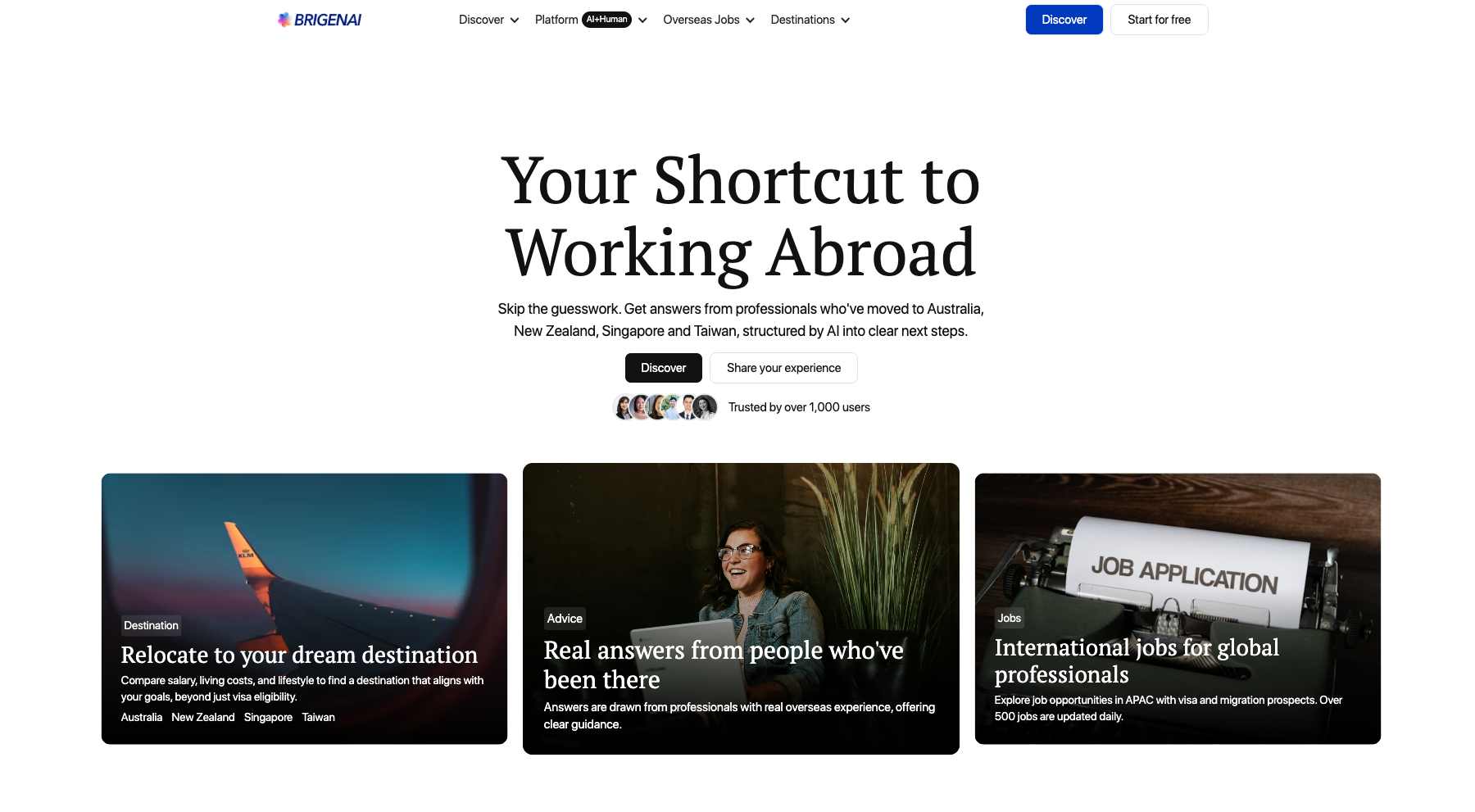
The platform combines AI-driven insights with real experiences from professionals who have actually worked in markets like Australia, New Zealand, Singapore, and Taiwan. You can use Brigenai’s global salary benchmarking database to assess whether a role’s compensation is genuinely competitive after cost-of-living adjustments. The international relocation checklist walks you through every step from visa application to housing, so nothing falls through the cracks. For professionals ready to move from research to action, Brigenai’s relocation and career services provide structured support at every stage of the process.
FAQ
What does understanding job markets abroad actually involve?
International labour market analysis covers sector demand, visa pathways, salary benchmarking, and cultural workplace norms in your target country. It goes beyond job boards to include government shortage lists, OECD employment data, and direct employer research.
Which sectors have the most international job opportunities in 2026?
Healthcare, technology, and engineering consistently show the strongest cross-border demand. AI-related roles grew 17% in early 2026 even as overall job postings declined, making tech skills particularly transferable internationally.
How important is language for working overseas?
Language proficiency is a decisive factor in markets like Germany, France, and Japan, where local language skills are often required even when English is used internally. In English-speaking markets like Australia, Canada, and the UK, strong written and spoken English remains the baseline expectation.
Should I visit a country before applying for jobs there?
A short exploratory visit significantly improves your chances by enabling face-to-face networking and giving you direct insight into local hiring norms. In-person connections and locally formatted CVs are consistently more effective than remote applications alone.
How do I find roles that will actually sponsor my visa?
Search specifically for “visa sponsorship” and “relocation assistance” on platforms like LinkedIn and Indeed Global. Cross-reference your occupation against government shortage lists for your target country to identify where employer sponsorship is most accessible and where visa processing is most straightforward.