

TL;DR:
- Singapore offers a unique blend of competitive salaries and merit-based opportunities amid strict visa requirements assessed through the COMPASS framework. The local workplace culture is performance-driven, with a strong emphasis on punctuality, hierarchy, and measurable outcomes, which can lead to burnout if unprepared. Thorough research, cultural fluency, and strategic planning are essential for professionals seeking successful career advancement in Singapore.
Singapore is not simply another international posting on a résumé. For professionals weighing whether to consider Singapore for career advancement, the city-state offers a genuinely distinctive combination of competitive salaries, a merit-driven culture, and a geographic position that opens doors across Southeast Asia. But the reality is more layered than the headline numbers suggest. Understanding the Employment Pass system, navigating a high-performance workplace culture, and aligning your qualifications with local expectations are all critical steps before you pack your bags.
Table of Contents
- Why consider Singapore for career: what the visa system actually demands
- Workplace culture and employee wellbeing in Singapore
- Salary expectations and the role of qualifications in career progress
- Singapore’s unique labour relations and workforce policies
- Practical steps to prepare for a career move to Singapore
- Why Singapore’s career merits are often misunderstood and what truly matters
- How Brigenai helps you navigate Singapore career relocation
- Frequently asked questions
Why consider Singapore for career: what the visa system actually demands
The gateway to working legally in Singapore as a foreign professional is the Employment Pass (EP). Since 2023, all new EP applications are assessed under the COMPASS framework, a points-based eligibility test that scores candidates across four individual attributes and two bonus criteria. Meeting the salary floor is just the entry ticket, not the destination.
As of 2026, the minimum qualifying monthly salary for a new EP application is S$5,600 for most sectors, rising to S$6,200 for financial services. These thresholds increase progressively with age, meaning a 45-year-old applicant needs to earn considerably more than the base figure to qualify. Singapore’s Ministry of Manpower adjusts these figures periodically, so verifying the current thresholds before accepting any job offer is essential.
COMPASS evaluates:
- Salary competitiveness relative to local peers in the same occupation and age bracket
- Qualifications from globally recognised institutions (universities ranked in top tiers carry more points)
- Diversity contribution at the firm level, meaning whether your nationality adds to or concentrates the existing workforce mix
- Support for local employment, rewarding employers who maintain a strong Singaporean workforce proportion
- Bonus points for shortage occupation roles and companies holding the Strategic Economic Priority status
Pro Tip: Even if your salary exceeds the minimum threshold comfortably, your employer’s firm-level COMPASS score can sink your application. Before signing an offer, ask your prospective employer about their COMPASS compliance status. It is a reasonable, informed question that good employers will welcome.
Explore Singapore Immigration Jobs to see which roles currently attract high EP approval rates, and read more about working in Singapore to understand how this visa landscape shapes day-to-day career decisions.
Workplace culture and employee wellbeing in Singapore
Walk into most Singapore offices and you will notice something immediately: the pace is relentless. The local concept of kiasu (a Hokkien term meaning fear of losing out) shapes workplace behaviour in ways that newcomers often find difficult to interpret. It drives extraordinary effort and attention to detail, but it also creates an environment where appearing unbusy can feel professionally risky.
Only 56% of Singapore workers describe themselves as happy at work, with 45% reporting feelings of burnout or exhaustion. That figure sits alongside the fact that 8 in 10 Singaporean employees believe workplace happiness is achievable, which reveals a gap between aspiration and reality that many foreign professionals stumble into unprepared.
“The performance culture here rewards output, not presence. But because presence signals commitment, many professionals end up performing presence rather than producing genuine results.” This tension is something many expats take months to identify and navigate.
The culture is also strongly meritocratic, which is genuinely good news for skilled foreign professionals. Promotions and pay increases are tied to measurable outcomes far more than seniority in many sectors. What matters is demonstrating value clearly and consistently.
Key cultural expectations you should prepare for:
- Direct, structured communication in formal meetings, though interpersonal dynamics can be more indirect
- Strong emphasis on punctuality and meeting deadlines without escalating issues upward unnecessarily
- Performance appraisal cycles that are taken seriously and tied directly to compensation outcomes
- Hierarchy awareness even in organisations that describe themselves as flat
Employers across Singapore are, slowly, taking employee wellbeing more seriously. Mental health programmes, flexible working arrangements, and purpose-driven work narratives are appearing in larger firms, particularly in tech and finance. But do not assume this is universal. Researching a specific company’s culture before accepting an offer will save you significant adjustment pain.
Salary expectations and the role of qualifications in career progress

Salary in Singapore is not just your take-home figure. It is also a visa eligibility criterion, a COMPASS scoring variable, and a signal of your market position. Getting this number right matters across multiple dimensions simultaneously.
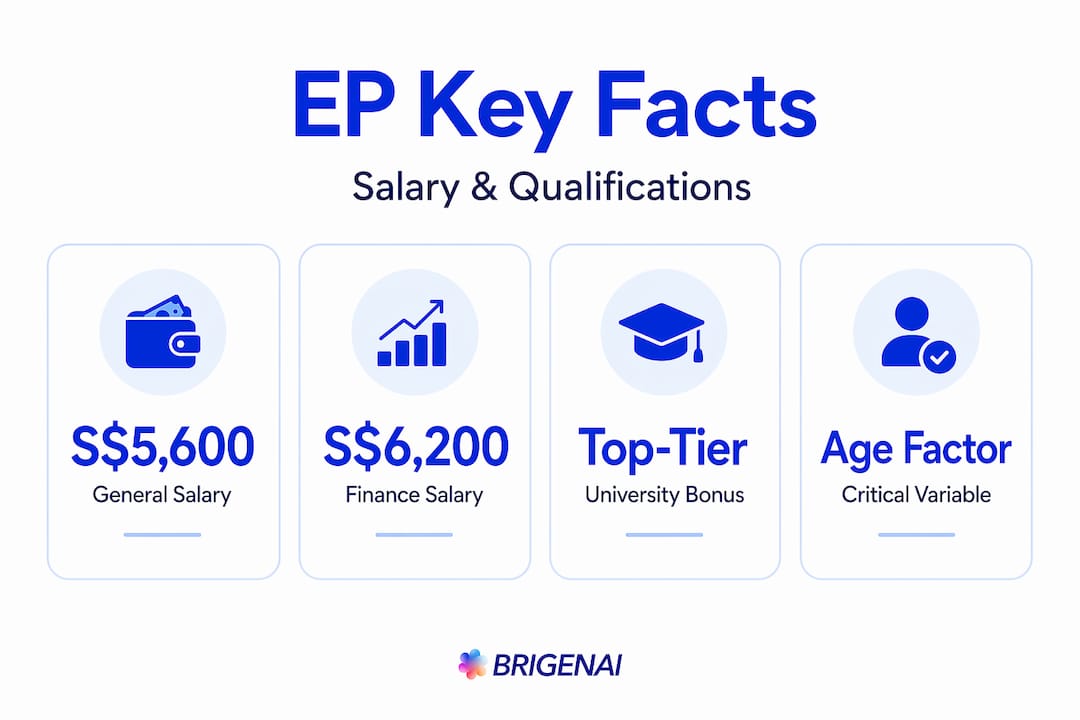
The minimum monthly salary for a new EP is S$5,600, increasing with age and sector. Here is how that plays out across common professional categories:
| Sector | Base EP salary (2026) | Notes |
|---|---|---|
| General (most sectors) | S$5,600/month | Increases with candidate age |
| Financial services | S$6,200/month | Higher threshold reflects sector wages |
| Tech and engineering | Varies | Often exceeds base, competitively paid |
| Healthcare professionals | Variable by role | Subject to additional licensing |
Age is a critical but often overlooked variable. A 40-year-old applicant targeting the same role as a 28-year-old candidate will need a salary roughly 30 to 40% higher to achieve comparable COMPASS scores on the salary dimension. This is not age discrimination. It reflects Singapore’s effort to ensure foreign professionals are paid at genuine market rates rather than undercutting local peers.
Qualifications from top-tier universities earn bonus COMPASS points and signal credibility in a market that respects academic credentials. However, it is worth noting that some professionals in Singapore deliberately accept roles slightly below their qualification level because the work itself offers greater meaning, stronger mentorship, or more direct career trajectory. The data shows this trade-off is real and personal.
Pro Tip: Use the average salary in Singapore tool to benchmark your expected offer against current market rates before entering any negotiation. Walking in with accurate data gives you genuine leverage, not just confidence.
If you are weighing Singapore against other international destinations, comparing career pathways across markets will help you understand where your qualifications and experience carry the most weight.
Singapore’s unique labour relations and workforce policies
Singapore’s approach to labour relations is unlike anything you will encounter in most Western economies. The tripartite model, built around the government, the National Trades Union Congress (NTUC), and employer associations, is the architecture that keeps the labour market stable and predictable.
Singapore’s tripartite model manages labour conflict through dialogue rather than adversarial bargaining, promoting predictability and worker protection while maintaining business sustainability. For foreign professionals, this means the rules of engagement are generally clear, enforceable, and not subject to sudden political disruption.
The Progressive Wage Model (PWM) is a particularly important development for those moving into Singapore. Rather than a blanket minimum wage, the PWM links pay floors to skills upgrading and career progression requirements in specific sectors. Employers in sectors covered by the PWM must follow structured pay scales tied to training benchmarks.
Here is how the tripartite framework affects your career as a foreign professional:
- Employers adhering to tripartite guidelines receive preferential treatment in EP application assessments. Working for a compliant employer reduces your visa approval risk.
- Wage disputes are resolved through mediation channels rather than court proceedings, which is faster and less adversarial than many foreign professionals expect.
- Fair hiring practices are enforced under the Fair Consideration Framework, meaning employers must genuinely consider Singaporean candidates before advertising to foreigners. This affects the types of roles that will realistically be open to you.
- Statutory annual leave, sick leave, and CPF contributions (Central Provident Fund, Singapore’s mandatory pension scheme) are clearly defined by law, giving professionals predictable conditions.
“The tripartite system does not eliminate workplace tension, but it does create guardrails that make Singapore a more predictable place to build a long-term career than many other Asian markets.”
Explore career pathways abroad to understand how Singapore’s labour model compares with other destinations when planning your international career.
Practical steps to prepare for a career move to Singapore
Knowing why Singapore is worth considering is only half the equation. The other half is knowing exactly what to do before you commit. Many professionals underestimate how much preparation affects both their visa outcome and their workplace landing.
- Run the COMPASS self-assessment before accepting any offer. The Ministry of Manpower provides an official Self-Assessment Tool. Candidates frequently fail EP applications due to inadequate COMPASS scores or firm-level issues that could have been caught early.
- Ask your prospective employer about their COMPASS firm-level score. This is non-negotiable information. A high individual score will not save a weak firm-level rating.
- Research workplace culture at the company level, not just the country level. Singapore’s startup scene operates very differently from its banking sector, and MNCs differ substantially from local conglomerates.
- Calculate your actual net income using sector and age-adjusted thresholds. The Singapore salary calculator accounts for CPF contributions and local taxation to give you a realistic picture.
- Plan for renewal. EP renewals require demonstrating career progression and meeting updated salary benchmarks. Factor future earning trajectory into your decision, not just your starting package.
Pro Tip: Use the international relocation checklist to move through the administrative and logistical side of relocation systematically. Missing housing, banking, or healthcare steps early creates unnecessary stress that bleeds into your professional performance.
Before finalising anything, explore moving to Singapore for a consolidated view of what life and work actually look like on the ground.
Why Singapore’s career merits are often misunderstood and what truly matters
Here is the perspective most relocation guides do not offer you. Singapore’s reputation as a career accelerator is real, but the professionals who thrive there are not the ones who moved for the salary. They are the ones who understood, going in, that the salary is a prerequisite, not a reward.
Singapore’s meritocratic system is a double-edged sword, fostering efficiency but also a kiasu culture that fuels burnout. What this means in practice is that the system will reward you generously if you perform, but it will not carry you. There is no coasting, no soft landing while you find your feet, and very little institutional patience for adjustment periods.
The professionals who struggle most in Singapore are typically those who arrive expecting the city’s global reputation to open doors automatically. It does not. What opens doors is demonstrating cultural fluency quickly, understanding that networking in Singapore is formal and relationship-driven rather than transactional, and accepting that communication styles require calibration depending on whether you are dealing with a Singaporean, a Malaysian Chinese, an Indian national, or an expatriate from a Western market.
What is genuinely shifting, and this matters for your long-term planning, is that younger Singaporean professionals are pushing back against the burnout culture in visible ways. Employer branding around purpose, wellbeing, and flexibility is gaining traction because the talent market demands it. The organisations leading this shift tend to be the ones most worth joining, not just as employers but as environments where a foreign professional can build credibility over time.
The honest trade-off is this: Singapore offers career acceleration that is hard to match in the Asia-Pacific region, a tax environment that rewards high earners significantly, and geographic access to one of the world’s most dynamic economic corridors. But it asks for intensity in return. If you are genuinely productive under pressure and culturally curious rather than culturally defensive, the trade is worth it. If you need your workplace to feel comfortable quickly, it will take longer than you expect.
Read more working in Singapore perspectives from professionals who have navigated this transition firsthand.
How Brigenai helps you navigate Singapore career relocation
Making the decision to relocate for your career is significant. Executing it well requires more than general research.
Brigenai is built specifically for professionals in your position. The platform offers AI-powered tools including a Singapore salary calculator, an international relocation checklist, and a skills list for relocation that maps your qualifications to visa and job market requirements. If you are in engineering or technology, explore curated engineering jobs abroad matched to Singapore’s current demand. The full suite of expat tools brings together salary benchmarking, cultural insights, and migration guidance into one place so your move is planned, not improvised.
Frequently asked questions
What is the minimum salary required to qualify for an Employment Pass in Singapore?
As of 2026, most sectors require a minimum monthly salary of S$5,600 for new EP applications, with financial services requiring S$6,200, and both figures increase progressively based on the applicant’s age.
What factors influence the approval of Employment Pass applications beyond salary?
Approval depends on the overall COMPASS score, which assesses four candidate attributes including qualifications, firm-level diversity, shortage occupation status, and local employment support, requiring a minimum of 40 points total.
Is Singapore’s workplace culture stressful for foreign professionals?
Singapore’s performance-driven environment can cause significant burnout, with only 56% of workers reporting they are happy at work, though employers are increasingly investing in wellbeing programmes to address this.
How does Singapore’s tripartite labour model benefit professionals?
The tripartite model creates stable, predictable labour conditions by managing disputes through structured dialogue between government, unions, and employers, which reduces the risk of sudden policy shifts affecting foreign workers.
What practical steps can professionals take before relocating to Singapore?
Run a COMPASS self-assessment, verify your employer’s firm-level compliance, benchmark your salary offer against current market data, and use official Self-Assessment Tools to identify potential application risks before committing to a role.