

Many skilled professionals in the Asia-Pacific region assume that landing a job offer abroad is the hard part. It isn’t. The harder part is understanding work sponsorship: what it actually means, who provides it, and why getting it wrong can derail an otherwise promising international move. Whether you’re a nurse in the Philippines eyeing a New Zealand hospital role, or a software engineer in Malaysia targeting an Australian tech firm, work sponsorship sits at the centre of your relocation plan. This article breaks down how sponsorship works in both Australia and New Zealand, compares key requirements, and gives you practical steps to move forward with confidence.
Table of Contents
- What is work sponsorship and how does it work?
- Key work sponsorship requirements in Australia
- How work sponsorship works in New Zealand
- Common challenges, exceptions and practical tips
- A fresh perspective on work sponsorship: barriers, benefits, and overlooked truths
- Take the next step towards global career success
- Frequently asked questions
Key Takeaways
| Point | Details |
|---|---|
| Employer support required | Most Asia-Pacific countries need employer sponsorship for skilled migrants to work legally. |
| System varies by country | Australia and New Zealand set unique approval, salary, and labour market rules for work visas. |
| Know your occupation list | Eligibility depends on your role being on an official skilled occupation list, which changes regularly. |
| Stay alert to exceptions | Regional concessions and special agreements may offer alternative sponsorship pathways. |
| Preparation is key | Understanding local processes and employer obligations increases your sponsorship success. |
What is work sponsorship and how does it work?
Work sponsorship is not simply a job offer with a relocation package attached. It is a formal legal arrangement. As defined in immigration practice, visa sponsorship is the process where an approved employer supports a skilled foreign worker’s visa application to legally work in the host country. That distinction matters enormously. Without it, you may be employed but not lawfully so.
Here is how the process generally works at its core:
- An employer applies for and receives approval as a sponsor from the relevant immigration authority
- They identify a genuine skill shortage in a role they cannot fill locally
- They nominate the foreign worker for that specific position
- The worker then applies for a sponsored visa tied to that employer and role
- The employer takes on ongoing compliance obligations, including salary requirements and reporting duties
Employers don’t simply choose to sponsor because it’s convenient. In most cases they are required to demonstrate that no suitable local candidate was available. This is sometimes called labour market testing, and it is a formal step, not a formality. It protects domestic workers while creating a structured pathway for skilled migrants.
The sectors with the highest rates of sponsorship activity include healthcare, information technology, engineering, and construction. These are fields where work visa guides and occupation lists tend to be most detailed and actively maintained.
One of the most common misconceptions is that sponsorship and a job offer are the same thing. They are not. A company can offer you a role and still be unable to sponsor you if they haven’t received approved sponsor status, or if the occupation isn’t on the relevant skilled list. Another misconception is that any employer can sponsor. Not every business qualifies, and some, such as recruitment agencies, face specific restrictions on how they can use their sponsor status.
Work sponsorship shifts the legal burden onto the employer, not just the migrant. That means an employer who sponsors you has financial and compliance skin in the game, which can actually work in your favour as a candidate.
For globally mobile professionals, understanding this dynamic changes how you approach your job search entirely.
Key work sponsorship requirements in Australia
Australia has one of the most structured employer sponsorship frameworks in the Asia-Pacific region. Navigating it requires understanding several sequential steps and keeping up with thresholds that change regularly.
Here is how the process works step by step:
- Standard Business Sponsorship (SBS) approval: The employer applies to become an approved sponsor. SBS approval is valid for five years and must be in place before any worker can be nominated.
- Labour market testing (LMT): The employer advertises the role domestically for a set period, proving no suitable Australian worker is available.
- Occupation nomination: The role must appear on the relevant Skilled Occupation List, and the position must meet salary and skills criteria.
- Visa application: Once nominated, the worker applies for their visa, most commonly the Subclass 482 (Temporary Skill Shortage) visa.
As confirmed in the official employer sponsorship guidance, employers must obtain SBS approval, conduct labour market testing, and nominate the position on the skilled occupation list, meeting both the Temporary Skilled Migration Income Threshold (TSMIT) and theCompulsory Superannuation Income Threshold (CSIT).
| Requirement | Current standard |
|---|---|
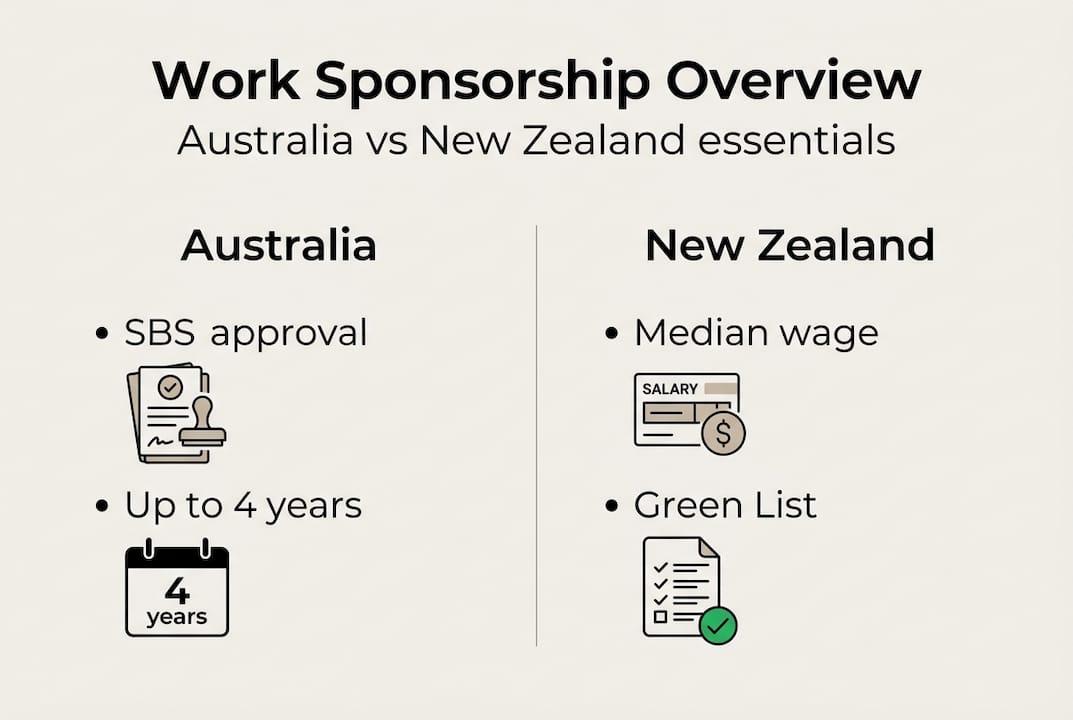
| Subclass 482 duration | Up to 4 years |
| TSMIT minimum salary (from July 2026) | AUD 79,499 |
| SAF levy (small business) | AUD 1,200 per year |
| SAF levy (large business) | AUD 1,800 per year |
| SBS approval validity | 5 years |
For workers in regional areas, Designated Area Migration Agreements (DAMA) provide meaningful concessions, including lower salary thresholds and access to occupations not on the standard skilled list. These are worth exploring if your target employer is outside a major capital city.

As of 2024, Australia introduced a 180-day grace period allowing sponsored workers to change employers without immediately losing their visa status. This was a significant improvement from the previous system and gives migrants more negotiating power.
Pro Tip: Check your occupation against the Australian visa pathways and skilled occupation list well before you start applying. Eligibility can change mid-year, and building your application around an occupation that gets removed is a costly mistake.
How work sponsorship works in New Zealand
New Zealand runs a similarly structured but distinct system built around the Accredited Employer Work Visa (AEWV), which launched in 2022 and replaced several older visa categories.
Here is what the process looks like from the employer’s side:
- The employer must obtain Accredited Employer status from Immigration New Zealand
- They must pass a Job Check, which confirms the role meets market wage rates and that no suitable New Zealand candidate is available
- A formal job offer is issued to the migrant worker
- The worker applies for the AEWV, which can be granted for up to five years depending on the role
For many roles, the wage threshold sits at NZD 35 per hour, which aligns with the median wage requirement. As part of the AEWV framework, New Zealand employers must meet Accredited Employer status and pass the Job Check, proving no local candidate is available and that the role meets the market wage before the worker can apply.
New Zealand has also introduced special bilateral agreements, including dedicated visa support for Philippine nurses and engineers. These arrangements streamline parts of the process and reflect the country’s targeted approach to filling specific sector gaps.
| Feature | Australia (Subclass 482) | New Zealand (AEWV) |
|---|---|---|
| Employer pre-approval required | Yes, SBS | Yes, Accredited Employer |
| Labour market test | Yes | Yes, Job Check |
| Minimum salary threshold | AUD 79,499 | NZD 35/hr (many roles) |
| Pathway to permanent residence | Yes, via Subclass 186 | Yes, via residence visas |
| Regional concessions | Yes, DAMA | Yes, region-specific roles |
Pro Tip: New Zealand maintains a Green List of high-demand occupations that can access fast-tracked residence pathways. If your profession appears on this list, you can significantly reduce your timeline to permanent residency. Explore Green List careers to see whether your occupation qualifies.
For a broader look at your options, reviewing NZ work visa options alongside the AEWV pathway will help you identify which route suits your background best.
Common challenges, exceptions and practical tips
Once you understand the formal steps, the next question is: what can go wrong? Quite a bit, actually, especially for migrants who don’t know the edge cases.
Recruitment agencies cannot sponsor directly. In both Australia and the UK, agencies cannot supply sponsored labour in the standard sense. This means if you are placed through a recruiter, the end employer must hold the sponsorship, not the agency. Many migrants don’t realise this until they’ve already accepted an offer.
Other common pitfalls include:
- Occupation removed mid-application: Skilled occupation lists are reviewed regularly. An occupation eligible when you began your application may not be listed by the time it’s assessed.
- Salary below TSMIT: Offers that fall below the minimum income threshold are not approvable, even if both parties agree to the arrangement.
- Changing jobs without a plan: While Australia’s 180-day grace period offers breathing room, it doesn’t automatically transfer your sponsorship. Your new employer must be an approved sponsor and nominate you before your previous role’s arrangement lapses.
- Family inclusion timing: Sponsored workers can generally include family members on their visa, but timelines and rights vary. In some cases, dependent work rights aren’t automatic.
Vetting a sponsorship offer is not just about salary. It’s about understanding exactly what obligations your employer has taken on, what happens if things change, and what rights you hold.
Regional concessions like DAMA agreements are underused by many skilled migrants. They exist precisely to make sponsorship viable in areas with acute labour shortages, and they sometimes allow occupations and salary levels that wouldn’t qualify under the standard programme. Checking work culture insights for specific destinations can also sharpen your understanding of what on-the-ground conditions look like beyond the visa paperwork.
A fresh perspective on work sponsorship: barriers, benefits, and overlooked truths
The “shortage first” approach that underpins most sponsorship systems is both defensible and frustrating in equal measure. It protects domestic workers from being undercut by cheaper overseas labour, which is a legitimate policy goal. But it also creates a system where your employability abroad depends heavily on factors outside your control: whether locals are applying, whether your salary matches a threshold set in another country, and whether your occupation appears on a list updated by bureaucrats who may be a step behind the actual market.
The power dynamic here is worth naming honestly. A sponsored worker is more constrained than a locally hired one. Changing roles mid-stream can jeopardise visa status. Disagreeing with an employer carries higher personal stakes. These realities are documented in visa sponsorship analysis, which notes that while sponsorship creates talent access pathways, it also carries exploitation risks that vary by country and industry.
What actually works, based on experience from professionals who have navigated these systems, is building genuine networks in your target country before you need them. Not mass-applying to every company on a sponsor register, but forming real connections through professional communities, alumni groups, and industry events. Employers are far more likely to take on the cost and compliance burden of sponsorship for someone they already know and trust.
Understanding your rights under a sponsorship arrangement is equally critical, especially post-pandemic when many regulations were updated. Explore the workplace benefits overseas resources to understand what protections apply in your target destination.
Take the next step towards global career success
Work sponsorship is complex, but it is navigable when you have the right guidance alongside you.
BRIGENAI was built precisely for this journey. The platform combines AI-structured insights with advice from professionals who have actually relocated to Australia, New Zealand, Singapore, and beyond. From matching your skills to in-demand occupations, to identifying employers who actively sponsor, to connecting you with vetted expert career advisors who understand the real process, BRIGENAI turns the complexity of work sponsorship into a clear, practical action plan. Explore the full range of relocation services and take the guesswork out of your next career move.
Frequently asked questions
Is work sponsorship required for all international jobs?
Most countries require work sponsorship for non-citizens in skilled roles, though some offer exceptions for specific visa categories or bilateral free movement agreements. The requirement depends heavily on the destination country and your nationality.
What types of jobs are commonly sponsored in Australia and New Zealand?
Healthcare, IT, and engineering are the most commonly sponsored occupations in both countries, reflecting persistent skill shortages in these sectors across the Asia-Pacific region.
Can recruitment agencies sponsor skilled migrants?
Recruitment agencies generally cannot sponsor migrants directly for employer-sponsored visas in Australia or the UK. The end employer must hold the sponsorship approval.
How long does it take to get sponsored work visas approved?
Processing times vary by case and employer status, but the Subclass 482 visa in Australia can take weeks to months depending on stream and documentation completeness. Priority processing options exist for some applications.