Artificial Intelligence is quickly changing what data professionals do. Companies now want analysts who can do more than just build dashboards or create reports. They are looking for people who can use analytics, machine learning, automation, and generative AI to solve tough business challenges.
If you are already a Data Analyst, you are closer to becoming an AI Data Analyst than you might realize.
Your skills in SQL, spreadsheets, business intelligence, and data storytelling give you a solid base. The next step is not to replace what you know, but to add new tools like AI, machine learning, Python, cloud technologies, and modern data engineering.
This guide shows a practical path from beginner analyst to AI Data Analyst. It explains which skills to learn, when to learn them, and how each stage builds on the last.

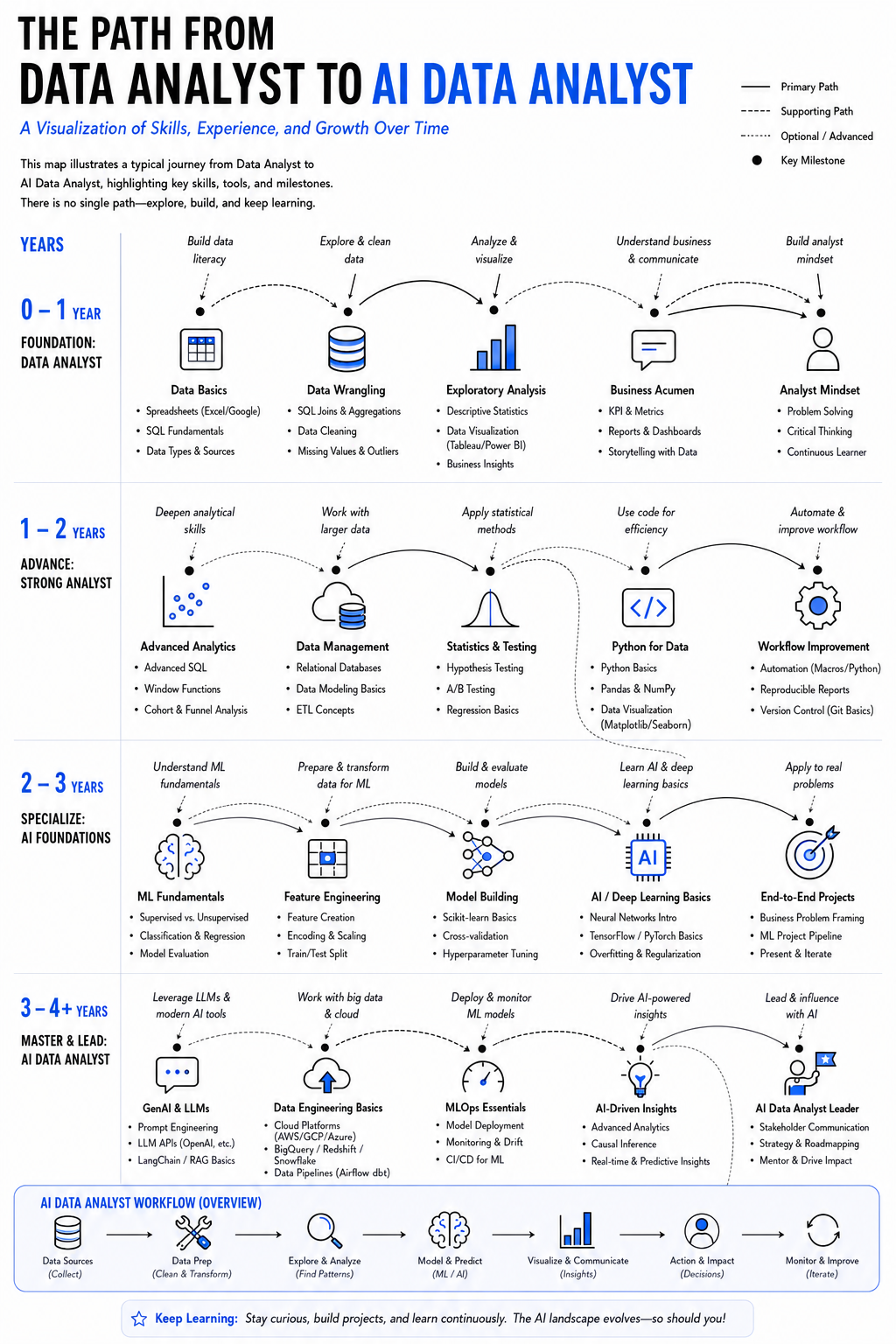
Stage 1 (0–1 Year): Build a Strong Data Analyst Foundation
Every successful AI Data Analyst starts with excellent analytical fundamentals.
Many beginners jump into machine learning before they understand how businesses actually use data. Most organizations spend much more time collecting, cleaning, organizing, and interpreting data than training AI models. Your first year should focus on becoming an outstanding Data Analyst.
Core Skills
Data Basics
Learn how data is stored, collected, and organized.
Focus on:
- Excel or Google Sheets
- SQL fundamentals
- Understanding different data types
- Relational databases
Even senior AI professionals still rely on these tools.
Data Wrangling
Data in the real world is often messy.
Develop confidence with:
- SQL Joins
- Aggregations
- Data cleaning
- Missing values
- Outlier detection
Experienced analysts often say that cleaning data takes up more than half of their daily work. Exploratory Data Analysis (EDA)
You need to understand your data before you start building AI models.
Learn how to:
- Calculate descriptive statistics
- Identify trends
- Create dashboards
- Build visualizations with Tableau or Power BI
- Extract business insights
The best analysts ask questions before they start building models.
Business Communication
Technical skills by themselves are not enough for success.
- Explain findings clearly
- Tell compelling stories with data
Good communication is often what sets senior professionals apart from junior analysts.
Develop the Analyst Mindset
Throughout your first year, cultivate habits that every AI professional relies on:
- Critical thinking
- Problem solving
- Curiosity
- Continuous learning
While technology changes quickly, strong analytical thinking always stays important.
Stage 2 (1–2 Years): Become a Strong Analyst
After you have a strong foundation, you can start focusing more on deeper analytics and automation, rather than just reporting. You will also start using programming to improve efficiency and handle larger datasets.
Advanced SQL & Analytics
Move beyond basic queries.
Learn:
- Window functions
- Common Table Expressions (CTEs)
- Cohort analysis
- Funnel analysis
- Advanced aggregations
Being able to write complex SQL is still one of the most valuable technical skills in data careers.
Data Management
Understand how modern organizations store information.
Study:
- Relational databases
- Data modeling
- ETL pipelines
- Database optimization
These skills will prepare you to work with larger AI systems.
Statistics & Experimentation
AI relies heavily on statistical reasoning.
Key concepts include:
- Hypothesis testing
- Regression
- A/B testing
- Confidence intervals
- Statistical significance
These skills help you tell the difference between real insights and random patterns.
Python for Data Analysis
Python becomes your primary analysis language.
Begin with:
- Python syntax
- Pandas
- NumPy
- Matplotlib
- Data manipulation
Python does not replace SQL. Instead, it works alongside SQL to let you do more flexible analysis and automate tasks.
Workflow Automation
As your projects grow, automation becomes increasingly valuable.
Learn:
- Python automation
- Reproducible reporting
- Git version control
- Basic scripting
When you automate repetitive tasks, you can spend more time solving important business problems.
Stage 3 (2–3 Years): Build AI Foundations
At this stage, your career starts to move from traditional analytics toward AI.
Instead of only analyzing historical data, you'll learn how to build predictive systems.
Machine Learning Fundamentals
Start by understanding core algorithms.
Topics include:
- Supervised learning
- Unsupervised learning
- Classification
- Regression
- Here, it is more important to understand the main ideas than to memorize algorithms.
Feature Engineering
The quality of an AI model depends heavily on its input data.
Learn how to:
- Create useful features
- Encode categorical variables
- Scale numerical data
- Split datasets correctly
Creating good features often has a bigger impact on model performance than choosing the right algorithm.
Model Building
Using Scikit-learn, practice building complete machine learning workflows.
Projects should include:
- Training models
- Cross-validation
- Hyperparameter tuning
- Performance evaluation
Getting real, hands-on experience is much more valuable than just learning theory.
Deep Learning Basics
Begin exploring neural networks.
Topics include:
- Neural networks
- TensorFlow or PyTorch
- Overfitting
- Regularization
Deep learning is especially useful for working with images, text, and language tasks.
End-to-End AI Projects
Employers want evidence that you can solve business problems.
Portfolio projects might include:
- Customer churn prediction
- Sales forecasting
- Recommendation systems
- Fraud detection
- Customer segmentation
Make sure to explain the business value of your work, not just how accurate your models are.
Stage 4 (3–4+ Years): Become an AI Data Analyst
At this point, you are doing much more than just making reports.
You are now building smart systems that help organizations make better decisions.
Generative AI & Large Language Models
Generative AI has become an essential skill for modern analysts.
Learn:
- Prompt Engineering
- OpenAI APIs
- LangChain
- Retrieval-Augmented Generation (RAG)
With these tools, analysts can automate reports, create AI assistants, and find insights in unstructured data.
Data Engineering Fundamentals
AI systems require reliable infrastructure.
Understand:
- AWS, Azure, or Google Cloud
- Snowflake
- BigQuery
- Redshift
- Airflow
- dbt
Understanding how data moves through an organization helps make AI solutions scalable.
MLOps Essentials
Building models is only half the job.
Learn how to:
- Deploy models
- Monitor performance
- Detect model drift
- Build CI/CD pipelines
Working with AI in real business settings is very different from what you learn in the classroom.
AI-Driven Business Insights
Advanced AI Data Analysts use predictions to help make strategic decisions.
You'll work on:
- Predictive analytics
- Causal inference
- Real-time dashboards
- Intelligent decision support
Instead of just explaining what happened, you will help organizations figure out what to do next.
Leadership
Senior AI Data Analysts influence both technology and business strategy.
Responsibilities often include:
- Communicating with stakeholders
- Leading analytics initiatives
- Mentoring junior analysts
- Defining AI roadmaps
- Driving organizational adoption of AI
As your technical skills grow, leadership becomes even more important.
Suggested Learning Timeline
Recommended Portfolio Projects
Rather than doing lots of small tutorials, focus on building a few complete business projects.
Examples include:
- Customer Churn Prediction
- Sales Forecasting Dashboard
- Marketing Attribution Analysis
- Retail Recommendation Engine
- Fraud Detection Model
- AI Financial Reporting Assistant
- LLM-powered Business Intelligence Chatbot
- Executive KPI Dashboard using AI Insights
It is better to have a few high-quality projects than many small ones.
Essential Tools to Learn
Career Outlook
Demand for AI-powered analytics continues to grow as businesses invest in automation and intelligent decision-making. Organizations are increasingly seeking professionals who can bridge traditional analytics with modern AI technologies.
Typical salary ranges in 2026 include:
Professionals with expertise in Python, machine learning, cloud platforms, and generative AI are likely to command the strongest opportunities, particularly in technology, finance, healthcare, and enterprise software.
Your 12-Month Action Plan
First 30 Days
Master SQL fundamentals, refresh Excel skills, and build your first interactive dashboard in Power BI or Tableau.
First 90 Days
Learn advanced SQL, begin Python with Pandas and NumPy, and complete a real-world exploratory data analysis project.
First 6 Months
Study statistics, automate data workflows with Python, and publish two portfolio projects showcasing business insights.
First Year
Build your first machine learning model using Scikit-learn, create an end-to-end predictive analytics project, and start exploring large language models and prompt engineering.
Key Takeaways
Transitioning from Data Analyst to AI Data Analyst is not about abandoning traditional analytics—it is about building on it. Strong SQL, data cleaning, visualization, and business communication remain the foundation of every successful AI career.
The most effective path is gradual: first master data analysis, then strengthen your programming and statistical skills, move into machine learning, and finally adopt cloud technologies, MLOps, and generative AI. By combining analytical thinking with modern AI tools, you'll be well positioned for one of the fastest-growing and highest-impact careers in data.