
Artificial intelligence is reshaping digital marketing faster than any previous technology shift. Marketers who combine traditional marketing expertise with AI, automation, analytics, and data-driven decision-making are becoming some of the most valuable professionals in the industry.
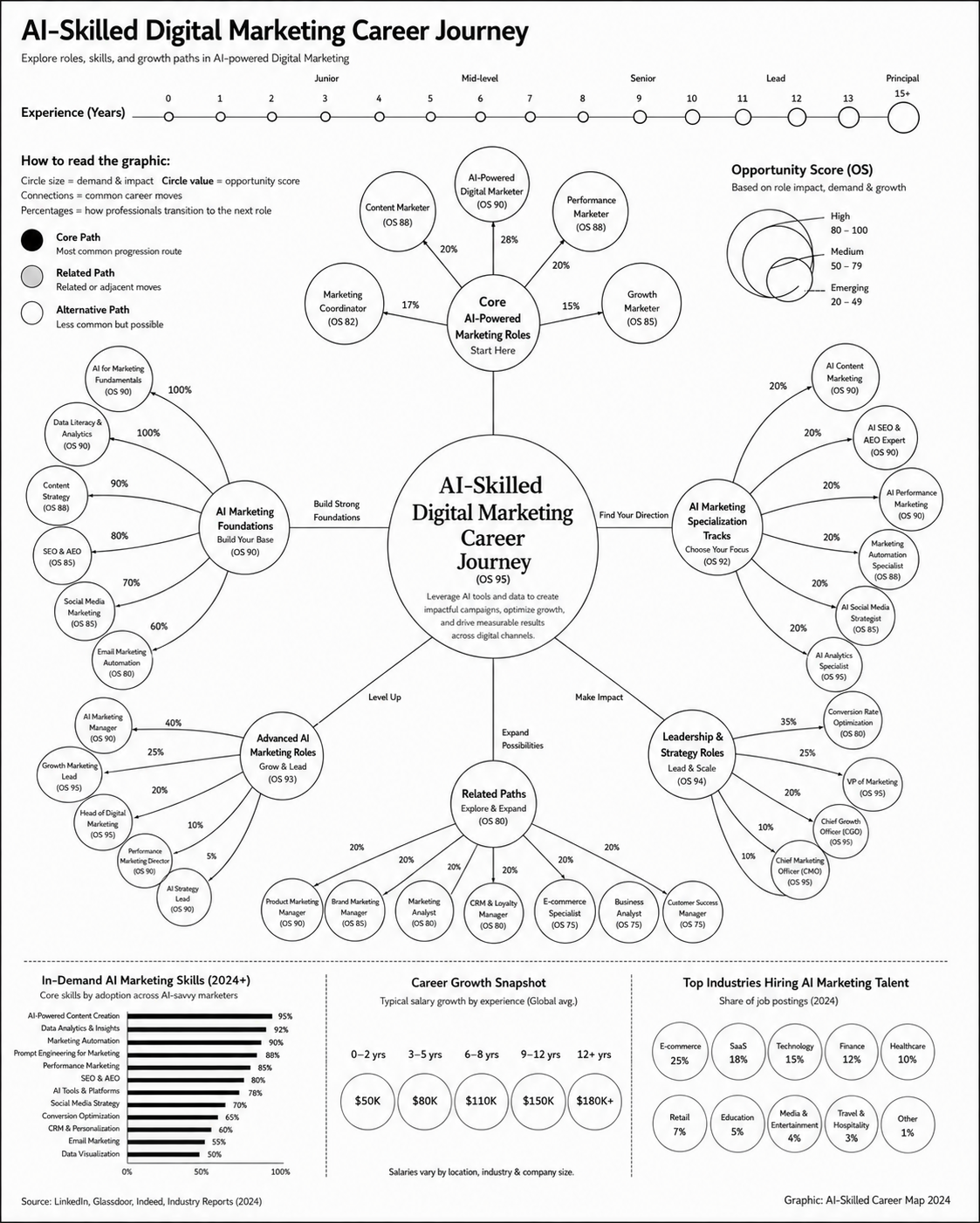
The AI-Skilled Digital Marketing Career Journey provides a clear roadmap for professionals looking to build, specialize, and advance their careers in AI-powered marketing. From foundational skills to executive leadership roles, understanding this progression can help marketers make smarter career decisions and stay competitive in an increasingly automated world.
Why AI Skills Are Becoming Essential in Digital Marketing
Digital marketing has evolved far beyond creating social media posts or managing ad campaigns. Today's marketers are expected to analyze large datasets, automate workflows, personalize customer experiences, and use AI tools to improve campaign performance.
According to LinkedIn's 2024 skills reports, AI-related marketing skills are among the fastest-growing competencies employers seek. Companies increasingly value professionals who can use platforms such as ChatGPT, Google Gemini, HubSpot AI, Jasper, and marketing automation systems to generate measurable business results.
The rise of AI does not eliminate marketing jobs. Instead, it changes the nature of the work. Marketers who understand both human psychology and AI technology will have a significant competitive advantage.
Stage 1: Building Strong AI Marketing Foundations
Every successful AI-skilled marketer starts with a strong foundation. The career map highlights six core competencies that form the base of future growth:
AI for Marketing Fundamentals (Opportunity Score: 90)
Understanding how AI works in marketing environments is the starting point. This includes:
- Generative AI tools
- Prompt engineering
- AI-assisted content creation
- AI-powered customer segmentation
- Marketing automation basics
Professionals entering the field should aim for complete mastery of these concepts, as they influence nearly every marketing function today.
Data Literacy and Analytics (Opportunity Score: 90)
Marketing decisions are increasingly driven by data. Core skills include:
- Google Analytics 4
- Looker Studio
- Customer journey analysis
- Dashboard creation
- Marketing attribution
Data literacy enables marketers to measure ROI and make evidence-based decisions.
Content Strategy (Opportunity Score: 88)
AI can create content, but strategy remains human-led. Marketers must learn:
- Audience research
- Content planning
- Brand messaging
- Content performance measurement
Strong strategists can effectively guide AI tools to produce higher-quality results.
SEO and AEO (Opportunity Score: 85)
Traditional SEO is evolving into Answer Engine Optimization (AEO), where content is optimized for AI search platforms such as ChatGPT, Perplexity, Claude, and Google's AI Overviews.
Key areas include:
- Semantic search
- Structured content
- Entity optimization
- Featured snippets
- Conversational search queries
Social Media Marketing (Opportunity Score: 85)
AI-enhanced social media management includes:
- Predictive audience targeting
- AI content generation
- Automated scheduling
- Social listening tools
Email Marketing Automation (Opportunity Score: 80)
Modern email marketing relies heavily on automation platforms such as:
- HubSpot
- Mailchimp
- Klaviyo
- ActiveCampaign
Understanding workflows and personalization systems remains highly valuable.
Stage 2: Exploring Core AI-Powered Marketing Roles
After developing foundational skills, marketers typically move into specialized operational roles.
AI-Powered Digital Marketer (Opportunity Score: 90)
This role serves as the central hub of AI-driven marketing activities.
Responsibilities include:
- Campaign management
- AI tool integration
- Performance analysis
- Customer acquisition strategies
- Marketing automation
Professionals in this role often act as connectors between creative, technical, and business teams.
Content Marketer (Opportunity Score: 88)
Content marketers use AI to:
- Generate content drafts
- Conduct topic research
- Optimize SEO performance
- Personalize content experiences
While AI improves productivity, strategic storytelling remains a uniquely human skill.
Performance Marketer (Opportunity Score: 88)
Performance marketers focus on measurable outcomes such as:
- Lead generation
- Paid advertising
- Conversion tracking
- ROI optimization
AI-powered bidding systems and predictive analytics play a major role in modern performance marketing.
Growth Marketer (Opportunity Score: 85)
Growth marketers experiment across multiple channels to drive rapid business expansion.
They commonly work with:
- Product-led growth strategies
- Customer acquisition funnels
- Retention campaigns
- AI-based customer insights
Marketing Coordinator (Opportunity Score: 82)
Many professionals begin their careers here. Responsibilities often include:
- Campaign support
- Reporting
- Content coordination
- CRM management
This role provides valuable exposure to multiple marketing functions.
Stage 3: Choosing a High-Value AI Marketing Specialization
Once marketers gain experience, specialization becomes the next growth lever.
AI Content Marketing Specialist (Opportunity Score: 90)
These professionals combine content strategy with AI production tools.
Common responsibilities:
- Scaling content operations
- Managing AI content workflows
- Maintaining brand voice consistency
- Content performance optimization
AI SEO & AEO Expert (Opportunity Score: 90)
As search evolves, specialists who understand both traditional SEO and AI search optimization are becoming increasingly valuable.
Skills include:
- Search intent analysis
- AI search optimization
- Technical SEO
- Knowledge graph strategies
AI Performance Marketing Specialist (Opportunity Score: 90)
These experts leverage AI to improve:
- Paid search campaigns
- Social advertising
- Budget allocation
- Predictive customer targeting
AI Analytics Specialist (Opportunity Score: 95)
One of the highest-scoring opportunities on the map, analytics specialists help organizations transform data into business insights.
Key tools include:
- SQL
- Power BI
- Tableau
- Google Analytics
- Predictive modeling systems
Marketing Automation Specialist (Opportunity Score: 88)
Automation specialists design customer journeys and scalable marketing systems.
They often manage:
- CRM platforms
- Email automation
- Lead scoring systems
- Lifecycle marketing campaigns
Stage 4: Expanding into Related Marketing Career Paths
AI skills also open doors to adjacent career opportunities.
Product Marketing Manager (Opportunity Score: 90)
Product marketers bridge the gap between product teams and customers.
Responsibilities include:
- Product positioning
- Go-to-market strategies
- Competitive research
- Customer messaging
Brand Marketing Manager (Opportunity Score: 85)
Brand marketers focus on:
- Brand awareness
- Reputation management
- Storytelling
- Market perception
AI tools increasingly support brand monitoring and sentiment analysis.
Marketing Analyst (Opportunity Score: 80)
Analysts specialize in:
- Campaign measurement
- Data interpretation
- Forecasting
- Reporting
Strong analytical skills can eventually lead to senior strategy roles.
CRM & Loyalty Manager (Opportunity Score: 80)
Customer retention is often more profitable than acquisition.
CRM professionals use AI to:
- Predict churn
- Increase customer lifetime value
- Improve customer engagement
E-Commerce Specialist (Opportunity Score: 75)
E-commerce marketers focus on:
- Online sales optimization
- Product recommendations
- Marketplace advertising
- Conversion rate improvements
Stage 5: Advancing into Leadership and Strategy Roles
Experienced marketers often move toward leadership positions where strategic thinking becomes more important than execution.
Conversion Rate Optimization (CRO) Leader (Opportunity Score: 80)
CRO specialists focus on improving business outcomes through:
- A/B testing
- User experience improvements
- Behavioral analysis
- Funnel optimization
Vice President of Marketing (Opportunity Score: 95)
VPs oversee marketing departments and align campaigns with business objectives.
Responsibilities include:
- Team leadership
- Budget management
- Strategic planning
- Revenue growth
Chief Growth Officer (CGO) (Opportunity Score: 95)
CGOs focus on sustainable company growth through:
- Customer acquisition
- Retention strategies
- Revenue expansion
Chief Marketing Officer (CMO) (Opportunity Score: 93)
The CMO is responsible for the overall marketing vision of an organization.
Modern CMOs must understand:
- AI transformation
- Customer experience
- Brand strategy
- Business growth
Stage 6: Reaching Advanced AI Marketing Leadership Roles
The highest-level AI marketing professionals combine leadership with deep technological understanding.
AI Marketing Manager (Opportunity Score: 90)
These leaders oversee:
- AI implementation
- Technology adoption
- Team training
- Process optimization
Head of Digital Marketing (Opportunity Score: 95)
This role directs all digital marketing functions while ensuring alignment with broader business goals.
Growth Marketing Lead (Opportunity Score: 95)
Growth leaders focus on scalable customer acquisition and retention strategies powered by data and experimentation.
AI Strategy Lead (Opportunity Score: 90)
One of the most future-oriented roles, AI Strategy Leads help organizations:
- Evaluate AI opportunities
- Build AI roadmaps
- Improve operational efficiency
- Create competitive advantages
As AI adoption increases globally, demand for these leadership positions is expected to grow significantly.
The Most In-Demand AI Marketing Skills in 2024
The career map highlights the most sought-after AI marketing skills based on industry adoption:
The strongest career opportunities lie at the intersection of AI, analytics, and business strategy.
Salary Growth Across the Career Journey
While salaries vary by country, industry, and company size, the global average growth pattern is clear:
Professionals who develop expertise in AI analytics, growth marketing, and marketing leadership often exceed these benchmarks.
Industries Hiring AI Marketing Talent
AI-skilled marketers are in demand across nearly every sector.
The largest hiring industries include:
- E-commerce (25%)
- SaaS (18%)
- Technology (15%)
- Finance (12%)
- Healthcare (10%)
- Retail (7%)
- Education (5%)
- Media & Entertainment (4%)
E-commerce and SaaS companies currently lead AI marketing adoption due to their strong reliance on digital customer acquisition and performance measurement.
Platforms like BrigenAI can help professionals understand how these opportunities vary across countries in the Asia-Pacific region, providing insights from people already working in AI-driven marketing roles.