

Every year, thousands of students commit to a university, a country, and a degree program before they've actually worked out what career that degree is supposed to lead to. The result is predictable: switched majors, disappointing job searches after graduation, and visa pathways that don't match the qualification they spent years earning. Knowing how to choose the right career path before studying abroad is arguably a more important decision than picking the university itself, because the career path determines whether the degree, the country, and the money spent actually pay off.
This guide walks through a practical process for study abroad career planning: how to assess your own strengths, how to match a major to real job outcomes, how to read job markets in different countries, and how visa and language rules narrow (or open up) your options. It's written for students, parents, and anyone trying to make this decision with more than guesswork.

What Is brigenai's Tools Hub?
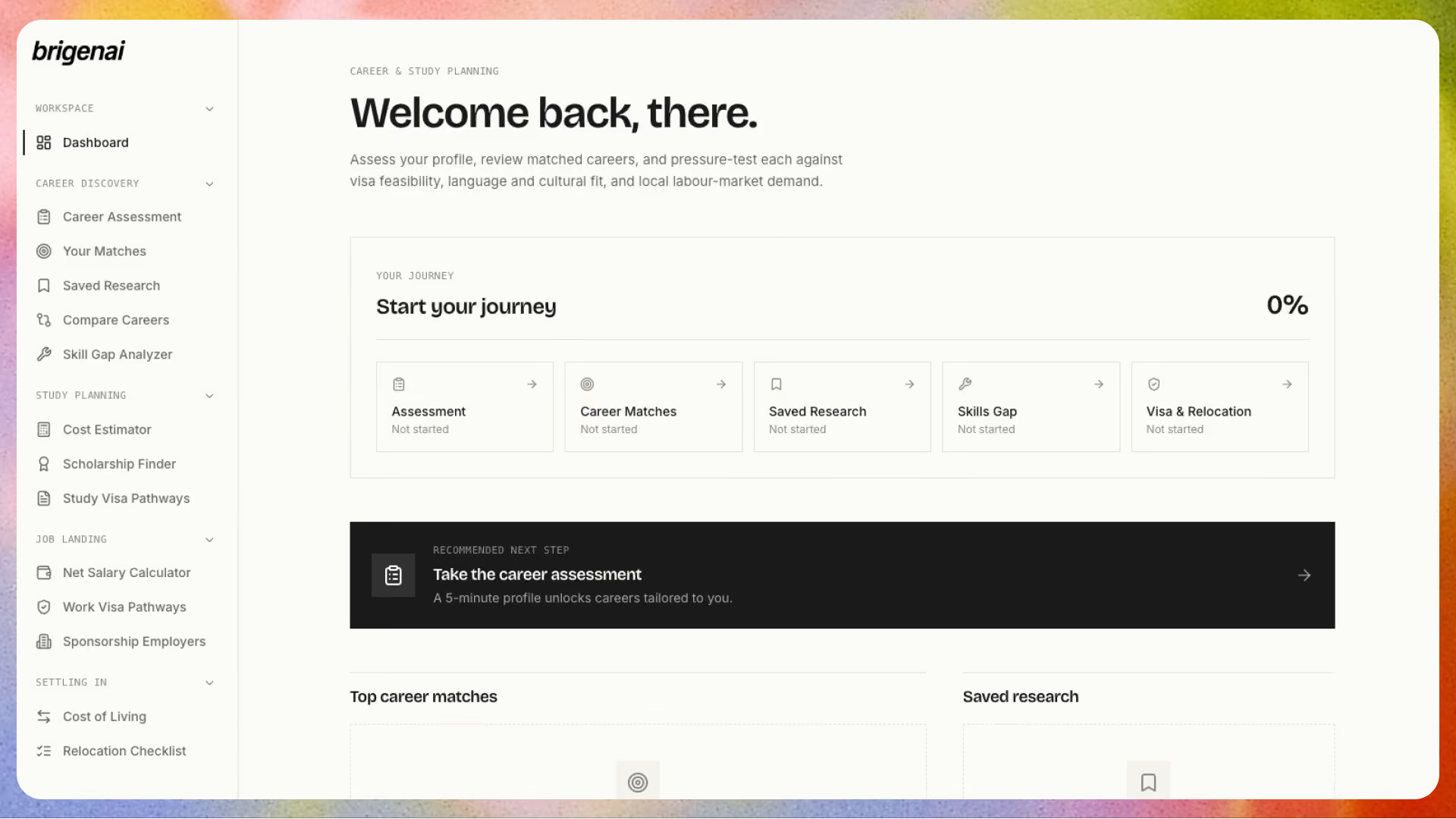
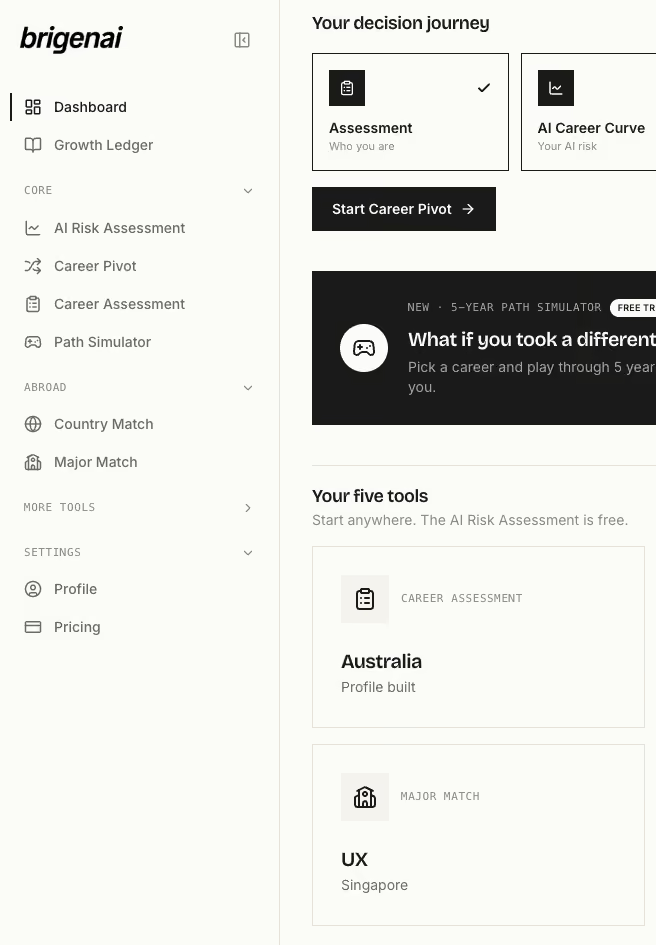
Deciding to study, work, or relocate overseas usually means piecing together information from a dozen different sources, visa rules on one site, a pay calculator on another, cost-of-living estimates buried in forum threads. brigenai built its Tools hub to bring all of that into one place, specifically for people moving to or within Australia, New Zealand, Singapore, Hong Kong, and Taiwan.
The platform starts with a free Career Assessment that matches your background and goals to realistic career paths and countries, not just a personality quiz, but a feasibility check grounded in real visa pathways and job markets. From there, you move into two toolboxes:
- Study Toolbox: scholarship search, study cost estimates, and student visa pathway research
- Work Toolbox: salary and pay calculators, work visa research, and a directory of employers known for sponsoring international talent
Every tool is free to use with no sign-up required, and the numbers behind them, from Australia's tax brackets to Singapore's CPF contributions, are kept current, so the results reflect real take-home pay rather than rough estimates. The sections below show exactly where each tool fits into the decision-making process.
Why Career Planning Matters Before Studying Abroad
Studying abroad is a significant investment of time and money, often tens of thousands of dollars once tuition, living costs, and lost years of income are added up. Choosing a career path before studying abroad, rather than after arriving, changes almost every decision that follows:
- Course and major selection: some majors lead directly into licensed or high-demand professions (nursing, engineering, IT); others are broader and require you to build direction yourself.
- Country choice: a strong job market for data analysts in Singapore doesn't guarantee the same demand in Taiwan or New Zealand.
- Visa strategy: many countries link post-study work visas and permanent residency pathways to specific occupation lists, not to degrees in general.
- Return on investment: the same qualification can lead to very different salaries and job security depending on where you study and what you specialize in.
Students who plan their career direction first, then choose a major, country, and university to fit it, generally end up with clearer job prospects and fewer regrets than students who work backward from "which country do I like" or "which university is famous."
How to Assess Your Interests, Skills, and Strengths
Before comparing countries or universities, get honest about what you're actually good at and what kind of work you'd tolerate doing for 40+ hours a week for years. This is the step most students skip, and it's the one that causes the most expensive mistakes later.
Start With Evidence, Not Preference
"I like the idea of X" is not the same as "I'm good at X" or "I'd still like X after doing it daily." Look for evidence in your own history:
- Subjects where you consistently perform well without needing to force motivation
- Tasks you've been asked to help others with (this often reveals a natural strength)
- Projects, part-time jobs, or volunteer work you stuck with longer than expected
- Feedback from teachers, employers, or mentors that repeats a theme
Separate Skills Into Three Buckets
- Technical/hard skills: coding, accounting, lab work, design software, languages
- Transferable skills: communication, project management, analysis, negotiation
- Domain knowledge: healthcare, finance, education, hospitality, engineering
A realistic career path usually sits at the intersection of a hard skill you can build, a transferable skill you already have, and a domain you don't mind working in long-term.
Use a Structured Career Assessment
Self-reflection alone tends to be biased, people either overrate what they enjoy or underrate what they're actually competitive at. A structured career assessment for students compares your background, skills, and goals against real occupation and visa data rather than personality-quiz labels. brigenai's free Career Assessment does this by matching your profile against realistic career paths and countries based on actual visa pathways and job markets, not just interest categories, a useful starting point before you narrow down a major.
How to Match Your Major With Future Career Goals
Once you have a clearer picture of your strengths, the next step is connecting that to an actual major and degree structure. This is where choosing a major for study abroad gets concrete.
Work Backward From the Job, Not Forward From the Subject
Instead of asking "what subject do I want to study," ask "what job or job family do I want, and what does that job actually require." Then check:
- Is this a licensed profession (nursing, teaching, accounting, engineering) with fixed entry requirements, or an open profession (marketing, business analysis, IT) where multiple majors can lead in?
- Does the target job typically require a specific major, or does it hire from a range of degrees plus relevant skills/internships?
- What do actual job postings for that role list as required qualifications? (Check 20-30 real listings, not just the job title description.)
Map a Few Realistic Major-to-Career Combinations
- Numbers, structure, systems: Accounting, Finance, or Data Science majors commonly lead to roles like financial analyst, auditor, or data analyst
- People, communication: Business, Marketing, or Psychology majors commonly lead to roles like marketing coordinator, HR, or communications
- Building, fixing, designing: Engineering, IT, or Architecture majors commonly lead to roles like software developer, civil engineer, or UX designer
- Care, health, service: Nursing, Public Health, or Allied Health majors commonly lead to roles like registered nurse or other health services roles
Your combination should be specific to you, this is a starting structure, not a final answer. This step matters most for anyone weighing the best career path for studying abroad, since some majors have a much clearer route to employment and visa sponsorship than others.
Check the University-to-Career Fit, Not Just Rankings
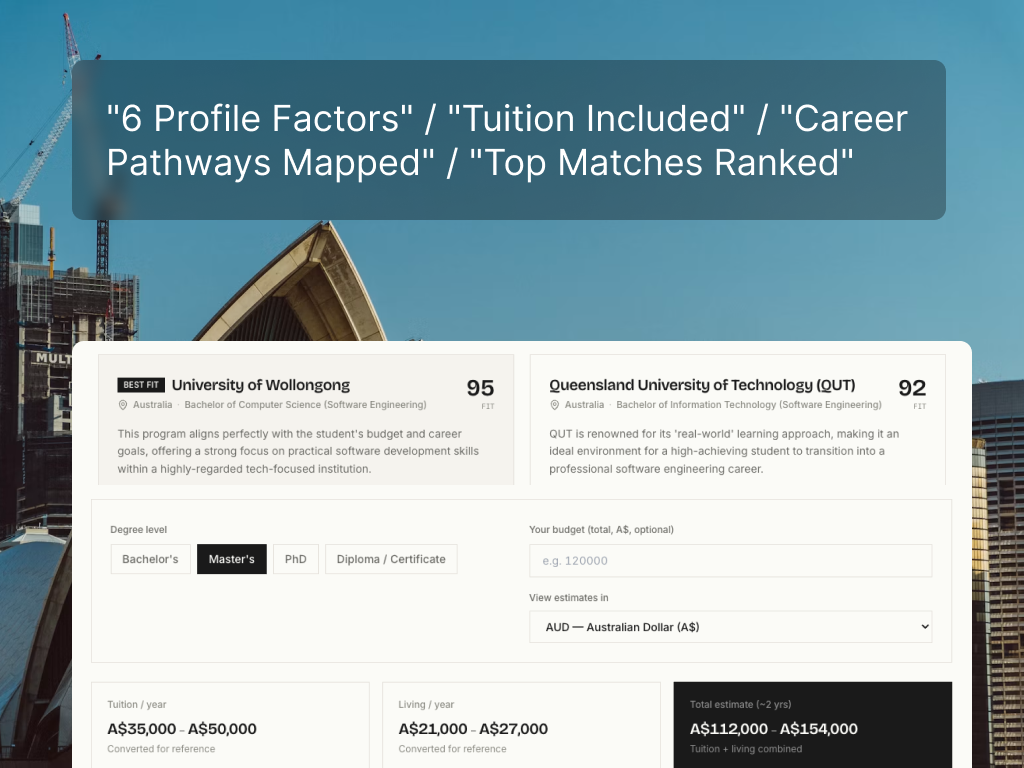
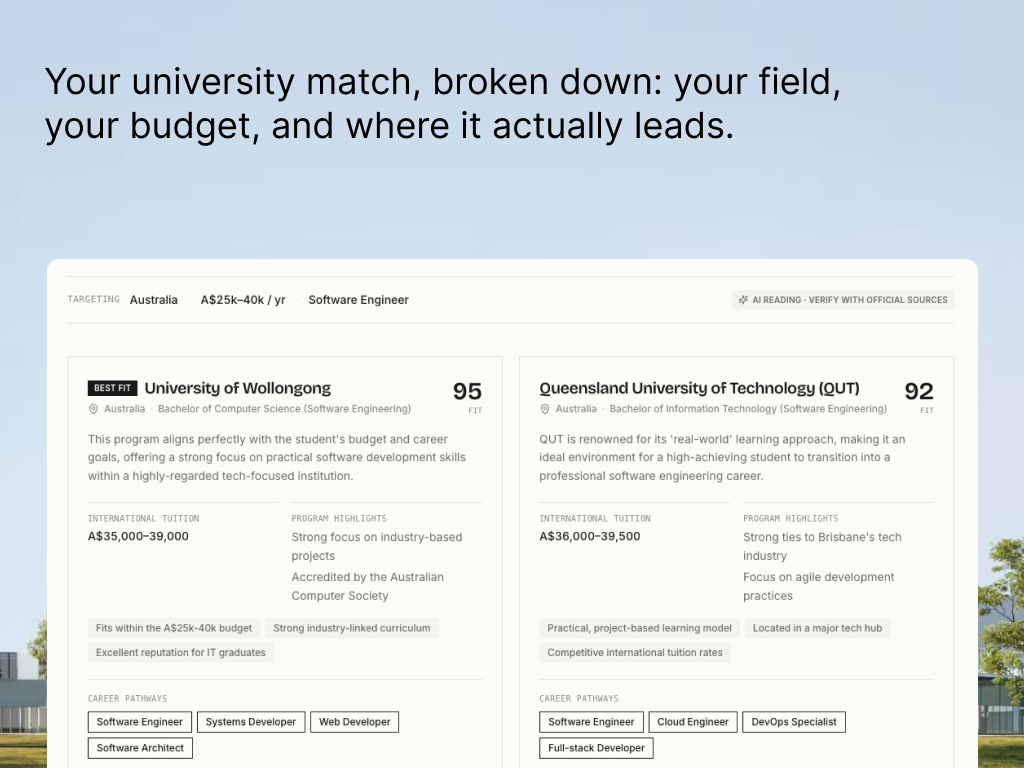
A highly ranked university with a weak internship pipeline in your target industry can be a worse choice than a mid-ranked one with strong employer connections in that field. Before shortlisting universities, compare their graduate outcome data, industry partnerships, and course accreditation for your chosen field, not just the overall ranking. Tools like brigenai's Choose Your Dream University page can help line these factors up against each other.

How to Consider Destination Country Job Markets
Choosing where to study is inseparable from choosing what to study, because job demand for the same qualification varies significantly across countries. This is the piece most students underweight.
Questions to Answer for Each Country You're Considering
- Is your target occupation on a skills shortage or priority occupation list? (This affects both job availability and visa outcomes.)
- What's the average starting salary for graduates in this field, after tax, compared to cost of living?
- Are there industry clusters in that country (finance in Singapore, tech in parts of Australia, manufacturing/tech in Taiwan) that match your field?
- How many international graduates typically get hired locally in this occupation, versus needing to return home?
Compare Countries Side by Side
Rather than researching each country separately across scattered sources, visa pages, salary calculators, forum posts, it's more efficient to compare cost of living, salaries, and visa requirements for a shortlist of countries at once. brigenai's Find Your Dream Country tool is built for exactly this kind of side-by-side comparison across Australia, New Zealand, Singapore, Hong Kong, and Taiwan, so you can see which market actually supports your intended international student career path before committing.
Don't Assume One Country's Job Market Applies Everywhere
A field that's in high demand in one country (say, aged care in Australia) may be saturated or restricted in another. Treat each country as a separate job market with its own supply and demand, not as an interchangeable "study abroad" category.
How Language Ability and Visa Rules Affect Your Choice
Even a well-matched major and country can fall apart if language requirements or visa rules aren't factored in early.
Language Ability
- Some professions (nursing, teaching, law, healthcare) require professional-level or licensing-body language certification, not just general academic English/language scores.
- Local job markets often expect conversational fluency in the local language for client-facing or public sector roles, even where the degree is taught in English.
- If you're considering Hong Kong or Taiwan, factor in whether Cantonese, Mandarin, or English is the practical working language in your target industry.
Visa Rules
Visa policy is one of the most underestimated variables in study abroad career planning, and it changes more often than course content does. Before locking in a country and major, check:
- Student visa conditions: work hour limits during study, which can affect your ability to gain relevant work experience
- Post-study work visa length: some countries offer 2-4 years, others much shorter, and this window is often your main runway to convert study into a job offer
- Occupation-linked pathways: permanent residency or skilled visa points in countries like Australia and New Zealand are frequently tied to specific occupation lists, meaning the same degree can lead to very different long-term outcomes depending on the exact job title you end up in
- Sponsorship likelihood: some industries and employers are far more experienced at sponsoring international graduates than others
Because these rules shift by country and update regularly, it's worth checking current numbers (tax brackets, visa thresholds, occupation lists) rather than relying on outdated forum advice, this is one of the reasons a maintained tool is more reliable than a one-off blog post.
Common Mistakes Students Make
- Choosing the country before the career. Falling in love with a city or university brand, then trying to retrofit a major and career onto it.
- Picking a "safe" broad major with no plan. General business or general arts degrees can work, but only if paired with a clear skills and internship strategy, otherwise they leave graduates without a defined career entry point.
- Ignoring visa and occupation lists until the final year. By the time students check whether their degree qualifies for a relevant visa pathway, course selection choices are already locked in.
- Copying a friend's or relative's path. What worked for someone else's skills, finances, and target country doesn't automatically transfer to a different person's situation.
- Treating rankings as the only signal of quality. A globally ranked university isn't automatically the best fit if its strength isn't in your intended field.
- Underestimating language requirements for licensed professions. Discovering a language certification barrier after enrolling is one of the most common, and most avoidable, setbacks.
A Step-by-Step Framework to Choose the Right Career Path
Here is a practical sequence for how to choose the right career path before studying abroad, built to be worked through in order:
- Assess yourself first. List your strongest skills, subjects, and past experiences with real evidence, not just preferences. Use a structured career assessment to check your profile against realistic career paths and countries.
- Shortlist 2-4 career directions, not just one, based on that assessment. Keep it broad enough to compare options.
- Work backward from each career to identify which majors and degree types actually lead there, and whether the profession is licensed or open.
- Check job market demand for each shortlisted career across the countries you're considering, salary, demand, and industry presence, not just general "the economy is strong" impressions.
- Check visa and occupation-list alignment for each career-country combination, including post-study work visa length and PR pathway eligibility.
- Check language requirements, both academic entry requirements and the practical working language of your target industry in that country.
- Compare universities within your shortlisted countries and majors based on graduate outcomes and industry connections, not rankings alone.
- Make the decision as a package, country, major, and career target chosen together, not sequentially in isolation.
Working through these eight steps on a dozen separate visa pages, salary calculators, and forum threads is slow, a single hub that keeps the Career Assessment, Study Toolbox, Work Toolbox, and country comparison tools in one place makes it considerably faster.

Frequently Asked Questions
How do I choose the right career path before studying abroad if I don't know what I'm interested in yet?
Start with evidence rather than waiting for certainty, look at subjects and tasks where you've consistently performed well or been asked to help others, then use a structured career assessment to compare that profile against realistic career and country combinations. Certainty usually comes after narrowing down two or three directions, not before.
What's the best career path for studying abroad if I want strong job security?
There's no single "best" path for everyone, but licensed and skills-shortage professions (such as nursing, engineering, and IT-related roles) tend to offer clearer job security and visa pathways than broad, unlicensed fields. The right choice still depends on your own skills, the specific country's occupation list, and current demand, so check country-specific data rather than general reputation.
How do I choose a major for overseas study if I'm interested in more than one subject?
Shortlist 2-4 career directions instead of forcing a single choice, then check which majors realistically lead to each one and whether those majors overlap. Many students find one major (like business or data science) supports multiple career directions, which reduces the pressure to decide everything immediately.
Does my choice of country change which career path makes sense?
Yes, job demand, salaries, occupation lists, and post-study visa rules vary significantly by country, so a career that's a strong choice in one country may be a weaker one elsewhere. It's worth comparing country-specific job markets before finalizing a major, rather than assuming a career path transfers equally across countries.
Can a career assessment really tell me what to study abroad?
A good career assessment won't hand you a single definitive answer, but it narrows a wide field down to a realistic shortlist by matching your background and goals against actual visa pathways and job markets. From there, the remaining steps, checking majors, job markets, visas, and language requirements, are what turn that shortlist into a final decision.
Conclusion
Learning how to choose the right career path before studying abroad isn't about finding one perfect answer on the first try, it's about working through skills, majors, job markets, visas, and language requirements in the right order, so that the country and university you eventually pick actually support the career you're aiming for. Students who plan career direction first, and country and course second, consistently end up with clearer job outcomes and fewer costly detours than those who choose based on rankings or reputation alone.
If you're at the start of this process, brigenai's free Career Assessment and Tools hub are built specifically to help students, parents, and future international applicants compare career paths, majors, and countries side by side, with no sign-up required and numbers that stay current with real tax, salary, and visa data.