

If you're finishing your bachelor's degree, you've probably had this conversation on repeat. One friend swears a master's degree changed their life. Another landed a great job straight out of undergrad and thinks more school is a waste of time and money. Your parents might just want you to pick whichever option feels "safer." Meanwhile, you're the one who actually has to live with the decision, the debt (or lack of it), and the years it takes to build a career.
Here's what a lot of that advice misses, especially if you're an international student: the choice isn't really about which path sounds more impressive. It's about what your post-study work visa allows you to do afterward. A master's degree that unlocks three extra years of work rights in a country can be one of the smartest investments you'll ever make. That same degree in a country with a six-month post-study visa might just leave you with more debt and less time to actually use it.
So let's slow down and walk through this properly. Not as a checklist you skim once, but as a way of thinking that you can actually apply to your own situation, your own country choice, and your own goals.
Why Post-Study Work Visas Matter So Much
Most people compare "get a master's" and "get a job" as if they're two equal, standalone options. But if you're studying abroad, there's a third factor sitting quietly underneath both choices: how long you're legally allowed to stay and work once you finish.
A few things worth understanding here:
- Visa length is basically your runway. The longer your post-study work visa, the more time you have to job-search, gain local experience, and eventually move toward a skilled visa or residency. A short visa means you're under pressure to find sponsorship almost immediately, which is a much harder position to be in.
- Your qualification level often changes what you're even eligible for. In a lot of countries, a master's degree unlocks a longer post-study work visa than a bachelor's does, sometimes by a year or more. If that's true for you, the "extra" year of study isn't really extra. It's what buys you enough time in the country to build something real.
- Work restrictions while you're studying matter too. Some student visas limit you to very few work hours a week. Others let you work more freely, which means you can start building local experience and references before you've even graduated.
- Some countries tie post-study work rights to specific fields. A master's in an in-demand area might come with real visa advantages that a general degree simply doesn't offer.
This is really the heart of it: depending on the country's rules, a master's degree can either be a genuinely smart strategic move, or an expensive detour that doesn't actually get you closer to what you want. The degree itself doesn't change. What changes is what it buys you in terms of legal work rights and a path to staying.

When a Master's Degree Makes More Sense
A master's degree tends to be the right call when it's solving a real problem for you, not just adding another line to your resume because it feels safer than making a decision. It's worth taking seriously if:
You need more time to legally stay and work.If your bachelor's degree only gives you a short post-study work visa (or none at all), but a master's would unlock a significantly longer one, that extra study time might genuinely be the only realistic way for you to build local experience and eventually qualify for residency.
Your target career actually requires it.Fields like data science, certain engineering paths, clinical professions, or finance often have hard requirements. If the job you actually want isn't open to bachelor's-only candidates in your target country, then a master's isn't a nice-to-have. It's the entry ticket.
You want real access to internships, industry connections, or research opportunities.Good master's programs are often built around industry placements, capstone projects with real companies, or alumni networks that are genuinely hard to access on your own, especially as an international student who's still building local connections.
You're aiming for a stronger long-term immigration pathway.Some points-based immigration systems give extra weight to postgraduate qualifications, or open up job categories that are harder to reach with a bachelor's alone. If permanent residency is your actual end goal, it's worth checking whether a higher qualification meaningfully changes your points or your options.
Be honest with yourself about the tradeoffs too. Another one to two years of tuition and living costs is usually the biggest expense you'll make before you've even started earning. You're also delaying your income, and there's a real risk that the job market shifts while you're studying, or that a master's alone doesn't guarantee a job if your field is already saturated with graduates. None of this means don't do it. It just means go in with your eyes open.
When Going Straight to Work Makes More Sense
Going straight into the workforce after your bachelor's degree isn't the "backup plan." For a lot of people, it's genuinely the smarter move. This tends to be true when:
You already have strong job prospects.If you're graduating with in-demand skills, solid internship experience, or real interest from employers, pausing to study further might cost you more in lost momentum than it gains you in credentials.
You need income now.Whether that's supporting family, paying off existing loans, or simply not having the funds for more study, this is a completely valid and important factor. Starting to earn sooner gives you income, savings, and independence years earlier than the study path would.
You'd rather build experience than sit in more classes.In fast-moving fields like tech, marketing, or business operations, employers increasingly care more about what you've actually done than what else is on your transcript. Two years of real work experience can outweigh two years of coursework for a lot of roles.
Your current visa already gives you enough time.If your bachelor's degree already comes with a post-study work visa long enough to find a job, get sponsored, and start building a career, there may be little practical benefit to spending more money and time on further study just to "extend" a runway you already have.
There's also a compounding effect worth mentioning. Starting your career earlier means promotions, references, and skills all start building sooner. By the time a master's graduate enters the workforce, you might already have a couple of years of experience and local market knowledge that they're just starting to build.

How to Compare Your Options: A Simple Decision Framework
Instead of treating this as one big scary decision, break it down factor by factor. For each one, note honestly which path, master's degree or straight to work, comes out ahead for your specific situation. Not your friend's situation. Yours.
- Visa length after graduation. Which option actually gives you more legal time to work and pursue residency? If the gap between a bachelor's and master's post-study visa is large where you want to live, this one factor might carry the whole decision.
- Likely salary in each path. What's a realistic starting salary with a bachelor's in your field, versus with a master's? Look a few years out, not just at the first job.
- Total cost of studying. Add up tuition, accommodation, and the income you'd be giving up during study. Make it a real number, not a vague sense of "it's expensive."
- Job market demand. Is your field crowded with bachelor's graduates, making a master's a genuine differentiator? Or is demand high enough that hands-on experience matters more than an extra qualification?
- Career requirements. Does the specific role you want actually require a postgraduate qualification, or is that just something job postings list as a "nice to have"?
- Immigration goals. If permanent residency is what you're working toward, does a master's meaningfully improve your points or timeline, or would it just be a costly detour?
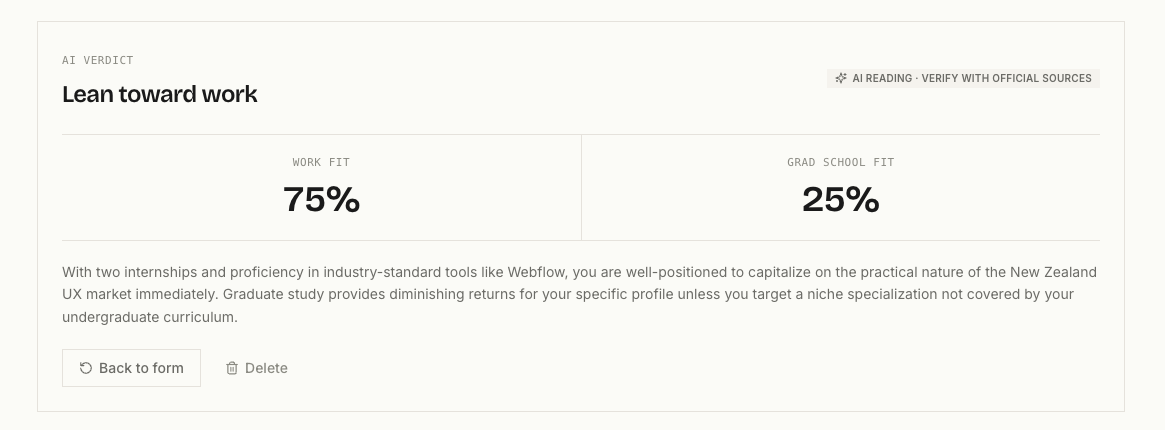
A simple way to use this: go through each factor and lean toward "study" or "work" honestly. If most of them point the same direction, that's usually your answer. If it's fairly split, let visa length and total cost carry a bit more weight, since they tend to shape everything else that follows.
Because visa rules, salaries, and living costs shift often and vary a lot by country, it's worth checking current numbers rather than relying on general advice from a forum thread from three years ago. Brigenai's free Career Assessment was built for exactly this moment. It matches your background and goals to realistic career paths and countries, grounded in real visa pathways and job markets rather than a generic quiz. From there, the Study Toolbox and Work Toolbox let you compare study costs, scholarships, salary calculators, and visa-sponsoring employers side by side, so you're deciding with real information instead of guesswork.
A Quick Note: The Right Answer Really Does Depend on the Country
One thing worth saying clearly: there is no single universal answer here, because post-study work visa rules differ a lot from country to country, and sometimes even between visa categories within the same country.
- Some countries offer generous, multi-year post-study work rights no matter your degree level, which makes going straight to work a much more viable option.
- Others tie visa length closely to your qualification, which can quietly push ambitious students toward a master's degree if staying long-term is genuinely the goal.
- Points-based immigration systems can reward postgraduate study heavily in one country and barely factor it in for another.
- Cost of living and salary levels shift the math too. The same master's degree can be a clear win in one country and a poor investment in another once you account for what it actually costs to live there.
If you're weighing Australia, New Zealand, Singapore, Hong Kong, or Taiwan, don't assume the rules are similar just because the countries are often grouped together. They're not. Tools like Find Your Dream Country and Choose Your Dream University can help you line up visa pathways, costs, and career fit before you commit to either path.
The takeaway here is simple: always check the current post-study work visa rules for the specific country and visa category you're aiming for. Don't assume a master's degree (or skipping one) is automatically the right move just because it worked out for someone else.
Frequently Asked Questions
Does a master's degree actually give you a longer post-study work visa than a bachelor's degree?In many countries, yes, but not everywhere, and not always by the same amount. Some post-study work visa systems add extra months or years for a postgraduate qualification, while others treat all degree levels the same. It really comes down to the specific country and visa category, so don't assume this without checking the current rules for where you want to stay.
Is a master's degree worth it if my bachelor's degree already qualifies me for a decent post-study work visa?Not necessarily. If your current visa already gives you enough time to find a job, get sponsored, and start building a career, spending another one to two years and a significant amount of money on a master's might not add much. It's worth it when the degree unlocks something you don't already have, like more time, a required credential, or a stronger residency pathway.
Which countries offer the best post-study work visa options for international students?This changes fairly often, so it's worth checking current rules rather than relying on outdated comparisons. Some countries offer generous multi-year work rights regardless of degree level, while others link visa length closely to your qualification. Comparing a few countries side by side, rather than assuming they're all similar, will give you a much clearer picture.
Can a post-study work visa lead to permanent residency?In a lot of cases, yes, it's often the first step. Many skilled migration systems let you convert local work experience gained on a post-study work visa into points or eligibility for a longer-term skilled visa or residency. The details vary a lot by country though, so it's worth understanding the full pathway, not just the post-study visa stage, before you commit to a plan.
Can I work and study for my master's degree at the same time to offset the cost?Often, yes, within the limits your student visa allows. Many international student visas permit part-time work during the semester and full-time work during breaks, which can help cover living costs. It won't usually cover full tuition, so it's still worth budgeting for the real cost of the degree rather than assuming part-time work will close the gap.
Conclusion
There's no universally "right" answer between pursuing a master's degree and going straight to work. But there is a better way to make the decision than the one most people use, which is comparing prestige, or following what a friend did, or picking whatever feels less scary in the moment.
Start with the factor that actually shapes your options the most: your post-study work visa eligibility. Then weigh it against your career requirements, a realistic look at salary differences, the total cost of studying, and what you actually want long term, whether that's a fast start to your career or a stronger shot at staying in the country you've come to call home for now.
A master's degree is the strong choice when it genuinely buys you more time to work, opens a door that's otherwise closed, or strengthens your path to residency. Going straight to work is often the smarter choice when your current qualifications already give you enough time, strong prospects, and good reasons not to delay your income.
Whichever path fits you, make the decision with real numbers instead of assumptions. That's really the difference between a choice you feel good about, and one you find yourself second-guessing for years.