

Taiwan regularly surprises professionals who assume that a modern, tech-forward Asian city must come with a Tokyo or Singapore price tag. It does not. For skilled migrants and career-focused expats, Taiwan’s living costs run roughly 30 to 40% lower than those two cities, placing it closer to Seoul in overall affordability. This guide breaks down what you will actually spend on housing, food, transport, and healthcare, so you can plan your move with real numbers rather than rough guesses.
Table of Contents
- How Taiwan compares to other Asian hubs
- Housing costs: The biggest variable for expats
- Day-to-day expenses: Food, transport, and healthcare
- Lifestyle quality and work-life balance in Taiwan
- What most cost-of-living guides miss about Taiwan
- Get expert help for your Taiwan relocation
- Frequently asked questions
Key Takeaways
| Point | Details |
|---|---|
| Lower living costs | Taipei is 30–40% cheaper than Singapore or Tokyo for most essentials. |
| Housing is key | Rent varies widely by district and can be your largest expense. |
| Healthcare advantages | Taiwan provides affordable, high-quality healthcare for skilled migrants. |
| Lifestyle value | Professionals gain not just savings but a strong work-life balance and community. |
How Taiwan compares to other Asian hubs
When professionals weigh up their options across Asia, the conversation usually centres on salary. But the city you choose shapes how far that salary actually goes. Taiwan stands out because it pairs a strong tech and engineering sector with a cost base that most other regional hubs cannot match.
According to expat cost data, Taiwan is 30 to 40% cheaper than Tokyo or Singapore, and broadly comparable to Seoul. That gap is not trivial. For a professional earning a mid-level tech salary, it can translate to several hundred dollars of genuine monthly savings, or simply a much higher quality of life for the same spend.
Here is how the four cities stack up across key cost categories:
| Category | Taipei | Seoul | Singapore | Tokyo |
|---|---|---|---|---|
| 1-bed apartment (city centre) | USD $500–$1,600 | USD $800–$1,500 | USD $1,800–$3,500 | USD $1,200–$2,500 |
| Monthly transport pass | USD $30–$45 | USD $50–$70 | USD $80–$110 | USD $80–$120 |
| Meal at local restaurant | USD $3–$8 | USD $6–$12 | USD $8–$15 | USD $8–$14 |
| Private health insurance | USD $50–$150 | USD $80–$200 | USD $150–$400 | USD $100–$300 |
The numbers tell a clear story. You can compare global living costs across multiple destinations to see how Taiwan fits your specific financial situation, but the headline is straightforward: Taiwan gives you a modern, safe, well-connected city at a fraction of what you would pay in Singapore.
For professionals considering relocation to Taiwan, the key cost drivers to watch are housing, transport, and healthcare. Transport and healthcare are genuinely affordable by any regional standard. Housing is where the real variation sits, and it deserves its own closer look.
“Taiwan offers professionals a rare combination: a globally competitive tech sector, a low cost base, and a quality of life that regularly outperforms cities twice the price.” — Taipei Expat Guide
Understanding the living costs in Singapore alongside Taiwan’s figures helps you frame the trade-offs clearly before you commit to a destination.
Housing costs: The biggest variable for expats
Housing will likely be your single largest monthly expense in Taiwan, and the range is wide enough that your district choice matters enormously. Taipei is the primary destination for most professional expats, and within the city, prices shift significantly depending on location and property type.
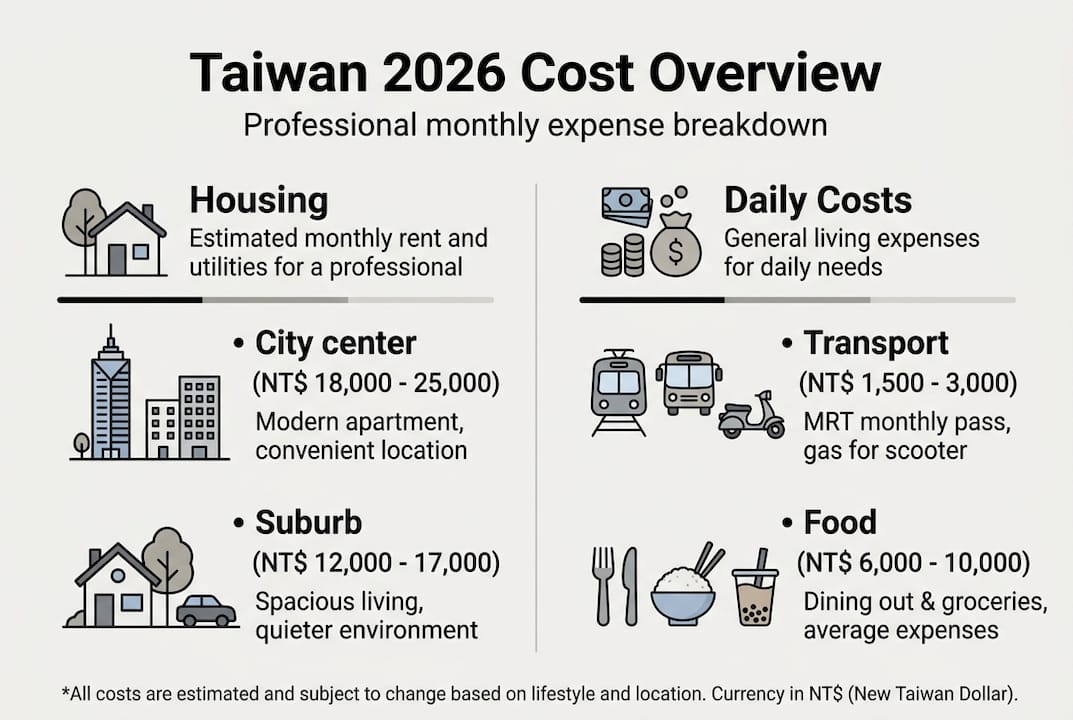
For a one-bedroom apartment in Taipei’s city centre, expect to pay between USD $500 and $1,600 per month. Outside the centre, that range drops to roughly USD $350 to $800. The district you choose within Taipei makes a substantial difference.

| District | 1-bed monthly rent (approx.) | Notes |
|---|---|---|
| Da’an | USD $900–$1,300 | Popular with expats, cafes, parks |
| Xinyi | USD $1,100–$1,600 | CBD, premium towers, nightlife |
| Zhongshan | USD $700–$1,100 | Central, good MRT access |
| Songshan | USD $650–$1,000 | More residential, slightly quieter |
| Zhonghe / Xindian | USD $350–$700 | Outer districts, great value |
For a three-bedroom apartment suitable for families or professionals wanting a home office, city centre prices typically range from USD $1,500 to $3,000 per month, with outer districts offering considerably better value.
Pro Tip: Living one or two MRT stops outside the most popular expat districts can cut your rent by 20 to 30% while adding only a few minutes to your commute. Zhonghe and Xindian are worth serious consideration for remote workers and those not tied to a specific office location.
A few factors shape expat housing costs in Taipei beyond the obvious location variable:
- Furnished vs unfurnished: Most Taipei rentals come furnished, which reduces your upfront setup costs considerably.
- Building age: Newer buildings with gyms and security command a premium. Older walk-up apartments in the same area can be 30 to 40% cheaper.
- Lease length: Landlords generally favour 12-month leases. Shorter terms are possible but often attract a premium.
- Agent fees: Typically one month’s rent, split between tenant and landlord.
If you are actively searching for jobs in Taiwan before you relocate, factor in the commute distance from your preferred district to the major tech and business precincts in Neihu, Xinyi, and Nangang.
Day-to-day expenses: Food, transport, and healthcare
Once you have your rent sorted, the rest of your monthly budget in Taiwan is genuinely manageable. Day-to-day costs are one of the strongest arguments for choosing Taiwan over other Asian hubs.
Food and dining
Taiwan’s night markets and local eateries are legendary for a reason. A full meal at a local restaurant or night market stall costs between USD $3 and $8. If you cook at home, a weekly grocery run for one person typically runs USD $40 to $70. Monthly food costs for a professional who blends local dining with occasional international meals generally fall in the USD $200 to $400 range.
Pro Tip: Leaning into local food is not just a budget move, it is genuinely one of the best parts of living in Taiwan. Night market staples like scallion pancakes, beef noodle soup, and oyster vermicelli cost almost nothing and are outstanding. Save your international restaurant budget for the weekends.
Here is a practical monthly food breakdown:
- Local restaurant meals (daily lunch, 22 days): USD $66–$176
- Groceries and home cooking: USD $80–$150
- Weekend dining out (international or upscale): USD $60–$120
- Coffee and drinks: USD $30–$60
Transport
Taipei’s MRT system is clean, punctual, and inexpensive. A monthly transport pass costs around USD $30 to $45. The YouBike public bicycle scheme extends your reach for almost nothing, and taxis and ride-share apps are affordable by any global standard. Most professionals spend less than USD $60 per month on transport, including occasional taxis.
Healthcare
This is where Taiwan genuinely stands apart. The national health insurance system covers most residents, including many visa-holding professionals, at a monthly premium of roughly USD $20 to $35. Out-of-pocket costs for GP visits and prescriptions are minimal. You can review tools for expats to help estimate your full healthcare budget before you arrive.
For context on how your salary will stretch across these costs, the average salaries in Taiwan data gives you a clear benchmark for what professionals in your field are earning.
Lifestyle quality and work-life balance in Taiwan
Cost figures only tell part of the story. What makes Taiwan genuinely compelling for professionals is the lifestyle that surrounds those numbers.
Taiwan consistently ranks among the safest countries in Asia. Petty crime is low, the streets are walkable at night, and the general social environment is welcoming to foreign professionals. For skilled migrants relocating alone or with family, that sense of safety is not a small thing.
The Taiwan professional expat guide highlights that professionals in Taiwan benefit from a combination of strong tech salaries, a reliable healthcare system, and a social environment that is genuinely open to international residents.
Beyond the practical, the lifestyle benefits stack up quickly:
- Outdoor access: Taiwan’s mountains, hiking trails, and coastline are accessible within an hour of Taipei. Weekend trips to Taroko Gorge or the east coast are a regular part of life for many expats.
- Food culture: Widely regarded as one of the best food destinations in Asia, Taiwan’s culinary scene ranges from street food to Michelin-starred restaurants.
- Community: A well-established international professional community exists in Taipei, with regular networking events, industry meetups, and expat social groups.
- Work culture: While Taiwan’s tech sector can be demanding, many professionals report a healthier work-life balance than they experienced in Tokyo or Seoul.
“The soft factors — safety, community, food, and access to nature — are what keep professionals in Taiwan long after the initial contract ends.”
For those weighing up multiple destinations, the Taiwan vs New Zealand lifestyle comparison offers a useful perspective on how Taiwan stacks up against another popular professional destination.
Exploring Taiwan as a destination in full detail will help you move from general interest to a concrete relocation plan.
What most cost-of-living guides miss about Taiwan
Most cost-of-living guides stop at rent and groceries. That is useful, but it misses the bigger picture for professionals making a serious relocation decision.
The real value of Taiwan is not just that it is affordable. It is that the things money cannot easily buy elsewhere — safety, community, access to nature, a functional healthcare system, and a genuinely welcoming culture — are built into everyday life here. These are the factors that determine whether a move works long-term, not just whether the rent is manageable.
We see this consistently in the experiences shared by professionals who have relocated through our platform. The ones who thrive in Taiwan are not simply those who budgeted well. They are the ones who engaged with the local community, took advantage of the outdoor lifestyle, and treated the move as a genuine life upgrade rather than a temporary cost-saving exercise.
When you are reviewing global pay data and comparing cities, factor in what you are gaining beyond the numbers. Taiwan rewards professionals who look at the whole picture.
Get expert help for your Taiwan relocation
Planning a move to Taiwan involves more than running the numbers on rent and groceries. Visa pathways, salary benchmarking, housing searches, and healthcare enrolment all require specific, up-to-date knowledge that generic guides cannot provide.

BRIGENAI connects you with vetted overseas career advisors who have lived and worked in Taiwan, alongside AI-powered tools that structure their experience into clear, actionable guidance for your specific situation. Whether you need help with your relocation plan, want to compare living costs across multiple destinations, or are ready to engage a specialist, our relocation services are built for professionals who want to move with confidence rather than guesswork.
Frequently asked questions
How much do professionals spend on rent in Taipei?
A one-bedroom apartment in Taipei’s city centre typically costs between USD $500 and $1,600 per month, with premium districts like Xinyi sitting at the higher end of that range.
Is the overall cost of living in Taiwan lower than in Singapore or Tokyo?
Yes. Taiwan is around 30 to 40% less expensive than Singapore or Tokyo, making it one of the most affordable major professional destinations in Asia.
What are typical monthly food costs for expats in Taiwan?
Most expats spend roughly USD $200 to $400 per month on food, with costs varying based on how often you dine locally versus at international restaurants.
How does Taiwan’s healthcare system impact living costs for migrants?
Taiwan’s national health insurance is one of the most affordable in Asia, with monthly premiums as low as USD $20 to $35 and minimal out-of-pocket costs for most professional visa holders.