

Most people assume Taiwan’s job market for foreigners begins and ends with English teaching. That assumption is costing skilled professionals real opportunities. Taiwan’s tech, biotech, and engineering sectors are actively recruiting international talent, and recent policy reforms have made it easier than ever to secure a foothold without being tied to a single employer. Whether you are a recent graduate, a mid-career engineer, or a finance professional weighing your next move, Taiwan offers structured pathways that most guides simply overlook.
Table of Contents
- Understanding the job market for foreigners in Taiwan
- Navigating work visas, permits and Gold Card pathways
- Finding jobs: Top platforms, sectors and practical tips
- Relocating to Taiwan: Process, support and integration tips
- Why savvy migrants in Taiwan look beyond the ordinary job routes
- Get expert support for your Taiwan career move
- Frequently asked questions
Key Takeaways
| Point | Details |
|---|---|
| Skilled jobs are growing | Taiwan now offers a wide range of high-skilled opportunities beyond English teaching, especially in tech, finance and engineering. |
| Visa pathways are flexible | Recent reforms provide easier access for professionals and graduates, with Gold Card options and faster permit routes. |
| Job search is platform-driven | Expats should prioritise specialist job boards such as 104 Job Bank and sector-focused platforms for optimal results. |
| Relocation is streamlined | Employers or self-applicants now support fast relocation, including family visas and integration assistance. |
| Expert advice accelerates success | Specialist guidance and expat tools can help professionals make the most of Taiwan’s evolving job market. |
Understanding the job market for foreigners in Taiwan
Taiwan’s economy runs on precision. The island punches well above its weight in semiconductors, electronics, and advanced manufacturing, and that creates genuine demand for skilled foreign professionals across multiple disciplines. The narrative that foreigners can only teach English is not just outdated — it actively misleads people who could be landing well-paid roles in high-growth sectors.
The skilled jobs in Taiwan that attract the most international talent sit across five core industries:
- Technology and semiconductors: Taiwan hosts global chipmakers and AI hardware firms hungry for engineers, data scientists, and product managers.
- Biotech and life sciences: A growing cluster of research institutions and pharmaceutical companies seek professionals with international credentials.
- Renewable energy: Government targets for offshore wind and solar have created a wave of engineering and project management roles.
- Finance and fintech: Taipei’s financial district actively recruits bilingual analysts and compliance professionals.
- Mechanical and industrial engineering: Cat B skilled work visas open doors for qualified tradespeople and engineers who can demonstrate vocational credentials.
Salaries in these sectors reflect the demand. A mid-level software engineer can expect NT$60,000 to NT$100,000 per month (approximately AUD 2,800 to AUD 4,700), while senior tech and finance roles can push well beyond that. Benefits often include health cover under Taiwan’s National Health Insurance scheme, which costs a fraction of comparable private cover abroad.
Two structural factors are driving this demand. Low unemployment and aging population pressures have pushed Taiwan to actively court skilled migrants, while 2025 reforms have broadened the talent inflow channels considerably. The misconception that only teachers are welcome persists largely because English teaching roles are the most visible and easiest to access without local networks.
“Taiwan’s future competitiveness depends on attracting global talent across engineering, technology, and knowledge sectors — not just filling classroom seats.”
Pro Tip: When searching for roles, go straight to expat-specific boards rather than general Taiwanese job sites. You will find English-language listings and employers already set up to sponsor foreign workers, which cuts weeks off your search time.
Navigating work visas, permits and Gold Card pathways
Understanding the visa landscape before you apply for a single job saves you enormous frustration. Taiwan’s system has three main tracks for professionals, each with distinct advantages.
The standard employer-sponsored route requires your Taiwanese employer to apply to the Ministry of Labor on your behalf before you can obtain a work visa. This is the most common path, but it ties you to one employer and requires them to demonstrate they could not fill the role locally. Permits are typically issued for one to three years and are renewable.
The Employment Gold Card is a different beast entirely. It is a 4-in-1 permit combining open work rights, residency, re-entry privileges, and a 50% income tax exemption on earnings above a threshold for the first three years. You apply directly online without employer sponsorship, and it is valid for up to three years with renewal options. Eligibility is based on demonstrated expertise in fields including technology, finance, law, education, and the arts.
Foreign talent reforms introduced in 2025 significantly expanded access. Graduates from the top 1,500 global universities can now apply for work permits without the previously required two years of work experience. Graduates from the top 200 universities who have completed their degree within the past five years can access a direct two-year work permit. There is also a digital nomad visa valid for up to two years for remote workers meeting income requirements.
Comparison: Standard visa vs Gold Card vs digital nomad visa
| Feature | Standard work permit | Employment Gold Card | Digital nomad visa |
|---|---|---|---|
| Employer required | Yes | No | No |
| Duration | 1 to 3 years | Up to 3 years | Up to 2 years |
| Open work rights | No | Yes | Remote work only |
| Tax incentive | No | Yes (50% exemption) | No |
| Family inclusion | Yes | Yes | Limited |
| Self-application | No | Yes | Yes |
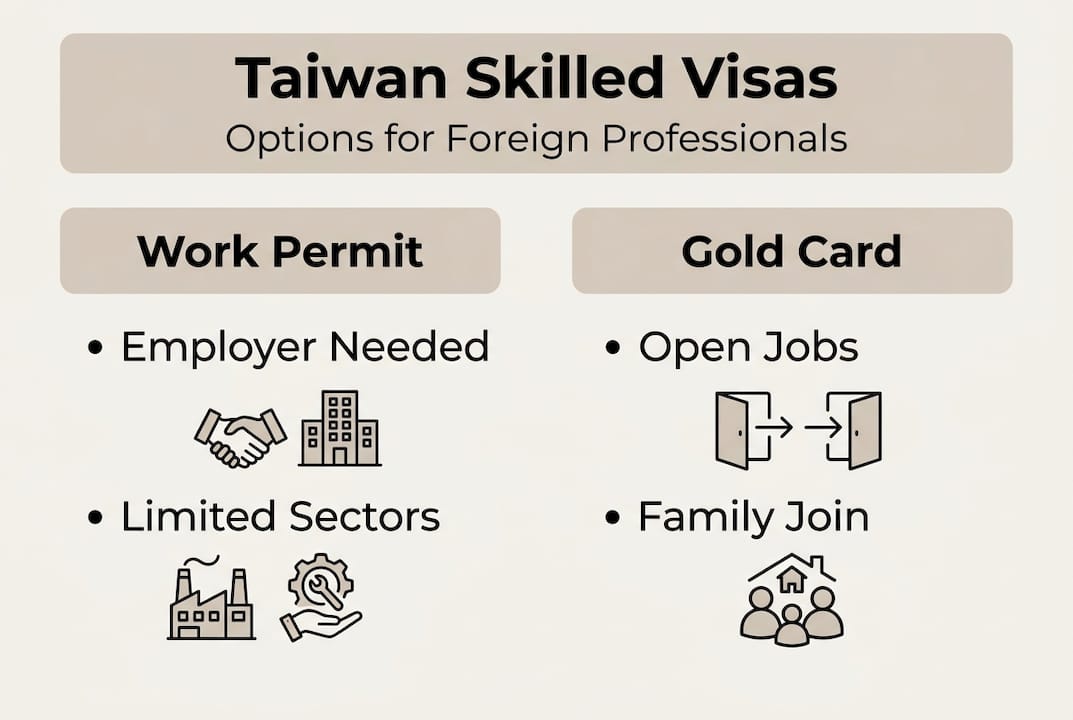
For your Taiwan job relocation, the Gold Card is worth serious consideration if your background qualifies. The freedom to switch employers, freelance, and negotiate from a position of strength changes the entire dynamic of your move.
Finding jobs: Top platforms, sectors and practical tips
Knowing where to look matters as much as what you are looking for. Taiwan has a handful of job platforms that genuinely serve foreign professionals, and picking the right one for your sector saves considerable time.
Top job sites for foreigners include:
- expats.104.com.tw: The expat-facing version of Taiwan’s largest job board, with English listings across tech, finance, and engineering.
- Meet.jobs: Built specifically for international job seekers, with English as the primary interface and visa sponsorship clearly labelled.
- Tealit.com: Strong for teaching and foreign professional roles, particularly useful for those entering Taiwan for the first time.
- 1111.com.tw and Yes123: Broader Taiwanese boards with some English-language postings in multinational companies.
- 518.com.tw: Useful for manufacturing and technical roles in central and southern Taiwan.
Platform comparison for foreign professionals
| Platform | English interface | Best sectors | Visa sponsorship noted |
|---|---|---|---|
| expats.104.com.tw | Yes | Tech, finance, education | Sometimes |
| Meet.jobs | Yes | Tech, startups, management | Often |
| Tealit.com | Yes | Teaching, professional | Yes |
| 1111.com.tw | Partial | Manufacturing, admin | Rarely |
| 518.com.tw | Partial | Engineering, trades | Rarely |
For engineering jobs in Taiwan, targeting multinational manufacturers in the Hsinchu Science Park and Taichung Industrial Park is a proven strategy. These companies are accustomed to hiring foreign engineers and often have internal relocation support.

Recent graduates should not overlook university networks. Foreign graduates from top universities can access two-year employment visas under the 2025 reforms, and alumni associations in Taiwan’s major cities regularly connect new arrivals with local employers.
Pro Tip: When filtering roles on any platform, always set salary to visible, add “English-friendly” or “international team” as keywords, and look specifically for companies that have listed foreign employees in their team pages. It signals an existing sponsorship process.
A broader comparison of work abroad platforms can also help you benchmark Taiwan against other APAC destinations before committing to your search.
Relocating to Taiwan: Process, support and integration tips
Securing a job offer is step one. Getting yourself and your family settled efficiently is what determines whether the move actually works long-term.
Here is a realistic step-by-step overview for employer-sponsored movers:
- Employer submits work permit application to Taiwan’s Ministry of Labor. Standard processing takes 30 to 60 days.
- Obtain your work visa from a Taiwanese representative office in your home country once the permit is approved.
- Enter Taiwan and register your address at the local household registration office within 15 days.
- Apply for your ARC (Alien Resident Certificate) at the National Immigration Agency. This is your primary ID document as a resident.
- Enrol in National Health Insurance through your employer, which takes effect from your first day of employment.
- Include family members by applying for dependent visas. Spouses of work permit and Gold Card holders are eligible to work in Taiwan without a separate employer sponsor.
Gold Card applicants follow a simpler path: the entire application is submitted online, and there is no employer involvement. Processing still runs 30 to 60 days.
For integration, a few practical realities will speed things up:
- Housing: Taipei rents for a furnished one-bedroom apartment in the city centre range from NT$18,000 to NT$30,000 per month. Taichung and Kaohsiung offer more space for less cost.
- Language: Mandarin is the primary language of daily life, though English is widely spoken in professional tech environments. Even basic Mandarin dramatically improves your experience outside the office.
- Professional networks: Groups such as Internations Taipei and sector-specific LinkedIn communities are active and genuinely useful for landing referrals.
Pro Tip: If you studied at a Taiwanese university, study time counts toward PR eligibility. Combined with a work permit period, this can shorten the typical five-year residency requirement considerably. Use the expat relocation tools to map your timeline before you arrive.
Why savvy migrants in Taiwan look beyond the ordinary job routes
Here is something most relocation guides will not tell you: employer sponsorship is a trade-off, not a given right. When your visa is tied to one company, you are negotiating from weakness. You cannot easily leave a toxic workplace, push back on below-market pay, or pivot to a better opportunity without triggering a complex permit re-application process.
The Gold Card advantages are therefore strategic, not just administrative. Freedom to move between employers, freelance for multiple clients, or launch a side venture while employed full-time shifts the balance of power back to you. The 50% tax exemption for the first three years is a genuine financial incentive that most people underestimate when comparing Taiwan to Singapore or Hong Kong.
The 2025 reforms have opened a narrow but real window for graduates and niche professionals who previously could not have considered Taiwan without a willing employer. Standard visas remain employer-tied and rigid, which means anyone who qualifies for the Gold Card or the graduate direct permit should pursue those routes first, not as a fallback.
Taiwan also rewards patience and niche positioning. Generalist candidates competing for broad tech roles face stiff competition. Professionals with specialised skills in compound semiconductors, offshore wind project management, or medical device regulation are walking into a market where supply simply does not meet demand. Track the latest Taiwan job trends to identify where those gaps sit before you begin applying.
Get expert support for your Taiwan career move
Making a well-informed career move to Taiwan takes more than a good CV and a job board bookmark.

BRIGENAI connects professionals and graduates with real-world guidance built on the lived experience of people who have already made this journey. From identifying which visa pathway suits your background, to matching you with roles that carry genuine sponsorship, to connecting you with vetted advisors across immigration, housing, and career strategy, the platform is built for exactly the kind of move you are planning. Explore the full suite of relocation services, get tailored advice through career advisory, and use the free expat tools to build your personal relocation roadmap.
Frequently asked questions
What is the easiest visa for skilled professionals moving to Taiwan?
The Taiwan Employment Gold Card is the most flexible option for highly skilled professionals, as it does not require employer sponsorship and combines work, residency, and re-entry rights in a single permit.
Which industries in Taiwan are most open to foreign professionals?
Tech, electronics, finance, biotech, and engineering are the leading sectors for skilled migrants, driven by high demand in semiconductors and national strategic priorities.
How long does it take to secure a work permit and relocate to Taiwan?
Standard work permit or Gold Card processing takes 30 to 60 days, with employers handling submission for sponsored roles and individuals applying directly for the Gold Card.
Is it possible for recent graduates to work in Taiwan without prior experience?
Yes. Taiwan’s 2025 reforms for graduates allow top university graduates to obtain direct work permits or Gold Cards without the previously required two years of work experience.
Can family members join skilled migrants relocating to Taiwan?
Yes. Both employer-sponsored permit holders and Gold Card holders can bring family members, with spouses eligible to work in Taiwan without requiring separate employer sponsorship.