

Australia is one of the most attractive destinations for Taiwanese professionals ready to take their careers to the next level. With 91% of skilled migrants securing employment and growing their earnings within 18 months of arrival, the opportunity is real. But the path there involves strict visa eligibility rules, a competitive points system, and cost-of-living adjustments that catch many people off guard. This guide walks you through the essential steps: choosing the right visa, navigating skills assessments, understanding the job market, and budgeting for life in Australia compared to what you know in Taiwan.
Table of Contents
- Choosing your migration pathway: visas and eligibility
- Step-by-step process: applying, assessments and timelines
- Job market and integration: employment, salaries, settling in
- Cost of living and lifestyle: how Australia compares to Taiwan
- What most guides miss: career mobility, trade-offs and real-life wins
- Ready to make your Australian move smoother?
- Frequently asked questions
Key Takeaways
| Point | Details |
|---|---|
| Choose the right visa | Compare independent and sponsored pathways to match your career goals and situation. |
| Start assessments early | Begin skills evaluation and gather documents well in advance to avoid delays. |
| Actively use job networks | Leverage Australian platforms and networking for fast employment after arrival. |
| Budget for higher costs | Plan for Australia’s steeper costs but expect greater income and lifestyle advantages. |
| Regional options benefit PR | Consider regional cities for lower living expenses and quicker permanent residency. |
Choosing your migration pathway: visas and eligibility
Not all visa pathways are created equal, and picking the wrong one can cost you months of preparation. Australia’s skilled migration system is built around a points-tested framework where your age, English proficiency, work experience, qualifications, and skills assessment results all add up to a score. You need a minimum of 65 points to be considered, but in practice, competitive candidates score well above that.
The three most relevant visa options for Taiwanese professionals are:
- Skilled Independent visa (subclass 189): No employer or state government needed. You apply independently and, if invited, receive permanent residency. It offers the most freedom but also the most competition.
- State or Territory Nominated visa (subclass 190): A state government nominates you based on local skills shortages, adding 5 extra points to your score and improving your chances of an invitation.
- Employer Sponsored visa (subclass 482 or 186): An Australian employer sponsors your move. You trade some career flexibility for job security and a clearer path to permanent residency.
Here’s a quick comparison to help you decide:
| Visa type | Requires employer | State nomination | PR pathway | Best for |
|---|---|---|---|---|
| Subclass 189 | No | No | Direct | Independent professionals |
| Subclass 190 | No | Yes | After 2 years | Those with lower points scores |
| Subclass 482 | Yes | No | Via subclass 186 | Those with a job offer |
Occupations listed on the Medium and Long-term Strategic Skills List (MLTSSL) get priority. Fields like IT, healthcare, engineering, and construction feature heavily. Before you go any further, check the official visa requirements to confirm your occupation qualifies under the points-tested system. For a broader overview of options, the BRIGENAI full visa guide is a useful starting point.
Pro Tip: Start your skills assessment the moment you decide to migrate. The process takes 8 to 12 weeks on average, and your Expression of Interest (EOI) cannot be submitted without it. Waiting on this step delays everything else.
Step-by-step process: applying, assessments and timelines
Once you’ve picked your pathway, follow these practical steps for a smooth application. The biggest mistake applicants make is treating the process as linear when several steps require preparation that overlaps.
- Skills assessment: Submit to the relevant assessing authority for your occupation (for example, ACS for IT, Engineers Australia for engineers). Allow 8 to 12 weeks.
- English language test: Sit IELTS or PTE Academic. Most visas require a score equivalent to at least Competent English, though higher scores earn you more points.
- Create an EOI via SkillSelect: Once your skills assessment is complete and your English result is confirmed, submit your Expression of Interest through the online SkillSelect system.
- Document preparation: Gather employment references, certified qualifications, identity documents, and health and character checks. Do not wait for an invitation to start this.
- Receive an invitation to apply: Invitations are issued in rounds, typically monthly. High-demand occupations receive invitations faster.
- Lodge your visa application: After invitation, you have 60 days to submit your full application with supporting documents.
- Wait for a decision: Processing times vary. Check Home Affairs updates regularly for current timeframes.
Here’s a realistic timeline for each stage:
| Stage | Estimated time |
|---|---|
| Skills assessment | 8 to 12 weeks |
| English test preparation and results | 4 to 8 weeks |
| EOI submission to invitation | 1 to 12 months |
| Visa application decision | 3 to 24 months |
Always cross-check your occupation against the MLTSSL before submitting your EOI. Occupations are updated periodically, and immi.homeaffairs.gov.au is the only source you should trust for current lists. For Taiwanese professionals beginning their research, the BRIGENAI guide on leaving Taiwan covers pre-departure planning in detail, and our job finding tips for migrants will help you start your job search before you even land.
Pro Tip: Missing documentation is the number one cause of visa delays. Build a checklist and have all documents certified and translated into English well before your invitation arrives.
Job market and integration: employment, salaries, settling in
After submitting your application, it’s vital to understand how to secure work and succeed once you arrive. The good news is that skilled migrants from Taiwan consistently perform well in the Australian labour market.
According to job outcomes data, over 91% of skilled migrants find employment within 18 months of arrival, with earnings growing steadily beyond that point. The sectors with the strongest demand for internationally qualified professionals include:
- Information technology: Software engineers and data analysts typically start on AUD 85,000 to AUD 120,000.
- Engineering: Civil and structural engineers earn AUD 80,000 to AUD 110,000 in major cities.
- Healthcare: Registered nurses and allied health professionals earn AUD 70,000 to AUD 95,000.
- Construction and project management: Strong pipeline of infrastructure projects is keeping demand high through 2026 and beyond.
For job searching, the most effective platforms are:
- Seek: Australia’s largest job board, particularly strong for professional roles.
- LinkedIn: Essential for networking with hiring managers and recruiters.
- Indeed and Glassdoor: Good for salary benchmarking and employer reviews.
Adapting your CV to Australian standards is non-negotiable. Australian employers expect a concise two to three page document with clear results rather than duties. References from Australian contacts carry significant weight, even if you’re still based in Taiwan when applying. Our finding work tips break down exactly how to present yourself effectively from abroad.

Pro Tip: Consider targeting regional cities like Adelaide, Brisbane, or Perth rather than Sydney or Melbourne. Regional areas often offer faster permanent residency pathways, lower living costs, and less competition for skilled roles. You can use our AI career advice tool to identify which cities align with your occupation and lifestyle preferences.
Cost of living and lifestyle: how Australia compares to Taiwan
With your career on track, let’s examine what your Australian life will actually cost and feel like compared to Taiwan. The numbers are significant, so going in with clear expectations protects your finances in the first year.
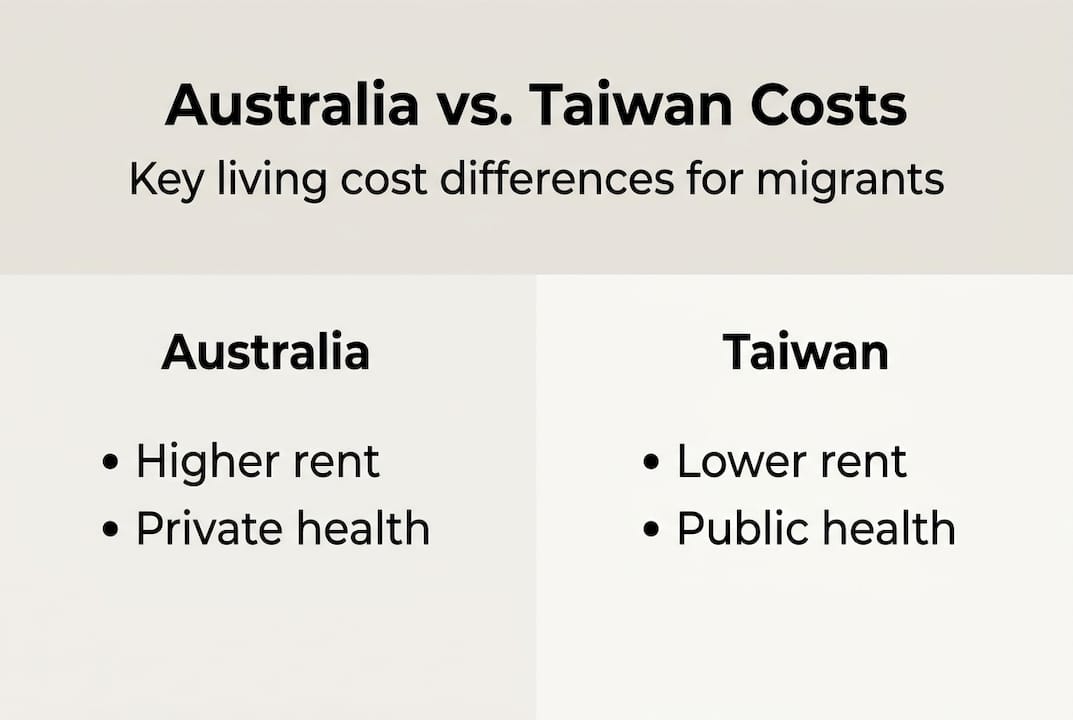
Living costs in Australia are 28 to 36% higher overall than in Taiwan, with rent running approximately 56% higher. Sydney and Melbourne are the most expensive cities. However, Australian salaries are structured to reflect this, which is why the lifestyle trade-off is far more manageable than the raw numbers suggest.
Here’s a practical comparison of major expenses:
| Expense | Taipei (monthly, AUD approx.) | Sydney (monthly, AUD approx.) |
|---|---|---|
| One-bedroom apartment (city centre) | AUD 700 | AUD 2,200 |
| Monthly transport pass | AUD 55 | AUD 200 |
| Groceries (one person) | AUD 200 | AUD 400 |
| Dining out (mid-range meal) | AUD 10 | AUD 25 |
Australia’s overall cost of living is 28 to 36% higher than Taiwan, with rent costs approximately 56% higher in major cities. Salaries, however, are proportionally higher and continue to grow with tenure.
Expenses that often catch newcomers off guard include private health insurance (compulsory for many visa holders before Medicare access is granted), utility bills that run higher than in Taiwan, and the cost of a car if you settle outside a major city.
For your first year, budget conservatively. Aim to have at least three to four months of living expenses saved before you arrive. Use BRIGENAI’s global cost comparisons tool to model your specific city and lifestyle scenario in detail.
Pro Tip: The quality-of-life gains in Australia, more space, cleaner air, outdoor lifestyle, and strong work-life balance, are real and meaningful. Many Taiwanese migrants report that within 12 months, the higher costs feel entirely normal against the backdrop of a better daily life.
What most guides miss: career mobility, trade-offs and real-life wins
Here’s something worth being honest about: most migration guides focus entirely on eligibility and process, and almost none of them talk about what happens after you arrive. That’s where the real decisions begin.
The subclass 189 visa gives you complete freedom to change employers, change cities, and change industries. That flexibility is genuinely powerful. But it also means you arrive without a built-in professional network, and building one takes deliberate effort. Employer sponsored routes feel safer, but locking yourself to one employer in a new country can limit your growth right when you’re ready to accelerate it.
The cost adjustments are real, but nearly every Taiwanese professional we’ve spoken with says the same thing: within a year, Australia stops feeling expensive and starts feeling like home. The lifestyle gains, space, pace, and professional culture, are often what people least expect to value and most come to rely on. For deeper guidance on navigating all of this, the BRIGENAI comprehensive Australia migration advice hub is built on exactly these kinds of real-world experiences.
Ready to make your Australian move smoother?
Knowing the steps is one thing. Having the right tools and expert support behind you is what makes the difference between a stressful move and a confident one.

BRIGENAI brings together AI-powered guidance and vetted human advisors to help you plan every stage of your Australian move. Start by checking your occupation against the eligible skills list to confirm your migration pathway. Then explore our end-to-end relocation support for practical help with housing, job leads, and settlement. If you’re ready to speak with a migration expert, our visa consultancy services connect you directly with professionals who have made the same journey. No guesswork, just clear next steps built on real experience.
Frequently asked questions
What is the minimum points requirement for skilled migration from Taiwan to Australia?
You need at least 65 points to be eligible, covering age, English proficiency, work experience, and qualifications. Most competitive applicants score significantly higher.
Which jobs are most in demand for Taiwanese skilled migrants to Australia?
Information technology, engineering, healthcare, and construction are consistently in high demand, as confirmed by skilled migrant employment data. These sectors also offer strong salary progression after the first year.
How much higher is the cost of living in Australia compared to Taiwan?
Overall living costs are 28 to 36% higher in Australia, with rent approximately 56% higher than in Taiwan’s major cities.
How quickly do Taiwanese migrants find work in Australia?
Over 91% of skilled migrants secure employment within 18 months of arrival, with income growing steadily from that point.
Is it easier to get permanent residency in regional Australia?
Yes, regional pathways often provide faster access to permanent residency, though they come with lifestyle trade-offs around proximity to major cities and services.
Recommended
- Taiwan - Destination
- Moving to Australia? Jobs, Visas, Salaries, Living Costs, Work Guide | BRIGENAI
- Move to New Zealand from Taiwan: Visa, Jobs, Lifestyle & Country Comparison (2026 Guide)
- Moving from USA to Australia: Essential Tips for a Smooth Transition
- Visa Application Step by Step: Secure Your Approval Fast