

Most graduates assume that heading overseas right after college is a detour from a “real” career. The data says otherwise. A large-scale study of 19,421 respondents across 30 countries found that international work experience directly leads to more promotions and greater financial success over time. Far from being a gap-year gamble, working abroad early in your career can fast-track your growth in ways that staying home simply cannot replicate. This guide breaks down the real career benefits, the honest risks, and the practical steps you need to take to make international experience work for you.
Table of Contents
- How international work experience supercharges your career
- Skills you build by working overseas
- Risks and realities: International work is not for everyone
- Making it work: Practical strategies for international job seekers
- A fresh take: Why taking the leap abroad is smarter than you think
- Take your next step toward working abroad
- Frequently asked questions
Key Takeaways
| Point | Details |
|---|---|
| Career acceleration | International work experience after graduation often leads to faster promotions and better job prospects. |
| Enhanced skill set | Graduates build critical skills like adaptability and cross-cultural communication, boosting their employability. |
| Potential challenges | Some international grads face lower initial earnings and job hurdles, so personal fit and planning are essential. |
| Maximize benefits | Choosing the right country, sector, and support network significantly increases the career ROI of working abroad. |
How international work experience supercharges your career
The career case for working abroad is no longer just anecdotal. Research now gives us hard numbers, and they are compelling. A study tracking earnings and promotion rates across 30 countries confirmed that graduates who work internationally see measurably faster career advancement than peers who stay home. The effect holds across industries and regions, which means this is not a niche benefit reserved for finance or tech.
One of the most striking findings comes from Japan. Japanese self-initiated expatriates, meaning workers who move abroad on their own initiative rather than through a company transfer, experience 6% annual earnings growth compared to just 1% for domestic workers. That gap compounds fast. Over a decade, the difference in lifetime earnings becomes substantial.

Here is a quick snapshot of what the numbers look like:
| Metric | International grads | Domestic grads |
|---|---|---|
| Annual earnings growth | ~6% | ~1% |
| Starting salary premium | ~$4,000 | Baseline |
| Promotion rate | Higher | Average |
| Career success attribution | Up to 50% from abroad | N/A |
The reasons behind these gains are not mysterious. When you work in a foreign country, you are forced to solve problems without your usual support system, communicate across language and cultural barriers, and adapt to unfamiliar workplace norms. Employers recognize this. A candidate who has thrived in a demanding international environment signals resilience, initiative, and leadership potential.
The sectors where you see the biggest payoff tend to be those with genuine skill shortages. Technology, healthcare, engineering, and financial services in markets like Australia, Singapore, and New Zealand consistently need qualified talent. Checking global salary comparisons before you commit to a destination can help you identify where your specific background commands a premium.
- Faster promotion timelines due to differentiated experience
- Starting salary premium averaging $4,000 above domestic peers
- Stronger long-term earnings trajectory compounding over years
- Higher perceived leadership potential by multinational employers
Pro Tip: Target countries or sectors with active skill shortages. Your value goes up when supply is low. Use career guidance abroad to identify the highest-demand roles in your field before you start applying.
Skills you build by working overseas
Salary and promotions are easy to quantify, but the skill development that comes from international work may be the more durable advantage. These are the competencies that follow you throughout your entire career, regardless of where you end up.
Research from the Forum on Education Abroad found that 90% of alumni who worked or studied internationally reported building job-relevant skills, with 85% specifically citing adaptability and a similarly high share pointing to cross-cultural communication. These are not soft skills in the dismissive sense. They are the exact competencies that employers screen for when filling leadership roles.
“Adaptability is not just a nice-to-have anymore. Hiring managers at global firms consistently rank it above technical skills when evaluating candidates for senior positions.”
Additionally, research on cultural orientation and employability shows that graduates who develop a strong understanding of their home culture alongside exposure to foreign environments build more robust employability pathways. The contrast sharpens your self-awareness and makes you a more effective communicator in any context.
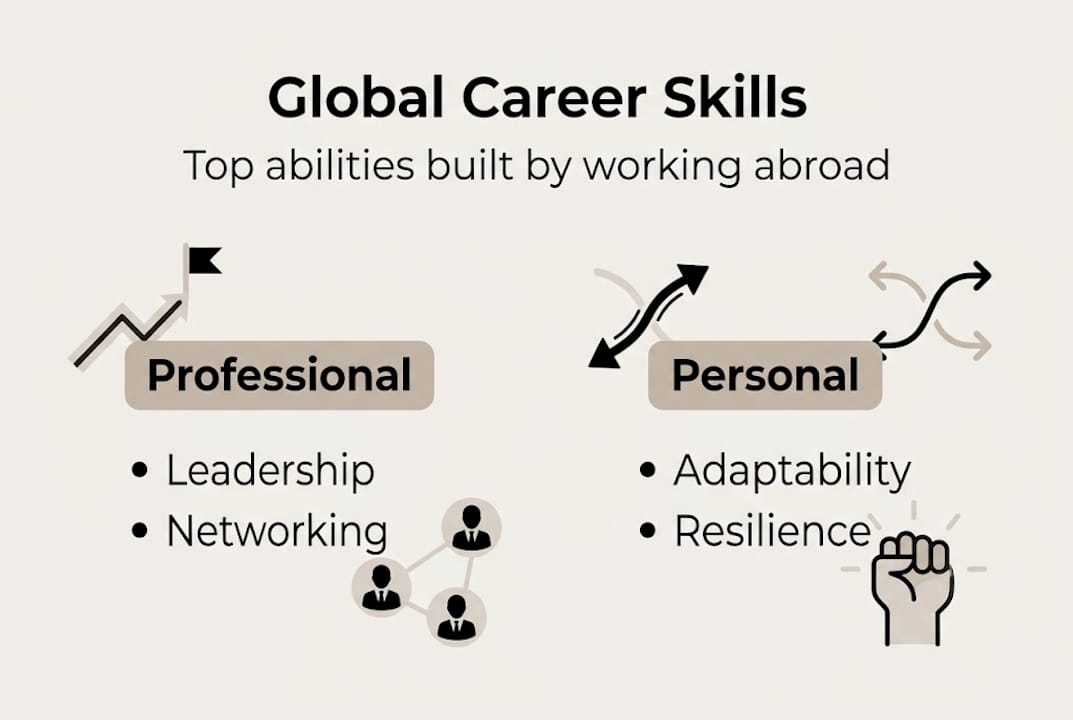
Here are the top skills international alumni consistently report gaining:
- Adaptability: Thriving when routines, systems, and expectations shift without warning
- Cross-cultural communication: Reading context, adjusting tone, and building trust across different backgrounds
- Problem-solving under pressure: Navigating bureaucracy, language barriers, and unfamiliar processes
- Resilience: Recovering from setbacks without the safety net of familiar support systems
- Global professional network: Connections that open doors in multiple markets for years afterward
These skills are directly linked to getting your first job and to sustained acceleration once you are in the door. Employers hiring for roles that involve managing teams, working with international clients, or expanding into new markets actively seek candidates who have lived these experiences rather than just read about them.
Pro Tip: When updating your resume or preparing for interviews, do not just list “worked in Singapore” as a bullet point. Describe a specific challenge you navigated, the cultural context, and the outcome. Explore key skills for global jobs to frame your experience in language that resonates with international hiring managers.
Risks and realities: International work is not for everyone
Honesty matters here. The data on international work experience is largely positive, but it is not universally so. Some graduates face real disadvantages, and ignoring that does not help you make a smart decision.
The clearest cautionary data comes from Canada. According to the 2023 National Graduates Survey, international student graduates in Canada had an employment rate of 88.6% compared to 91% for domestic graduates three years after graduation. More striking, they earned 19.6% less than their domestic peers over the same period. That is a significant gap, not a rounding error.
| Outcome (3 years post-grad) | International grads in Canada | Domestic grads in Canada |
|---|---|---|
| Employment rate | 88.6% | 91% |
| Earnings relative to domestic | 19.6% less | Baseline |
Separate research on cultural orientation found that individuals with a strongly individualistic orientation, meaning those who prioritize personal goals and independence over group belonging, tend to develop fewer international work competencies. In practical terms, if you struggle to adapt your communication style or find it hard to integrate into team-oriented cultures, the expected gains may not materialize.
“The graduates who struggle most abroad are often those who underestimate how much cultural fit matters relative to technical skill.”
Here is who should think carefully before committing:
- Graduates entering low-demand fields in oversupplied markets
- Those with limited financial runway to absorb a slow job search
- Individuals with minimal support networks who may struggle with isolation
- Graduates in countries where international credentials are not well recognized
- Those who have not researched visa pathways and legal work authorization
None of this means you should stay home. It means you should go in with clear eyes. Reading career consultant tips before you commit to a destination can help you avoid the most common and costly mistakes.
Making it work: Practical strategies for international job seekers
Knowing the benefits and risks is only useful if you translate that knowledge into action. Here is how to actually make international experience pay off.
The single most important strategic decision is where you go. Research on returns to international career moves shows that short-term benefits are actually higher in countries with lower economic freedom, likely because the challenge sharpens your skills faster. However, the best long-term returns come from roles at multinational firms, which have the resources and incentive to reward globally experienced talent.
| Strategy | Why it works | Pitfall to avoid |
|---|---|---|
| Target skill-shortage sectors | Higher demand means better pay and faster hiring | Chasing prestige over fit |
| Join a multinational firm | Best long-term ROI on international experience | Ignoring company culture |
| Build a documented achievement record | Makes experience transferable and credible | Vague resume entries |
| Research visa pathways early | Avoids wasted applications and legal issues | Assuming you qualify automatically |
| Use dedicated job platforms | Faster access to verified opportunities | Relying only on generic job boards |
Here is a practical sequence to follow:
- Identify your target country and sector based on skill demand and visa eligibility
- Use best work abroad platforms to find verified listings in your field
- Research the cost of living and expected salary range using expat tools before accepting any offer
- Document every cross-cultural achievement during your time abroad, not just job duties
- Build and maintain your LinkedIn presence with specific, quantified international wins
Pro Tip: Your LinkedIn profile is often the first thing a recruiter sees. Update it to highlight specific cross-cultural projects, international clients, or global team leadership. Use numbers wherever possible. “Managed a team across three time zones to deliver a project 10% under budget” is far more powerful than “gained international experience.”
A fresh take: Why taking the leap abroad is smarter than you think
Conventional career advice still defaults to stability: get a local job, build tenure, climb the ladder. That model made sense when careers were linear and employers rewarded loyalty with security. Neither of those conditions reliably holds anymore.
The data we have reviewed points toward a different conclusion. The opportunity cost of NOT working abroad may actually be higher than the risk of going. You miss the earnings premium, the accelerated promotions, the skill differentiation, and the network that compounds over decades. Fear of the unknown is not a strategy. It is just a default.
Here is the insight that most career guides miss: adaptability is not just one skill among many. It is the meta-skill that makes all your other skills more valuable in a changing market. Future leaders in every field, from marketing to medicine to engineering, will need global agility. The graduates building that now will have a structural advantage over those who wait.
The real mistake is letting incomplete information or vague anxiety make this decision for you. Go in informed, go in strategic, and use guidance from career advisors who have actually made this move themselves.
Take your next step toward working abroad
You now have the evidence, the risks, and the playbook. The next move is yours.
BRIGENAI combines AI-driven tools with real human expertise to help recent graduates like you find the right international opportunity, in the right country, at the right time. Whether you are exploring marketing jobs overseas or need to map out your visa options and salary expectations, the platform gives you everything in one place. You can speak with a career advisor who has firsthand experience working abroad, or use our AI-powered expat tools to model your cost of living, housing, and job prospects before you commit. Your global career starts with one informed step.
Frequently asked questions
Is working abroad after graduation really worth it?
For most graduates, international work experience leads to higher employability, faster promotions, and greater long-term earning potential, especially for those who adapt well to new environments and choose high-demand sectors.
What are the top skills you gain from working abroad?
Adaptability, cross-cultural communication, and resilience are the most valued skills from international roles, with 90% of alumni reporting strong job-skill development and 85% specifically citing adaptability.
Are there any downsides to working abroad right after college?
Yes. Some international graduates earn less and face lower employment rates, as seen in Canada where they earn 19.6% less than domestic peers three years after graduation, so industry, location, and personal fit matter enormously.
How do I find the right job abroad after graduation?
Target countries with skill shortages, use dedicated international job platforms, and seek expert advice to identify high-ROI opportunities at multinational firms where international experience is most rewarded.